
International Climate Finance Goals Tracker
This tracker collates data on progress toward the four globally agreed-upon climate finance goals.

International climate finance—funding that supports developing countries in their transition to low-emission and climate-resilient economies—is a central pillar of global climate action. It includes measures to reduce or avoid greenhouse gas emissions (mitigation), efforts to reduce the negative effects of climate change (adaptation), and ways to deal with unavoidable climate impacts (loss and damage).
In 2009, developed countries committed to mobilizing USD 100 billion a year in climate finance for developing countries, from public sources and the private finance that this mobilizes, by 2020. In 2015, as part of the grand bargain that secured the Paris Agreement, developed countries agreed to extend this $100 billion-per-year goal through to 2025, and governments agreed to negotiate a new collective quantified goal (NCQG) on climate finance before 2025.
After a multiyear negotiating process, the NCQG was finalized at the COP29 United Nations climate negotiations in November 2024. The goal contained three nested quantified targets:
- The largest target, at least $1.3 trillion per year by 2035, encapsulates all international climate finance going to developing countries.
- Within this, the second target, at least $300 billion per year by 2035, comprises the public finance provided by developed countries and voluntary contributors to developing countries, as well as the private finance that this mobilizes.
- Finally, the tripling of U.N. climate fund outflows by 2030 is a subset of the public finance within the $300 billion.
In addition to the NCQG goals, a year later, at COP30, governments agreed to triple adaptation finance by 2035. All four goals and how they relate to each other are illustrated in the figure below.
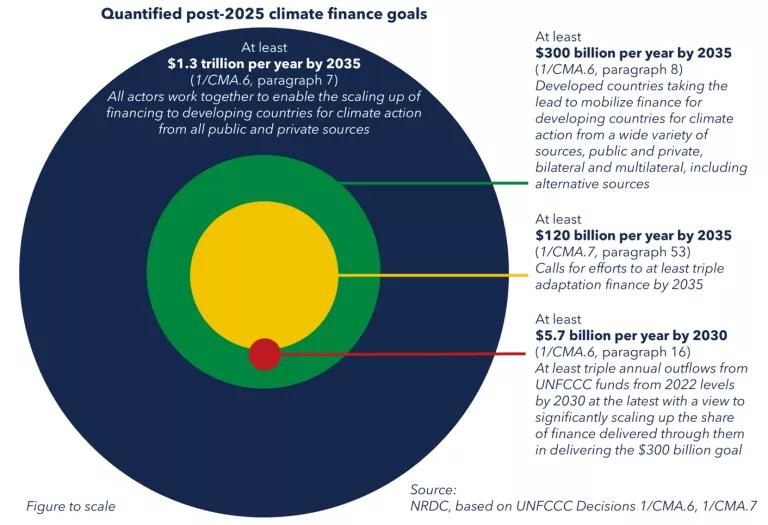
This tracker presents four graphs that show progress toward each of these four quantified post-2025 targets, and it will be updated as new climate finance data becomes available. Each graph shows:
- actual reported data (solid blue line)
- what a straight-line trajectory to reach the goal would be (green dashed line)
Visually, the difference in slope of the blue and green lines gives an indication of whether each goal is on track. However, it is important to note that past climate finance trends are not necessarily an indicator of future growth, so a graph that looks on track now can change in the future. Politicians must regularly renew decisions about public climate finance allocations so that support can fluctuate. While private climate finance may be more resilient to political cycles, it is not immune, and public finance remains a bedrock for most NCQG goals.
Target 1: At least $1.3 trillion per year by 2035 by all actors from public and private sources
7. Calls on all actors to work together to enable the scaling up of financing to developing country Parties for climate action, from all public and private sources, to at least USD 1.3 trillion per year by 2035.
What is the target?
All actors in the global community will work to scale up climate finance to developing countries from public and private sources to at least $1.3 trillion per year by 2035. This aligns with expert assessments, such as those by the Independent High-Level Expert Group on Climate Finance (IHLEG), of the amount of international public and private finance that developing countries (excluding China) will need by 2035 toward their overall climate investment needs of $3.1 to $3.5 trillion annually.
What data do we use?
An entire cottage industry has developed to track climate finance flows mobilized by developed countries to meet the previous $100 billion goal. The $1.3 trillion goal has a far broader scope, and as a result, there is not yet specialized tracking of these flows.
We use data from Climate Policy Initiative’s (CPI) Global Landscape of Climate Finance, which collates data from a variety of sources—including the Organisation for Economic Co-operation and Development (OECD), International Energy Agency, and Bloomberg New Energy Finance—and covers public, private, domestic, and international climate finance. It is possible to filter this data to show just international flows (finance raised in one country and spent in another) and exclude flows into advanced economies to give an estimate of international climate finance flows to developing countries.
What are the limitations and open questions?
- Developed and developing country definitions: The NCQG was adopted under the Paris Agreement, and neither it nor the U.N. Framework Convention on Climate Change (UNFCCC) defines the terms developed and developing countries, despite making frequent references to these categories. CPI’s data categorizes countries’ development status based on the International Monetary Fund’s classifications. These do not necessarily align with common usage under the UNFCCC. Furthermore, the IHLEG’s analysis explicitly states that the $1.3 trillion represents the needs of developing countries excluding China, yet mainland China is classed by the IMF in the Emerging Market and Developing Economies category, so international flows into China ($6.7 billion in 2024) are included in the data.
- Transregional finance: Some CPI flows are categorized as “transregional,” i.e., they flow to more than one region ($21.5 billion in 2024). It is not yet possible to disaggregate how much transregional finance went to developing countries, so it is not included. This means it is an undercount of total international climate finance to developing countries.
- Types of flows: CPI’s data focuses on real economy primary capital flows for low-carbon and climate-resilient development interventions. The data does not include investments in clean technology research and development or manufacturing, on the basis that these costs will be captured in the deployment stage of projects that use these technologies. This is a deliberately conservative approach that may lead to underestimates.
- Data coverage: CPI notes that there remain gaps in data tracking and availability, such as private adaptation finance, where terminology may not match definitions used for public finance tracking, meaning figures may be an underestimate of actual flows. Where primary project-level data is unavailable, CPI uses evidence-based calculations from reputable secondary data sources to fill in gaps.
Where are we?
Target 2: At least $300 billion mobilized from public, private, bilateral, and multilateral sources, with developed countries taking the lead
8. Reaffirms, in this context, Article 9 of the Paris Agreement and decides to set a goal, in extension of the goal referred to in paragraph 53 of decision 1/CP.21, with developed country Parties taking the lead, of at least USD 300 billion per year by 2035 for developing country Parties for climate action:
(a) From a wide variety of sources—public and private, bilateral and multilateral—including alternative sources;
(b) In the context of meaningful and ambitious mitigation and adaptation action and transparency in implementation;
(c) Recognizing the voluntary intention of Parties to count all climate-related outflows from and climate-related finance mobilized by multilateral development banks toward achievement of the goal set forth in this paragraph;
9. Encourages developing country Parties to make contributions, including through South–South cooperation, on a voluntary basis.
What is the target?
Developed countries agreed to take the lead in mobilizing at least $300 billion per year by 2035. This goal has a similar scope to the previous $100 billion–per–year goal: public funds from bilateral and multilateral sources; private finance mobilized by the public sector; and alternative sources. But the new goal also allows developing countries to voluntarily count finance they provide toward the goal; there was also agreement that all multilateral development bank (MDB) climate finance going to developing countries can count, rather than just the share of these flows that are attributable to developed countries, as was the case for the $100 billion goal.
What data do we use?
The tracking of flows toward the $300 billion goal is more well developed, since the scope is similar to the $100 billion goal for 2020–2025. The OECD has done regular reporting on progress toward the $100 billion goal; first compiling data from various sources, including direct reporting from member countries and reporting from multilateral financial institutions, then conducting verification and adjustments to avoid double counting. As noted above, neither the UNFCCC nor the Paris Agreement defines developed countries. The OECD report does classify the following countries as developed: Australia, Austria, Belgium, Bulgaria, Canada, Croatia, Cyprus, Czechia, Denmark, Estonia, European Union, Finland, France, Germany, Greece, Hungary, Iceland, Ireland, Italy, Japan, Latvia, Liechtenstein, Lithuania, Luxembourg, Malta, Monaco, Netherlands, New Zealand, Norway, Poland, Portugal, Romania, Slovak Republic, Slovenia, Spain, Sweden, Switzerland, United Kingdom, and the United States.
All MDB climate finance outflows to developing countries, attributable to inflows from both developed and developing countries, can be included in the $300 billion goal. The headline figures of the OECD reports include only MDB climate finance attributable to developed countries, per the criteria for the $100 billion goal. In recent years, the OECD report has also included data on MDB outflows that are attributable to developing countries and the associated private finance this mobilizes in its methodology section. For the purposes of calculating the straight-line trajectory to the $300 billion goal, we include all MDB public climate finance outflows to developing countries and the private finance that this mobilizes, resulting in a higher baseline starting point for the straight-line growth line.
Other bilateral and multilateral climate fund contributions that are attributable to developing countries are not counted unless developing countries specifically request their contributions be voluntarily included.
What are the limitations and open questions?
- Self-reporting: OECD reports use data from developed countries’ self-reporting. While this reporting should comply with OECD reporting guidelines and standards—and the OECD makes adjustments to address double counting—responsibility for what is counted as climate finance largely rests with individual countries, and there have been some cases of reporting projects with dubious links to climate.
- Inclusion of other contributors: The NCQG decision encourages developing countries to make contributions on a voluntary basis. For countries that do volunteer, it is not clear how data on their climate finance contributions would be included in tracking. Developing countries that are members or participants in the OECD’s Development Assistance Committee already report international public finance to the institution, so opting into future OECD climate finance reporting would be a possibility, but for other countries, it is not clear how their contributions can be accounted.
Where are we?
For more on individual countries’ multiyear climate finance commitments, see NRDC and E3G’s Climate Finance Commitments Tracker.
Target 3: At least triple the annual outflows from UNFCCC climate funds from 2022 levels by 2030
16. Decides that a significant increase of public resources should be provided through the operating entities of the Financial Mechanism, the Adaptation Fund, the Least Developed Countries Fund, and the Special Climate Change Fund and also decides to pursue efforts to at least triple the annual outflows from those funds from 2022 levels by 2030 at the latest, with a view to significantly scaling up the share of finance delivered through them in delivering on the goal contained in paragraph 8 above.
What is the target?
Governments agreed to pursue efforts to at least triple the annual outflows from UNFCCC climate funds from 2022 levels by 2030. These are the three operating entities of the Financial Mechanism: the Global Environment Facility (GEF), the Green Climate Fund, the Fund for Responding to Loss and Damage (FRLD), as well as the Adaptation Fund, the Least Developed Countries Fund, and the Special Climate Change Fund.
What data do we use?
NRDC uses data from Climate Funds Update (CFU), run by Heinrich Böll Foundation and ODI Global. CFU is the main source of multilateral climate fund data used by the UNFCCC’s Biennial Assessment and Overview of Climate Finance Flows (BA) report series. There are minor discrepancies between CFU and BA figures, but CFU is the more up-to-date dataset, including any cancellations and changes in project amounts. The lowest recent year of outflows, 2022, was used as a baseline, with CFU data putting fund approvals at just $1.9 billion, for a tripling target of $5.7 billion by 2030.
What are the limitations and open questions?
- Point of measurement: We use the amount of finance approved each year by U.N. climate fund governing boards. The goal could also be measured as actual disbursements to project implementers, but this data is less widely and consistently available.
- Scope of outflows: While all the other UNFCCC climate funds provide solely climate finance, the GEF also provides funding for other environmental issues. CFU only counts the GEF’s climate-related finance, but the text of the NCQG decision does not specify that it only be climate-related outflows. The NCQG decision was also silent on whether such readiness support—which helps countries build capacity to access the funds—should be included in the goal. CFU’s data includes readiness support approved by funds, in addition to project finance.
- Collective or individual tripling: It is not clear whether the aim is for each fund to individually triple its 2022 outflows by 2030 or to collectively triple their aggregate 2022 outflows by 2030, which could mean that some funds more than triple, while others grow more slowly, or even fall. We assess progress on the basis of collective tripling, with a key consideration being that, in 2022, the FRLD had not approved any projects, so individual tripling of its 2022 outflows would be $0.
Where are we?
For more on the latest pledges to UNFCCC climate funds, see NRDC’s Climate Funds Pledge Tracker.
Target 4: Triple adaptation finance by 2035
53. Reaffirms the doubling by 2025 in paragraph 18 of decision 1/CMA.3; calls for efforts to at least triple adaptation finance by 2035 in the context of decision 1/CMA.6, including paragraph 16 thereof; and urges developed country Parties to increase the trajectory of their collective provision of climate finance for adaptation to developing country Parties.
What is the target?
Governments agreed to at least triple adaptation finance for developing countries by 2035. This goal was set in the context of the NCQG decision, meaning that developed countries take the lead, with other countries encouraged to contribute voluntarily, and that all MDB adaptation finance outflows to developing countries and private finance mobilized by public interventions can count.
What data do we use?
As for the $300 billion goal, we use OECD reporting to track progress. The OECD does not yet provide adaptation finance breakdowns of MDB outflows that are attributable to developing countries, so the figures presented are an underestimate of total adaptation finance that can be counted toward the tripling goal. Other bilateral and multilateral climate fund contributions attributable to developing countries are not counted unless and until developing countries specifically request their contributions be voluntarily included.
What are the limitations and open questions?
- The same limitations and questions as the $300 billion goal apply.
- Baseline year and amount: The tripling goal did not explicitly state a baseline year. The previous adaptation finance goal, agreed to at COP26 in Glasgow, was to double 2019 levels (when $18.8 billion public adaptation finance was provided and $1.5 billion in private adaptation finance was mobilized, according to OECD reporting) by 2025. The tripling target was agreed to in 2025, and absent saying anything differently in the text, the most logical readings are that the new goal should be tripling actual 2025 levels (which won’t be reported until 2027 at the earliest) or the previous doubling goal. If the previous goal of doubling adaptation finance by 2025 is met, the baseline would be around $40 billion, and tripling this would be at least $120 billion per year by 2035. A further consideration is whether to include all MDB outflows in the baseline figure; we are currently unable to do this due to lack of data availability.
- Approach to crosscutting finance: Some climate finance is reported as “crosscutting” or "dual benefit,” i.e., it addresses both adaptation and mitigation objectives ($15.1 billion in 2024). The goal does not include guidance on whether and how to account for crosscutting finance, so it is not included. This means that we do not capture all adaptation finance that could potentially count toward the goal.
Where are we?
Related Resources

Multilateral Development Banks’ Clean Electricity Finance

Climate Finance Commitments Tracker
