
Combating Illegal Fishing and Leveling the Playing Field for Our Nation’s Fisheries: Opportunities for U.S. Leadership
As we head into National Ocean Month, this is a key moment to take stock of policies to combat the global illegal fishing crisis and the terrible costs it exacts.
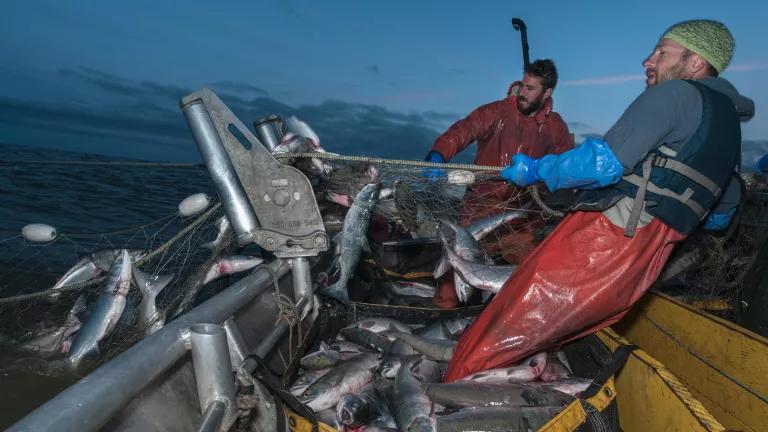
Sockeye salmon fishing in Bristol Bay, Alaska

Seafood and fishing are mainstays of coastal economies all over the world, and they are a major source of dietary protein for more than three billion people, including many of the world’s poorest and most vulnerable communities. Illegal, unreported, and unregulated (IUU) fishing—estimated to account for one-third of global catch—plays a uniquely harmful role in degrading ocean ecosystems, depleting fish populations, and distorting seafood markets. These practices globally are propped up by human rights abuses at sea and in the seafood processing sector.
Other key threats associated with IUU fishing:
-
IUU fishing is a top threat to economic and national security interests. The prevalence of illegally harvested seafood depresses incomes for fishers globally, with a price tag of up to $50 billion lost each year. These practices specifically harm U.S. fishing communities as they seek a fair price for their legal catch.
-
IUU fishing compromises port and maritime security. Ranging from small-scale violations to organized criminal operations, IUU fishing activities exploit the same routes and infrastructure used for trafficking and smuggling.
-
IUU fishing is harming U.S. fishermen, like Gulf shrimpers and salmon fishers in Alaska, and has become a high-profile concern in Congress due to its economic impacts. It has also grabbed the attention of the Trump administration—as reflected in a recent executive order (EO) titled “Restoring American Seafood Competitiveness,” which recognized the need to “address unfair trade practices, eliminate unsafe imports, [and] level the unfair playing field that has benefited foreign fishing companies.”
As we seek solutions to ensure a healthy ocean and sustainable fisheries into the future, we must address the issue of IUU fishing and its associated labor abuses.
NRDC believes that there are real opportunities to address these threats in 2025. Turning these opportunities into real progress will, however, depend on a coordinated whole-of-government effort that is supported by robust policymaking, funding, and stakeholder input. Below is an overview of top opportunities to advance U.S. leadership on IUU fishing and level the playing field for U.S. fishing communities.
Support an all-hands-on-deck approach to enforcement, which requires robust agencies and funding
Because IUU fishing is a complex global issue that touches on many national priorities, federal agencies must be able to work together to leverage their full authorities and share information to combat IUU fishing and related labor abuses.
The need for this whole-of-government approach to adequately combat global IUU fishing has been recognized for several years now. National Security Memorandum 11 (2022) directed 11 federal agencies to use the full range of their authorities. Most recently, Executive Order 14276 calls on an interagency Seafood Trade Task Force to develop a joint strategy for improving access to foreign markets and addresses unfair trade practices such as IUU fishing. Another important venue for whole-of-government policymaking is the U.S. Interagency Working Group on IUU Fishing, which was congressionally established in 2019 to combat IUU fishing worldwide and strengthen maritime security. The IUU Working Group’s current five-year strategy seeks to, among other goals, “ensure only legal, sustainable, and responsibly harvested seafood enters trade.”
Such interagency efforts are key to bringing worldwide recognition to the issue of IUU fishing and making U.S. policy gains, but they are now at risk from the Department of Government Efficiency’s (DOGE) drastic efforts to reduce and reorganize federal agencies. It is critical to recognize that, without robust government programs—including enforcement officers, trade analysts, diplomats, and fisheries and workers’ rights experts—progress will be stalled. Worse, an influx of IUU seafood will harm economic competitiveness and national security interests.
Strengthen seafood import controls to block trade of IUU seafood
In the United States, we have tremendous market power to transform international fishing practices by rejecting IUU fished seafood from our markets: We import more seafood by value than any other single nation in the world, including an estimated $2.4 billion of seafood imports derived from IUU fishing practices. To successfully leverage U.S. market power to counter IUU fishing, we must be capable of blocking illegally harvested imports from U.S. commerce and enforcing against culpable actors and countries.
President Trump’s Executive Order 14276 calls on the National Oceanic and Atmospheric Administration (NOAA) and partner agencies to “eliminate unsafe imports” and harness advanced technologies to “more effectively target high-risk shipments from nations that routinely violate international fishery regulations.”
The key policy aimed at these goals is NOAA’s Seafood Import Monitoring Program (SIMP). The data collection, screening, and auditing of seafood import data currently taking place under SIMP provide an essential platform for keeping IUU fished imports out of U.S. markets.
At the end of 2024, NOAA released an action plan for SIMP based on an inclusive yearlong review process and more than 7,000 stakeholder consultations. The SIMP action plan provides a detailed road map for major improvements to the SIMP that would greatly enhance its efficacy, including:
- Improving screening and detection processes
- Aiding labor enforcement efforts by partner agencies, such as under the Tariff Act of 1930
- Expanding traceability requirements to all seafood imports, potentially utilizing a tiered system to designate which data elements must be reported for which species
- Ramping up analytical and enforcement capacity
- Promoting government-to-government data sharing to enhance global enforcement efforts
On the topic of expanding SIMP requirements to encompass additional species, the EO contains vague language directing NOAA to “consider revising or rescinding recent expansions” of the program. However, NOAA has not yet taken any action to expand SIMP requirements to additional species—in fact, it withdrew a proposed rule in 2023 that would have done this. The SIMP action plan provides a process for NOAA to consider a revised, tiered approach for collecting SIMP data for all imports and develop strategies to efficiently close loopholes that are easy for bad actors to exploit. But it is not clear that the EO contemplates this process, and the EO language does not prevent NOAA from moving forward with this aspect of its action plan. Over the coming months, NRDC and partners will be encouraging NOAA to advance these improvements to SIMP. (NRDC’s chief recommendations for strengthening SIMP data collection and enforcement can also be found in our technical issue brief “Strengthening U.S. Leadership to Deter Illegal Seafood.”)

A U.S. Coast Guard member inspecting catch aboard a vessel while conducting IUU fisheries boardings in the eastern Pacific Ocean
Boost international enforcement and capacity building to deter IUU fishing practices
We are also advocating for federal agencies to maximize their use of other enforcement authorities, such as the High Seas Driftnet Fishing Moratorium Protection Act (High Seas Driftnet Act). One of the main tools that the United States can use to put pressure on other nations to end IUU fishing, this law requires NOAA to submit a regular report to Congress identifying nations engaged in IUU fishing and other harmful practices if NOAA has evidence of specific vessels engaged in IUU fishing. If the listed nations do not address the issue, NOAA can issue a negative certification, which can have drastic consequences, including denial of access to U.S. ports and restrictions on seafood and other fish product imports.
Despite the law’s promise as a tool to curb IUU fishing, NOAA has historically underutilized this law—only a handful of negative certifications for IUU fishing have ever been issued by the agency, and previous administrations have not issued seafood import bans for certified nations.
Lawmakers on both sides of the aisle in Congress support leveraging the High Seas Driftnet Act for stronger enforcement against bad actors. Recent proposals to do this include the FISH Act (S. 688), introduced by Alaska senator Dan Sullivan and Rhode Island senator Sheldon Whitehouse, and the Illegal Fishing and Forced Labor Prevention Act (H.R. 3075 in 117th Congress), led by California representative Jared Huffman, which we anticipate will be reintroduced this year. Enacting these proposals to better leverage the High Seas Driftnet Act is critical to cutting off financial incentives for illegal fishing, better coordinating with other major seafood importing countries (such as the European Union), and transforming international fishing practices.
U.S. Customs and Border Protection (CBP) is the main agency responsible for screening imports into the United States, and it has a key role to play in enforcing against labor violations that overlap with IUU fishing. In order to make better use of their limited investigatory capacity and target their audit and enforcement actions, CBP and NOAA should work together to use SIMP data to proactively identify patterns of behavior that indicate an increased likelihood of forced labor. This effort will be aided by an expanded SIMP.
Several agencies in the IUU Working Group—including the Coast Guard, NOAA, U.S. State Department, and U.S. Agency for International Development (USAID)—will need support to boost at-sea and in-port inspections internationally. An essential complement to this work is capacity building and technical support in source countries and flag states to strengthen and better enforce their laws . This work is critical to ensuring that sanctions are ultimately successful and align with the United States’ historic emphasis on diplomacy to bolster international fisheries management. This type of soft diplomacy is seriously threatened by DOGE efforts, as seen by the dismantling of USAID, but it is a critical part of boosting U.S. fishermen’s competitiveness.
Use trade levers to advance international cooperation and pressure when necessary
The U.S. government should also be making a concerted, collaborative effort with the international community to pressure countries that are allowing, or profiting from, illegal fishing. Executive Order 14276 may jump-start this effort, as it calls on the United States Trade Representative to address unfair trade practices associated with IUU fishing and the use of forced labor in the supply chain, including pursuing solutions through negotiations or trade enforcement authorities.
We urge prioritizing commitments from trade partners that strengthen seafood import controls, promote increased transparency in the seafood sector, and improve coordination and data sharing. (For more information, see joint recommendations from organizations in the United States, E.U., and Japan—the majority of the global seafood market—for stronger international coordination on combating IUU fishing and labor rights abuses.)
Explicitly define IUU fishing to include violations of fundamental labor rights
Labor rights abuses and IUU fishing are deeply interconnected, and compliance with international labor standards is critical to ending illegal fishing and overfishing. Restrictions on migrant workers’ ability to form or lead trade unions, systemic discrimination against migrant fishers in many distant-water fisheries, and rampant forced labor in many fisheries combine to significantly reduce the cost of labor and keep otherwise unprofitable fishing operations afloat.
This is why NRDC and partners have advocated for a revised legal definition of IUU fishing that recognizes labor rights violations as part of IUU fishing, particularly in the context of the High Seas Driftnet Act and the Magnuson-Stevens Act, which currently use a narrow definition that limits the ability of the U.S. government to combat the full range of illicit behaviors at sea and address critical sources of IUU fishing.
Congress has twice legislated a definition of IUU fishing that is aligned with the United Nations Food and Agriculture Organization’s definition and is stronger than the one in the High Seas Driftnet Act and its regulations. It is time for NOAA Fisheries and partner agencies, such as the U.S. Department of Labor and CBP, to follow through on NOAA’s withdrawn 2022 rule that would have aligned with congressional intent and amended the IUU definition to formally include forced labor.
This National Ocean Month, we call on policymakers to prioritize U.S. leadership to combat IUU fishing and labor abuses in the seafood sector, including supporting the key agencies tasked with this effort. Without this core support, the U.S. government’s ability to protect U.S. fishing communities and broader national security interests will be severely hampered.
Related Blogs

The Trump Administration Is Racing to Launch the Deep-Sea Mining Industry, Despite Huge Risks and Broad Opposition

16 Years after Deepwater Horizon, We’re Charging in the Wrong Direction
