The God Squad from Hell: Trump Convened Committee to Greenlight Extinction
The administration voted in favor of oil and gas interests over the survival of some of America’s most imperiled wildlife.


On the last day of March, the Trump administration convened the Endangered Species Committee, or so-called God Squad, a rarely used panel that has the power to condemn an endangered species to extinction. In an incredibly brief but deeply consequential meeting, the God Squad voted to allow oil and gas activities in the Gulf of Mexico to move forward without regard to their impacts on the area’s critically imperiled species. Exempting these activities puts federally listed species, including the Rice’s whale, manatees, and five species of sea turtles, at risk of irreversible harm—and potentially extinction.
This administration believes the future of cherished wildlife is negotiable when some of the wealthiest companies on earth ask for a favor. This broad, baseless exemption could spell disaster for wildlife across the nation, as it creates a gaping loophole in our most effective tool for protecting wildlife. But as powerful as the committee is, it must comply with the limits and procedures set out in the law. This exemption cannot stand.
What is the God Squad?
To understand the God Squad, it’s helpful to understand interagency consultation, a process that courts have called the “heart” of our most powerful wildlife protection statute, the Endangered Species Act (ESA). It requires that all federal agencies ensure that their actions do not jeopardize the continued existence of endangered or threatened species or degrade important places that these species call home. To comply with this protective guarantee, agencies must consult with the U.S. Fish & Wildlife Service (FWS) and National Marine Fisheries Service (NMFS)—agencies with the expertise to analyze the impacts of proposed actions on listed species and habitat.
At the end of the consultation process, one or both of these agencies issue their opinion as to whether a proposed action is likely to jeopardize listed species. If either makes a “jeopardy” determination, it must suggest “reasonable and prudent alternatives” to the proposed action that would not push the species perilously toward extinction. Moving forward with a project that jeopardizes a listed species is a violation of the ESA.
NRDC’s director of marine mammal protection, Michael Jasny, talks about the God Squad and the power this committee has to condemn an endangered species to extinction.
Congress has found that in extraordinarily rare cases, there can be intractable conflict between the ESA requirements and a project that needs to move forward as a matter of public policy. Take, for example, the project that inspired Congress to create the God Squad: the Tellico Dam. This dam was nearly complete and had received tens of millions of dollars in public funding by 1975 when the snail darter—a tiny fish whose entire known habitat would have been submerged by the dam—was listed as an endangered species. Completing the dam might have have wiped out the fish, violating the ESA. But ceasing construction would have been an enormous waste of money and resources that Congress simply couldn’t stomach.
Congress then amended the ESA to create the Endangered Species Committee, known as the God Squad due to its authority to determine the life or death of a species. The committee was empowered to allow projects to move forward in rare circumstances where doing so was clearly in the public interest but would jeopardize listed species—and where other requirements were met. In these cases, the committee could potentially consign a species to extinction.
Surprising many, the God Squad declined to consign the snail darter to oblivion. Congress itself stepped back in later and exempted the Tellico Dam project from the ESA. All the while, researchers had been developing methods to transplant the snail darter, and eventually, those efforts proved successful. That species is now emblematic of the success of the ESA, but it also represents a simpler truth: No scientific or engineering problem is so intractable that a species must be forever removed from the planet to solve it—America could keep both the snail darter and the dam, with no help needed from the God Squad.
Until this week, the God Squad had granted only two exemptions since its creation in 1978. The first was for a dam that threatened the whooping crane. Remarkably, the whooping crane survived the first ESA exemption ever issued and most likely will survive the third. The second and last exemption, until now, was in 1992, for a logging project that would have wiped out the northern spotted owl. It was ultimately withdrawn following litigation, and the owl continues its tenacious fight for a future.
Who’s who on the God Squad
The committee tasked with deciding the future of our wildlife is led by the secretary of the U.S. Department of the Interior and five other administration officials, each of whom had a vote. This particular group has more experience with industry and oil and gas than they do with the environment. The vote on March 31 in favor of oil and gas appeared to be unanimous.
- Secretary of Defense: Pete Hegseth was in attendance speaking on the need for energy development under the ruse of a national security need that is entirely manufactured.
- Secretary of the Interior: Doug Burgum led this meeting, despite having no wildlife expertise—and a track record in this administration of pandering to the oil and gas industry. Having a billionaire businessman lead a committee tasked with the future of endangered species does not bode well for anyone who cares about our natural heritage.
- Secretary of Agriculture: Brooke Rollins has helped shape theTrump administration’s anti-environmental policy.
- Secretary of the Army: Daniel P. Driscoll is a former military officer whose mandate as secretary is focused on the U.S. Army’s policies, budget, and operational training and readiness.
- Acting Chair of the Council of Economic Advisers: Pierre Yared is an economist with no environmental background.
- Administrator of the U.S. Environmental Protection Agency: Under Lee Zeldin, the EPA has made its sharpest turn in decades away from its core environmental mission. Instead of doing its job to keep people safe, the agency is systematically dismantling protections for the environment and human health.
- Administrator of the National Oceanic and Atmospheric Administration: Neil Jacobs is the only scientist on this committee, with a background in atmospheric science.
The president must also appoint at least one additional individual from outside the federal government. Tallied together, the presidential appointees’ votes will count as one. Yet there were no non-federal representatives included in this meeting, and thus the committee may not have been fully present.
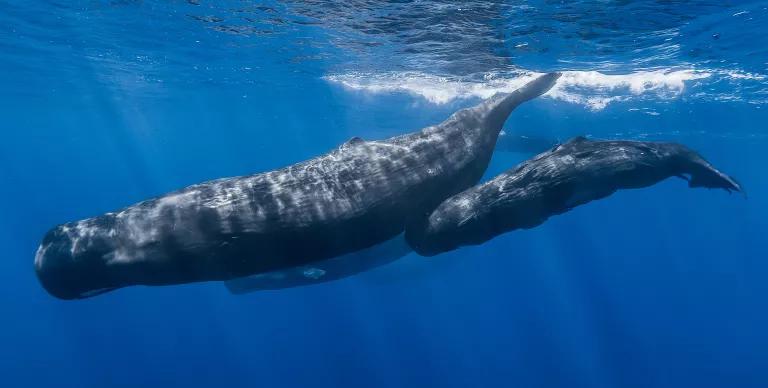
Sperm whales
Wildlife at risk
The Gulf of Mexico is home to extraordinary wildlife—from manatees to corals to sea turtles—that could be jeopardized if oil and gas companies are granted an exemption from the God Squad. More than two dozen marine and coastal species in the Gulf are listed as endangered or threatened under the ESA. It is well understood that oil and gas operations in the region, and their consequent oil spills, have enormous effects on the Gulf ecosystem and the area’s imperiled wildlife. For example, the BP Deepwater Horizon disaster is estimated, by the government, to have killed 17 percent of the entire Rice’s whale population, in addition to causing reproductive loss and adverse health impacts in surviving whales. The spill also killed thousands of sea turtles and nearly one million seabirds.
Seismic surveys for oil and gas exploration cause chronic stress for whales and potential habitat abandonment, disrupting their ability to communicate, feed, and reproduce.
Here are just some of the Gulf’s ESA-listed species that could be put at risk of extinction:
- Five species of sea turtles: Hawksbill, Kemp’s ridley, leatherback, loggerhead, and green sea turtles can all be found in the region. They face a myriad of obstacles to their survival from the oil and gas industry, including oil spills, vessel strikes, marine debris, explosions, and underwater noise pollution. The government itself has found that, without further protection, the oil and gas industry will kill more than 30,000 sea turtles in the Gulf over the next 45 years. And this number doesn’t account for the expansion of leasing into the eastern Gulf, which the Trump administration has proposed.
- Manatees: These gentle, much-loved animals and symbols of Florida make their home in the meadows of seagrass that line the Gulf coast. They are considered especially vulnerable to oil spills because of their foraging in the intertidal zone.
- Rice’s whales: These whales are extraordinary: a magnificent 45-foot-long animal that some have taken to call “America’s whale” and “Florida’s whale.” Scientists believe that they’ve lived in the Gulf for at least three million years, having made their way through the primordial passage that connected the Atlantic and Pacific oceans. Unfortunately, thanks to human activity—such as oil spills, seismic blasting, plastic pollution, and fatal collisions with ships—they’re among one of the most endangered marine mammals on the planet, with fewer than 100 individuals left. The decades since commercial whaling was abolished have shown that baleen whales, like the Rice’s whale, can bounce back and recover, but conservation measures are needed.
- Sperm whales: Once hunted by the whaling industry, sperm whales are the largest of the toothed whales. They can be found year-round in the Gulf, and its small population remains at risk.
- Gulf sturgeon: This fish species uses the Gulf's nearshore coastal waters, where oil spill exposure poses a documented risk.
The administration has worked to dramatically increase offshore oil and gas leasing in the Gulf, championing legislation that requires 30 lease sales over the coming years, plus proposing 7 more sales in the draft national program. Expanding oil and gas activity in the region, including off Florida, will heighten impacts for already stressed Rice’s whales and other wildlife.
Why are they doing this?
For profit, of course.
This convening of the God Squad for the first time in 30 years is about giving oil and gas companies a free pass to drive incredible wildlife to extinction in the name of billionaire profits. Big Oil CEOs should not be able to determine a species’ existence on this planet simply because they could make more money if they didn’t have to comply with the law. The administration is now asking a committee to say that saving imperiled species does not matter.
Calling up the God Squad fits with a broader pattern of Trump administration actions to boost the oil and gas industry regardless of the cost. With complete disregard for the well being of coastal communities, the future of our planet, and the habitats of incredible wildlife, the administration recklessly put forth a proposed draft national offshore oil and gas program that would expand drilling by offering 34 new lease sales between 2026 and 2031. The proposal would open up untouched waters of Alaska to drilling, attempt to resurrect the offshore oil and gas industry in California, and offer up waters off the coast of Florida that haven’t been put up for leasing in decades—on top of adding even more leasing in the central and western Gulf of Mexico.
The administration has also proposed weakening safety rules designed to prevent oil spills, rescinded guidelines on voluntary measures to avoid lethal vessel collisions with endangered animals, and has begun the process of comprehensively weakening ESA protections.
If these wealthy companies resist doing basic oil spill prevention and instead prefer to rig the system to allow imperiled wildlife to go extinct, they should not be drilling in our waters.
Predictably, the Trump administration declared a “national energy emergency” to attempt to justify this extinction waiver, but this is an entirely manufactured crisis. This is the same administration that has attempted to shut down five offshore wind projects—all already under construction and one close to 90 percent complete—on the pretext of national security. The administration is using the pretext of national security to help the industries it likes and hurt industries it hates. By killing off offshore wind and gutting renewable credits, the administration has intentionally handicapped the very energy sources that would actually make America independent of global prices.
And to be clear, this vote to bypass the ESA will not lower gas prices.
On March 13, Secretary Hegseth told the American people not to worry about the Strait of Hormuz, saying the military had the situation under control. Yet, on that exact same day, he signed a memo claiming a national security “emergency” so extreme that it requires the God Squad to authorize the extinction of American wildlife. True energy security means moving away from the volatile, global oil market that leaves U.S. families at the mercy of foreign conflicts.
Looming threat beyond the Gulf
There is no conceivable justification for sacrificing endangered species—or any wildlife—to further enrich the oil and gas industry. Doing so reflects a concerted effort to rescind, weaken, or prevent adoption of basic environmental protection measures for this industry, including oil spill prevention, well-control rules, and even voluntary guidance to avoid lethal vessel collisions with endangered animals. To inflict needless harm on endangered species would do nothing for Americans except squander the country’s natural heritage.
The Trump administration’s vote to condemn species in the Gulf will likely not stop here—this unchecked use of the God Squad could fundamentally undermine our nations’ most important and popular wildlife protection law. It paves the way for its proposed expansion of oil and gas leasing off Florida, California, and Alaska.
This expert blog was originally published March 19, 2026, and has since been updated with new information and links.
If the God Squad is successful, federally listed species will be driven further to extinction.
Tell your members of Congress to stop allowing fossil fuel companies to harm wildlife just to advance the Trump administration's drill, baby, drill agenda.
Protect endangered wildlife from the outrageous God Squad exemption!
The Trump administration’s God Squad unanimously voted to sacrifice endangered marine species—manatees, sea turtles, and whales—that are getting in the way of its plans for expanding oil and gas drilling in the Gulf of Mexico. NRDC sued, but we also need your help to keep up a massive public outcry to so that endangered species aren't pushed to extinction.
Related Blogs

16 Years after Deepwater Horizon, We’re Charging in the Wrong Direction

BLM Moves to Subsidize Dirty Drilling, Cut Out the Public, and Send Taxpayers the Bill