16 Years after Deepwater Horizon, We’re Charging in the Wrong Direction
From aggressively expanding offshore drilling to reversing protections for U.S. coasts, waters, and wildlife, pro-polluters are putting the country at greater risk of the next catastrophic oil spill.

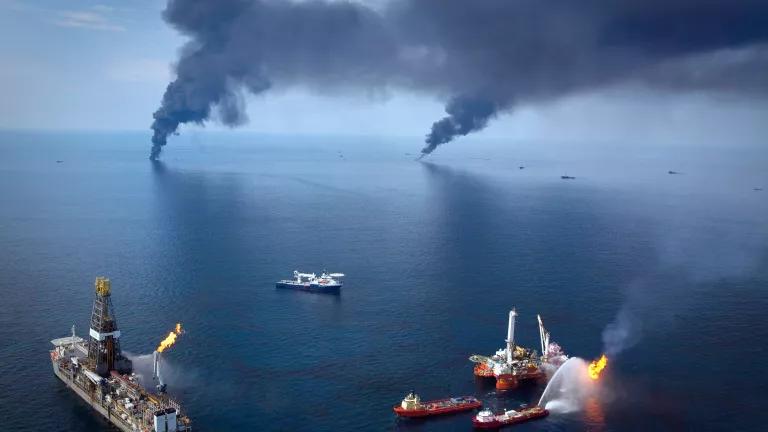
Fire boat response crews hosing down the burning remains of BP's Deepwater Horizon after an explosion on the rig, in the Gulf of Mexico, April 20, 2010

On April 20, 2010, a massive explosion on the oil rig Deepwater Horizon and its resulting oil well blowout killed 11 people, injured 17 others, and started the largest oil spill in U.S. history. The nation watched in horror as crude oil gushed from the uncapped well for the next 87 days, spreading through the waters of the Gulf of Mexico and onshore to beaches and wetlands.
Before the well was capped, 134 million gallons of oil spilled into the ocean, creating a suffocating stain that devastated wildlife like sea turtles and dolphins, poisoned the fish that feed the Gulf’s people and economy, and coated more than 1,300 miles of shoreline with its thick, dark sludge. The spill killed nearly one million seabirds, thousands of sea turtles, and nearly 20 percent of all Rice’s whales—a critically endangered species that continues to face an onslaught of threats from oil drilling in the Gulf.
Learn More
The Gulf lost an estimated $247 million due to fisheries closures, billions of dollars in tourism revenue, and countless jobs. Many Gulf residents lost their livelihoods and way of life, and those who stepped in to clean up the spill continue to face increased risks of cancer, respiratory conditions, and heart disease.
Deepwater Horizon’s devastation makes clear that Gulf communities, Gulf wildlife, and our ocean cannot afford another disaster. Yet 16 years later, the president and some Republicans in Congress are charging ahead with policies that increase the risk of another disaster. From aggressively expanding offshore drilling and weakening safety rules to undermining financial safeguards and reversing protections for U.S. coasts and waters, they are putting us at greater risk of the next catastrophic oil spill.
Undermining safety and environmental protections
Sixteen years after the largest oil spill in U.S. history, the current administration is working to undermine environmental and safety rules that were designed to prevent another catastrophic blowout and oil spill.
Following the Deepwater Horizon disaster, investigators identified the operational mistakes, technical issues, and oversight failures that led to the explosion and well blowout, concluding that the catastrophe could have been prevented. Established in 2016, the well control rule implemented some of the much-needed safety and technical reforms identified in Deepwater Horizon’s aftermath. During his first term, the Trump administration weakened this rule, citing the “unnecessary burdens” that the rule’s commonsense safety measures placed on industry. Under President Joe Biden, the U.S. Department of the Interior again revised the rule, restrengthening many of the requirements.
Now, the current administration is working once again to undermine basic safeguards necessary to prevent the next Deepwater Horizon. The Bureau of Safety and Environmental Enforcement (BSEE) released its proposed updates to the well control rule earlier this spring. The changes will substantially undermine safety and public oversight of oil and gas operations. The agency wants to deny the public access to reports documenting equipment failure—undermining transparency and public accountability—and extend timelines for operators to launch investigations into failed equipment, increasing the risk of blowouts. The new rule diminishes BSEE’s oversight over the industry’s choice of experts tasked with certifying that the equipment is safe. These experts must be independent third parties, but in abdicating its oversight responsibilities, the BSEE is letting the fox guard the henhouse.
Strong protections are more important than ever, as Gulf drilling operations move into deeper waters, where extreme temperatures and pressure make drilling even riskier. The Trump administration just approved BP’s Kaskida project, the company’s first completely new oil field since the Deepwater Horizon disaster. “Loss of control” blowout events—the cause of Deepwater Horizon—are six times more likely to happen in high-pressure, high-temperature deepwater wells like Kaskida than in standard deepwater wells.
These changes risk the health and safety of offshore workers and Gulf communities, businesses, and wildlife—just to lower costs for Big Oil. Deepwater Horizon proved that we cannot trust the oil and gas industry to regulate itself or protect its workers or our ocean.
The Bureau of Ocean Energy Management (BOEM) is also proposing to roll back a Biden administration rule requiring oil and gas companies to post an additional $6.9 billion to guarantee that they will properly decommission old wells and platforms—something that the oil and gas industry has consistently failed to do.
The Gulf is littered with idle iron: unused and abandoned wells, platforms, and pipelines left behind by oil and gas companies. Companies are legally and contractually required to clean up infrastructure once operations are complete, but they routinely fail to do so. According to a U.S. Government Accountability Office (GAO) report, more than 2,700 wells and 500 platforms were past due for decommissioning in the Gulf of Mexico as of June 2023. Federal agencies have failed to enforce industry obligations. The GAO found that the Interior Department “does not effectively ensure that industry operators meet decommissioning deadlines for offshore wells and platforms at the end of their useful lives.”
Idle and abandoned infrastructure leak oil and methane, create safety hazards for vessel crews, and pose an ongoing risk of oil spills that is heightened by increasingly strong hurricanes that can collide with corroded structures. In fact, the Taylor Energy oil spill—which has gone on for more than 20 years and spilled up to 29,000 gallons of oil per day into the Gulf—began when Hurricane Ivan hit an active oil production platform.
If finalized, BOEM’s new rule will make it more likely that taxpayers will bear the cost for cleaning up the oil and gas industry’s mess—enhancing yet another subsidy for fossil fuels.
On top of that new rule, the Interior Department announced plans to combine BOEM and BSEE into a single entity called the Marine Minerals Administration. The two agencies were created separately in 2011 on the recommendation of an independent commission that investigated the Deepwater Horizon disaster and found that housing offshore leasing and safety regulation under one roof created dangerous conflicts of interest. This dangerous merger decision will likely weaken protections for oil workers, coastal communities, and marine life. It prioritizes oil industry profits above health and safety.
The structural separation of BOEM and BSEE was a hard-won lesson of the Deepwater Horizon catastrophe. As the post-spill commission made clear, you cannot prioritize both industry profits and public safety within the same office. To dissolve that barrier is to invite a return to serious ethics issues and regulatory capture that defined the first failed Minerals Management Service.

A Rice's whale swimming in the western Gulf of Mexico
Administration pushes for more leasing and drilling in the Gulf and offshore Alaska and California
The Trump administration has recklessly put forth a proposal to expand offshore oil and gas drilling that would offer 34 new lease sales offshore from Alaska, California, Florida, and in the Gulf of Mexico between 2026 and 2031. The proposal would open up untouched waters of Alaska to drilling, attempt to resurrect the offshore oil and gas industry in California, and offer up waters off the coast of Florida that haven’t been put up for leasing in decades—in addition to adding even more leasing in the Gulf of Mexico. This plan would damage these places and the people who rely on them for generations.
The draft proposed program has been met with bipartisan opposition. The entire Florida congressional delegation sent a letter to the administration opposing drilling off their coast. In California, not only did 26 members of its delegation also write a letter opposing any drilling off of their state’s coast, but a bipartisan measure was also introduced that opposes the proposed offshore drilling program.
Any expansion of leasing is unnecessary to meet U.S. energy needs and will only exacerbate the harms that fossil fuel development has already inflicted—particularly on the frontline communities, shores, and wildlife of the Gulf region. Last year’s Reconciliation Act—the administration’s gift to Big Oil and billionaires—already requires BOEM to hold 30 region-wide Gulf lease sales from 2025 through 2040, providing the oil and gas industry with the opportunity to bid on 80 million acres of Outer Continental Shelf lands twice every year.
BOEM will release its second draft of the leasing program in the coming months. While the final leasing program has yet to be seen, the current administration seems poised to expand offshore leasing as much as possible.

Trump Executive Orders Jeopardize Our Oceans
How Deep Were the Impacts of the BP Oil Disaster?
What We Learned from the BP Oil Disaster

America’s Newly Discovered Whale Is Already in Trouble

The Fight to Keep Oil and Gas Rigs Out of Our Waters. For Good.
Sacrificing Gulf wildlife for Big Oil profits
On the last day of March, the Trump administration convened the Endangered Species Committee, or so-called God Squad, a rarely invoked tool under the Endangered Species Act. The committee voted to exempt oil and gas activities in the Gulf of Mexico from the Endangered Species Act under the pretext of national security concerns. This thinly veiled giveaway to Big Oil puts federally listed species—including the Rice’s whale, manatees, and five species of sea turtles—at risk of irreversible harm and potentially extinction.
The God Squad exemption eviscerates protections for Gulf wildlife, making these incredible species even more vulnerable to the next oil spill. Sacrificing these incredible animals in the name of billionaire profits is unacceptable. NRDC is fighting this illegal action in court.

Large pools of oil leaking from the Deepwater Horizon
The fight continues for all of our coasts and waters
The president’s first executive order of his second term unlawfully revoked permanent protections from offshore drilling for more than 625 million acres of the Atlantic Ocean, Pacific Ocean, eastern Gulf of Mexico, and Alaskan seas, which were put in place by Presidents Joe Biden and Barack Obama. This move opens up huge areas of our ocean to potential offshore oil and gas leasing. The rollback opened the door for Interior Secretary Doug Burgum’s proposed offshore oil and gas leasing program to include sales off the coasts of California and Alaska.
We successfully challenged a similar attempt to undo protections from drilling in the Atlantic and Arctic oceans in 2017—and we are again challenging the president’s illegal actions to undermine ocean protections. NRDC and our partners filed a lawsuit against the administration last year. This challenge was brought by a broad coalition of groups, including NRDC, Alaska Wilderness League, Center for Biological Diversity, Conservation Law Foundation, Earthjustice, Greenpeace, Healthy Gulf, Northern Alaska Environmental Center, Oceana, Sierra Club, Surfrider Foundation, and Turtle Island Restoration Network.
NRDC continues to fight offshore oil and gas drilling on multiple fronts. We challenged the first sale held under the Reconciliation Act, along with partners Center for Biological Diversity, Friends of the Earth, Healthy Gulf, and Sierra Club. We will continue fighting to protect our ocean from drilling.
Deepwater Horizon is a stark reminder that the stakes couldn’t be higher for ocean wildlife and coastal communities. The president and some congressional Republicans are barreling in the wrong direction and failing to learn from the past as they put polluters over people, again and again. Our climate, communities, and endangered species can’t afford to risk another oil disaster. We will continue to fight to protect our ocean from oil and gas drilling.
This expert blog was originally published April 18, 2025, and has been updated.
Related Blogs

The God Squad from Hell: Trump Convened Committee to Greenlight Extinction

BLM Moves to Subsidize Dirty Drilling, Cut Out the Public, and Send Taxpayers the Bill