Seeking Justice: An Oral History of Building a Principled Partnership
Leaders of EJHA and NRDC reflect on the importance of listening and earning trust and offer a model for developing a durable allyship.

This case study is based on stories collected by Phillip Norman, oral historian.
Over decades, and after several missteps, NRDC (Natural Resources Defense Council) and EJHA (Environmental Justice Health Alliance for Chemical Policy Reform) have cultivated a relationship rooted in an institutional memorandum of agreement (MOA) that can serve as a model for how Big Green national environmental nonprofits and environmental justice (EJ) organizations can work together to build an aligned movement.
Most recently, EJHA and NRDC renewed their MOA for another three-year term, shaping joint advocacy and shared priorities that the groups will pursue together into 2029.
Michele Roberts, EJHA’s national coordinator, views the partnership’s ongoing, open dialogue as a keystone of its success. “lt helps us to be able to create and make better policies and better decisions,” she explains. “You come to understand that that quick win might not help that community, which is why it’s so important to have a relational experience built on trust that doesn’t feel transactional.”
The story of this partnership provides valuable lessons in community building and outlines modes of collaboration for other green groups to build on.
WATCH: Seeking Justice: An Oral History of Building a Principled Partnership Between EJHA and NRDC
I. Environmental justice leaders calling out Big Greens in the 1990s
Throughout the 1990s, leaders in EJ communities across the country were routinely frustrated by the Big Greens failing to recognize the interlocking nature of struggles for environmental, economic, and racial justice.
That feeling catalyzed a career path for Roberts herself. A native of Wilmington, Delaware, she started out as a local government scientist testing waste products from chemical facilities sited along the county’s predominantly Black, Route 9 industrial corridor. She quickly learned that no one was being held accountable for these frequent and untimely deaths resulting from the rampant pollution of her hometown and surrounding communities.
“I was actually in the lab in New Castle, Delaware, testing waste products, looking at magazines in real time of this thing they were calling environmental justice. And I began to think about the people around Southbridge and Wilmington who had died,” Roberts says. “My father and mother’s friends…and it just seemed like people just started dying in abundance. These folks all lived in what we now call environmental justice communities.” Before long, she left the job and threw herself into the environmental movement full-time.
That movement, though, didn’t seem to have much of an interest in communities like hers. “I came out of government, looking at how fractured government was, and I’m looking at this thing called a movement, and it’s the same deal.”

Across the country in Albuquerque, New Mexico, Richard Moore—a former national co-coordinator of EJHA and an active leader through the affiliate community-based organization Los Jardines Institute—was experiencing a similar sense of fracturing. While working as co-coordinator of the regional grassroots coalition Southwest Organizing Project (SWOP), surveying residents in the city’s historically marginalized Latino and Indigenous communities, he came across numerous environmental concerns. But the organizations that were nominally concerned with “environmental issues” paid little mind to leaders like him. “They would say, ‘We always thought that you all weren’t interested in environmental issues,’” Moore remembers, “because you guys are real busy trying to get housing and trying to get different things.’ But we were also real busy thinking about clean air, clean water, and clean soil. We’re not using the same language, but that don’t necessarily mean that we’re not interested.”
Inspired by the strategies of grassroots allies on the Gulf Coast, in 1990, Moore and other members of SWOP penned an open letter to the 10 Big Greens to point out these failures. The letter placed emphasis not only on racial and gender exclusion in the environmental movement, but it also called out corporate conflicts of interest on the boards of several Big Greens.
“The letter sent out by [SWOP],” explains José Bravo, executive director of EJHA affiliate Just Transition Alliance, “was an invitation to mainstream Greens in that day to join the summit and have a discussion with people around environmentalism, in order for us to get them to understand that race played the number one factor in the siting of industries, the siting of everything that white people didn’t want in their communities.”


Scenes from the First National People of Color Environmental Leadership Summit (clockwise from top left): Richard Moore speaking to delegates; a crowd of delegates at the rally; onstage at the opening ceremony (left to right), EJ leaders Rose Auger, Benjamin Chavis, Gail Small and Toney Anaya
Courtesy United Church of Christ Environmental Justice Ministry
; 2)R.D. Bullard
; 3)Courtesy United Church of Christ Environmental Justice Ministry
On October 24, 1991, the First National People of Color Environmental Leadership Summit kicked off in Washington, D.C. The summit was a watershed moment and an opportunity for historically excluded EJ communities to develop an environmental movement that reflected their experiences and priorities, on their own terms. At the invitation of EJ groups, NRDC’s first president, John Adams, attended and spoke at the gathering.
The work of agitating Big Greens and organizing the leadership summit in the 1990s helped EJ leaders build solidarity among themselves and within larger movement spaces. In the coming decades, Moore, Roberts, and Bravo would come together again as EJHA leadership and community-based affiliate organizations to continue the work of building alignment with organizations like NRDC.
II. Foundations for NRDC’s evolving relationship with EJ communities
The efforts to build real, working relationships between NRDC and the grassroots EJ movement began to bloom.
San Francisco–based NRDC attorney Johanna Wald placed a personal phone call to Moore expressing her support for the concerns outlined in SWOP’s letter to the group of 10. That call set the tone for decades of constructive relationship building between NRDC staff and EJ organizations in Albuquerque. Wald visited Albuquerque for a series of discussions concerning the ways in which NRDC could better support EJ community interests. “Then we decided,” Moore remembers, “let’s just do something together. And then that something will help us get to know each other a little bit better, build a little bit of confidence in our working relationships.”
On Wald’s recommendation, Mitch Bernard, a young NRDC attorney from New York City, was invited to Albuquerque to offer SWOP legal counsel in what ended up being a successful fight to block construction of a federal courthouse in the historically Latino barrio of Santa Barbara Martineztown. “The legal component was just one part of a larger organizing strategy,” says Bernard, now NRDC’s chief counsel. “They asked us to bring something that we had that could assist them. That's all we did. And I think that's one good model for how this kind of relationship can work.”
This story—about the principled NRDC attorney building bridges with EJ communities—would continue to repeat itself in the years to come.

In 2014, in West Virginia’s Kanawha Valley, then–NRDC legal fellow Jared Knicley was introduced to People Concerned About Chemical Safety (PCACS), an EJHA affiliate community group responding to the devastation of a massive chemical spill on the Elk River.
In order to get to work, Knicley had to overcome skepticism from local leaders who had previously had difficult interactions with NRDC. In 2008, after a chemical incident at the Bayer CropScience pesticide facility in Institute, West Virginia, NRDC lawyers had visited the region to explore a potential lawsuit but ultimately did not pursue a case. “Every group that has shown some interest and given us some hope, it’s like it always faded out,” remembers Sue Davis, one of the local PCACS leaders who organized time and resources to facilitate NRDC’s unfruitful 2008 visit.
Knicley was determined to come through for the community. “It’s like the campsite rule, right?” says Knicley. “You leave a campsite at least as good as you found it…. In whatever you’re doing, you have to make sure that community partners are going to be better off because of the relationship.” To achieve this, he shadowed Pam Nixon, a central leader in PCACS, as he learned the ropes of lawyering in close coordination with a fenceline community.
Knicley’s work in West Virginia culminated in a day-long hearing at Manhattan’s Thurgood Marshall federal courthouse where EJHA, PCACS, and NRDC together won an argument to rectify the system’s failures that had precipitated dangerous chemical discharges like the Elk River disaster.
But progress is rarely linear. In 2016, when NRDC and numerous other Big Green players left fenceline communities out of eleventh-hour negotiations to revise the Toxic Substances Control Act (TSCA), the working relationship with NRDC was called into question.
At the time, Moore and Roberts were coordinators of the Fenceline Action Work Group, formed within the national network Coming Clean. Together, they created a space for centering the oft-excluded voices of leaders who lived, worked, played, and prayed along the fenceline of the nation’s largest chemical facilities.
The work group agreed that legislative provisions addressing heavily polluted “hot spots” and legacy contamination in frontline EJ communities should not be negotiated out of the revised TSCA bill. However, fenceline leaders weren’t at the negotiating table when revisions were finalized. “The Washington players of these national groups made the decision for us—without us,” says Roberts. “We knew that groups like NRDC were in the room…[but] the leadership of the fenceline working group, Richard Moore and I, were never allowed in the room from the beginning.”
The fallout from the TSCA negotiations demonstrated how quickly partnerships can fall apart under political pressure. It was also responsible for members of the work group deciding to form their own organization, EJHA.
Thinking back on those turbulent times, Roberts evokes the memory of Dr. Henry Clark, a storied EJ movement leader who served as a driving force in the formation of EJHA. “Dr. Henry Clark believed that it took all of these different groups, and movement spaces, to come together,” says Roberts. “But he said folk had to come together with intentionality.”

III. Creation of the EJHA-NRDC memorandum of agreement
Moore, Roberts, and EJHA affiliates had forged numerous, principled partnerships with NRDC staffers. Now, they were eager to elevate beyond those interpersonal relationships.
Around the same time that her colleague Knicley was working on the ground with affiliate leaders in West Virginia, then–NRDC legal fellow Sara Imperiale began sitting in on meetings between NRDC and EJHA’s national leadership. As a member of NRDC’s small EJ team, Imperiale quickly took interest in and inspiration from the ongoing work of centering fenceline communities in Big Green environmental spaces.
“There was this energy built around formalizing the commitment and the relationship. Because up to that point, there had been these positive one-on-one experiences for certain projects with certain individuals. But that only takes us so far in this project of movement building” recalls Imperiale. “Folks leave organizations, their priorities shift, the funding changes. So there was this ask coming from EJHA: Can we move it from an individualized, positive experience to an institutional commitment?”
At the prompting of Roberts and Moore, coordinators of the newly formed EJHA, the two groups began developing a historic MOA.
In 2017, after months of discussion and drafting, EJHA leadership and affiliate representatives met with NRDC leadership at the organization’s New York City headquarters. EJHA surprised everyone in the room—“including ourselves”, remembers Moore—when they insisted on taking the MOA for a test drive before setting pens to paper. “We said, ‘Look, we’ve worked extremely hard, diligently, to get where we are,’” Moore remembers. “Let’s just not sign the MOA, and let’s practice the MOA.” For Moore, the decision to take several months of practice before ultimately signing the document later that year was “another piece of the process”; a step that reinforced the slow, patient work it takes for movement builders to ensure equity across all of their working relationships.
The MOA details how EJHA and NRDC will build joint advocacy, share credit for that work, and approach equitably fundraising together.
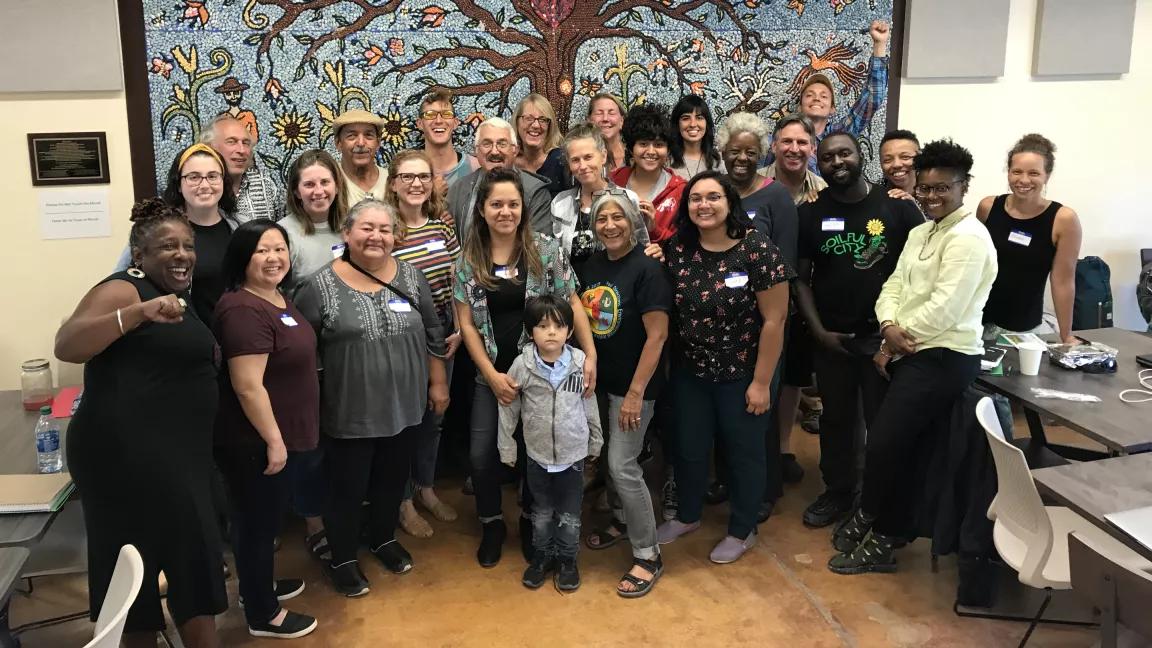

The 2023 EJHA-NRDC MOA in-person leadership meeting in Albuquerque, New Mexico

The 2025 EJHA-NRDC MOA in-person leadership meeting in Washington, D.C.

IV. EJHA-NRDC MOA as a model for how Big Greens and EJ groups can work together to build a more aligned movement
Today’s engagements between NRDC and EJHA look a lot different from the confrontations of the 1990s. For NRDC’s part, the organization’s staff has become much more diverse, and in 2021, it launched the Environment, Equity & Justice Center (EEJC), where Imperiale leads the community lawyering team. EEJC attorneys, scientists, and other staff work full-time on EJ partnerships and dedicate their expertise to a broad range of joint advocacy projects, including those outlined in the MOA.
Since 2017, MOA signatories have met at regular biennial intervals to reflect on and recommit to principled partnership. The 2025 leadership meeting boasted the highest-ever attendance by EJHA affiliates, a sign of how these relationships have grown over the last eight years. Staff and leadership from EJHA and NRDC were joined by representatives from REACT in Louisville, Kentucky Los Jardines Institute in Albuquerque; TEJAS in Houston; and PCACS in Charlestown, West Virginia.
Affiliate groups’ participation in the 2025 leadership meeting helped move things forward. “We were able to get their direct feedback about their highest priorities and their preferences for how NRDC engages with them,” says Imperiale.
As EJHA’s national organizer, Stephanie Herron sees a difference in how NRDC approaches its relationship with the affiliates after nearly a decade with the MOA. Things have moved beyond the transactional. “NRDC now comes to EJHA spaces and asks ‘How can we bring our legal skills and tools to support community goals?’”
These regular convenings also allow participants to foster long-term personal ties, even friendships, outside the specifics of any one joint campaign. “I think the other piece…is us being able to interact with each other as human beings,” says Moore. “And I think [in this work] sometimes the human being–ness of the whole thing…is really missing. Our work with NRDC is both personal and professional. We’ve kind of broken those barriers. We really have. It just means so much, I think, to all of us.”
Related Resources

White House Watch: Tracking Attacks on Our Environment & Health
Centering on Communities to Drive Speed and Scale