
Microplastic Is Inside Your Body
As plastic pollution piles up across the globe, researchers are busy investigating the potential negative outcomes to our health.

Children walking beside River Buriganga, in Dhaka, Bangladesh, where plastic waste floats in the water even after a recent cleanup
Plastic is everywhere. There’s the stuff you see littering the ground, cluttering your home, and washing up on the beach. But it’s the plastics you don’t notice—the bits you can’t easily see in your food, in your water, and in your body—that are also a serious health concern. We breathe them in, gulp them down, and gobble them up in our food. So far, scientists have found microplastics—and their even smaller counterparts, called nanoplastics—inside our brains, livers, intestines, hearts, kidneys, and even breast milk.
Some industries intentionally manufacture microscopic plastic for various uses, such as pellets and cosmetics. But a lot of microplastic is what eventually happens to larger plastic products after they begin to break down—actually, “break apart” is more accurate since plastic may never fully biodegrade.
Once inside our bodies, what does all this plastic do? Scientists are just beginning to understand the potential dangers. But a growing body of research is showing a link between microplastic exposures and negative outcomes for health, such as liver and bowel disease and some cancers.
Learn More

“There are tiny particles of plastic that we are clearly exposed to that can move around our body and wreak havoc once they're there,” says Dr. Katie Pelch, a senior scientist at NRDC, “even if we don't fully understand the mechanism of how that damage is occurring.”
And yet we remain hooked on the stuff. The amount of plastic that manufacturers produce—and consumers “throw away”—grows year after year. The world currently produces 400 million metric tons of plastic, a figure the United Nations projects will skyrocket to 1,100 million metric tons by 2050. Given this trajectory, acting on both the global front and the personal one is imperative.
Matthew Campen, a toxicologist at the University of New Mexico, says, “If we stop making new plastics today, there is still a ton of plastic that's been produced for every human on earth.”
“We know that microplastics are found throughout our body—almost everywhere that scientists have looked."
Dr. Katie Pelch, senior scientist, Environmental Health program, NRDC
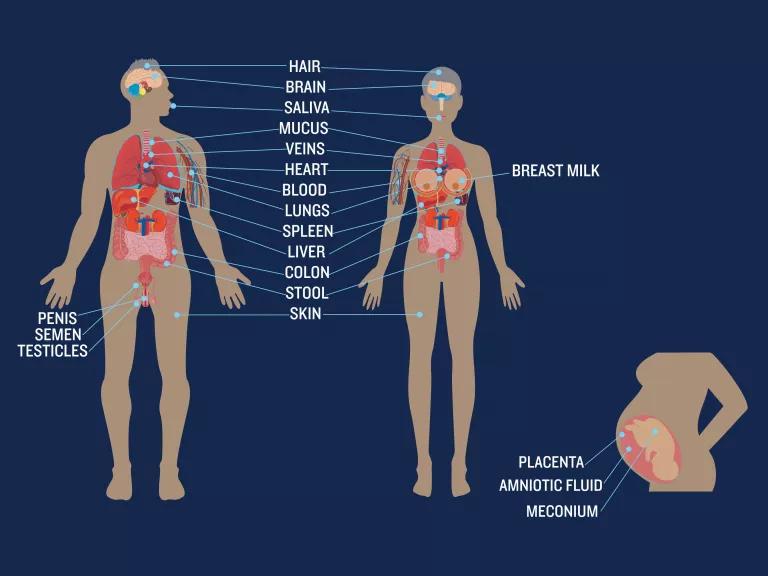
Microplastics in the human body
How are we exposed to microplastics?
Microplastics find their way into our bodies in a number of ways. At home, we inhale plastic particles from furniture and synthetic carpets, such as polyester, when they waft into the air as dust. Our skin may absorb them when we apply some sunscreens and deodorants. Our bodies take them in via certain toothpastes and tampons. We may also drink plastic when we sip from bottled water, put hot drinks into plastic-lined containers, and steep tea enclosed in plastic tea bags.
Another way people consume microplastics is through food.
How exactly does plastic get into our food? One way is by microwaving meals in plastic containers, but on a larger scale, it’s entering at the source. “We think that it's biomagnifying through agricultural pathways and into the food we eat,” says Campen.
That’s right—microplastics are infiltrating soil, crops, and farm animals. Many synthetic fertilizers, as well as sewage sludge sprayed on agricultural lands, contain tiny plastic particles that plants and grazing livestock take up in their tissues.
And plastic’s presence in waterways leads to contaminated fish and other aquatic life too. For instance, researchers observing marine organisms off the coast of Oregon found plastic microfibers in oysters and razor clams. Meanwhile, reams of research has detected microplastic in ecosystems on the East Coast and along the shorelines of nearly every continent.
“It's in our river water. It's in our fish. It's in our shellfish,” says Elise Granek, a coastal ecologist at Portland State University who studies microplastics.
Further offshore, oceanographers have found plastic particles in the stomachs of deep-sea fish and crustaceans—not very surprising, considering that plastic trash is even present at the bottom of the Marianas Trench, the ocean’s deepest point.

Where do microplastics accumulate inside your body?
Once we inhale, ingest, or absorb plastic particles that are tiny enough to infiltrate the bloodstream, they make their way just about anywhere. “We know that microplastics are found throughout our body—almost everywhere that scientists have looked,” says NRDC’s Pelch.
In just the last few years, researchers have published numerous papers describing the presence of microplastics in organs, tissues, and fluids. They can amass in the brain, heart, colon, liver, spleen, and testicles. They are in our skin and hair and found in spit, mucus, and semen. Scientists have detected them in the very first poop of babies—exposed to microplastic via the placenta and amniotic fluid before they were even born.
NRDC’s director of plastics and petrochemical advocacy Renée Sharp talks about the long-lasting impacts of plastic in our bodies and our communities, as well as the culprit behind all of it.
What are those plastics doing to our health?
The state of the research on human health and microplastic is still early, but studies show associations between plastics in our bodies and heart disease, preterm birth, dementia, higher rates of cancer, and lower sperm counts.
“It's possible that physical obstructions to neural networking may have an effect on how the brain develops,” says Campen, who has authored numerous studies on microplastic concentrations in the human body and who was the first to find them in the brain. “These little, tiny, inert particles could simply be in the way. Multiple sclerosis has been going up, and fertility has been going down. Sperm count has dropped 50 percent globally in my lifetime. So these are odd things that merit some investigation.”
Such work is indeed underway. At her lab at the University of Rhode Island, neuroscientist Jaime Ross is studying how mice with genetic preconditions for dementia behave after microplastic exposure.
Typically, as mice move around a room, they will stay close to the walls to protect themselves from predators. But in Ross’s lab, male mice exposed to microplastic seemed to lose this survival instinct. These mice would hang out in the middle of the room for twice as long as the control group. Meanwhile, their female counterparts demonstrated memory loss. The team showed them novel objects, took the objects away, and then presented them to the mice again. The females were slow to approach the items, which indicated they didn’t recognize them.
To Ross, the results are clear: “If you dose a mouse with microplastics that has these preconditions that make it more susceptible to dementia, then behavioral changes ensue.”

A physical chemist demonstrating the glass filtration apparatus used to test water samples for nanoplastics (microscopic plastic pieces) in New York City—a new study found the average liter of bottled water has nearly a quarter million invisible pieces of nanoplastics.
How new policies could help curb microplastics
Health care workers, scientists, and activists are now pushing government officials to mandate that companies reduce the amount they produce and use, disclose the types of plastics they use, and begin to clean up their mess.
Global leaders are scheduled to meet in August to discuss a binding plastics treaty that could do just that, but a number of countries are fighting the effort. With or without international action, federal, state, and local governments can also enact policies that help curb plastic waste.
For instance, the New York Waste Reduction and Recycling Infrastructure Act, recently passed in the state’s senate, would help reduce the use of plastic packaging. Illinois is also considering phasing out certain single-use products, such as plastic bags.
Businesses could also reduce their plastic use on their own (though such voluntary efforts often fall woefully short) or manufacture products that catch plastic before they enter the environment, which could be a draw for consumers. Some dryers, for example, use technology to trap microplastics from clothing made of fleece, polyester blends, or other synthetic materials.
In Oregon, Granek’s colleagues are studying the potential benefits of bioswales, which are vegetated ditches that capture stormwater runoff and may stop the spread of plastic. “We've documented the problem,” says Granek. “Now we're doing some work to try to look at solutions.”
But the best solution, of course, is to stop plastic at its source—well before it enters our waterways, homes, or bodies at all.
How to avoid microplastics
Avoiding plastics completely is virtually impossible. Plastic, including microplastics, exists in so many different formulations in so many products, from cosmetics to household textiles to packaging.
“I think the biggest mistake we make in this world of plastics is pushing responsibility off on individual consumers,” says Campen.
He’s right. Policy changes are the most effective ways to reduce plastic production, waste, and exposure, but consumers can still take steps to protect themselves and their families. For starters, buy less of it. Avoid drinking plastic particles by choosing tap over bottled water when possible and by using glassware and metal thermoses. Use glass baby bottles. You could also reduce microplastics in meals by putting leftovers in glass or ceramic storage containers, chopping on bamboo or other wooden cutting boards, cleaning with plastic-free sponges, and saying no to pans with nonstick coatings like Teflon.
Look for fabrics made from natural fibers for your clothes, furniture, and rugs. Check labels on personal care products and avoid those with ingredients like polyethylene, polymers, or microbeads. Use tampons made from 100 percent cotton without a plastic applicator or PFAS-free period underwear.
Buy fewer groceries that are packaged, vacuum-sealed, or carried home in plastic. “I don't think we need our cucumbers wrapped in plastic,” says Ross. “Let's not have single-use plastic and just throw it in the trash. It's going to come back and bite us—if it hasn’t already.”
This NRDC.org story is available for online republication by news media outlets or nonprofits under these conditions: The writer(s) must be credited with a byline; you must note prominently that the story was originally published by NRDC.org and link to the original; the story cannot be edited (beyond simple things such as grammar); you can’t resell the story in any form or grant republishing rights to other outlets; you can’t republish our material wholesale or automatically—you need to select stories individually; you can’t republish the photos or graphics on our site without specific permission; you should drop us a note to let us know when you’ve used one of our stories.
Most people's brains contain a plastic spoon's worth of microplastics.
Meanwhile, the plastic industry is on track to triple plastic production over the next 40 years. Tell the FDA to protect us from microplastics!

Tell the FDA to protect us from microplastics
A recent study found that most people's brains contain a plastic spoon's worth of microplastics. Meanwhile, the plastic industry is on track to triple plastic production over the next 40 years. Tell the FDA to protect us from microplastics!
Safe Drinking Water
Bottled Water vs. Tap Water
“Forever Chemicals” Called PFAS Show Up in Your Food, Clothes, and Home