
To Speed Up Climate Progress, Support for Developing Countries Is Key
A closer look at international climate finance promises and why the billions of dollars in pledges truly matter.

Cyclone Evan wreaked havoc throughout Fiji when it passed through the island in December 2012.
AP/Tertius Pickard


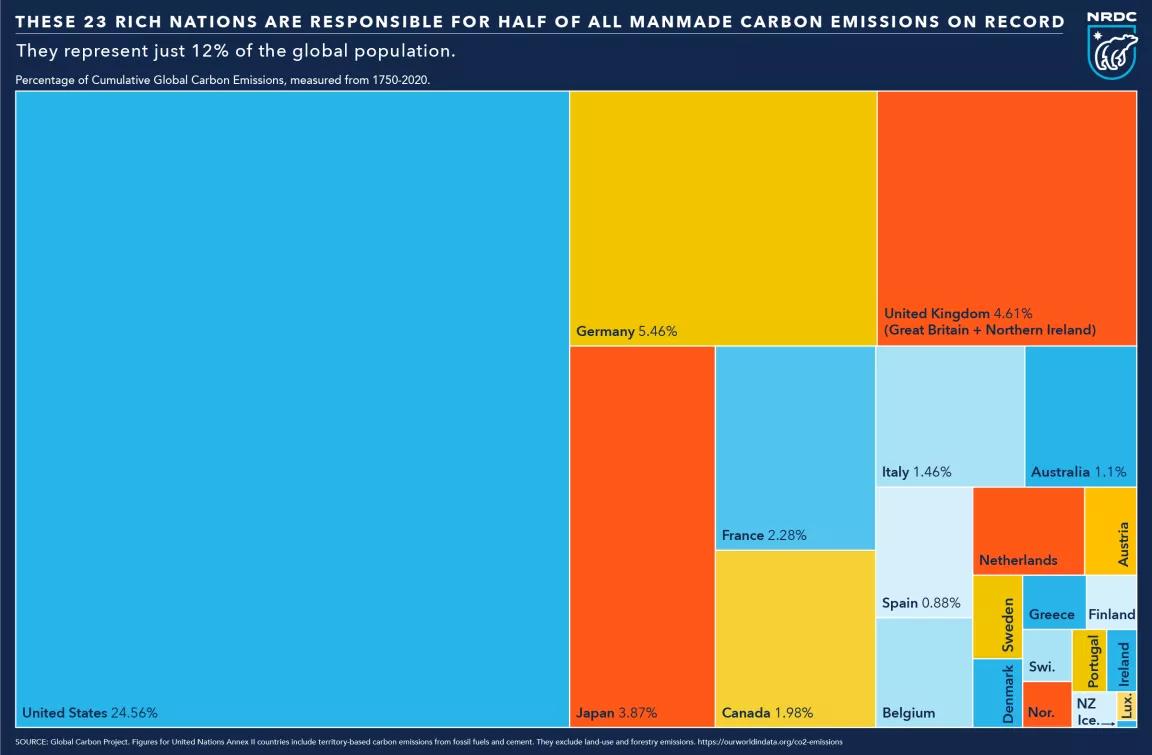
There’s no denying it: Wealthy countries, including the United States and European nations, have emitted the lion’s share of greenhouse gases that led to the climate crisis. In fact, just 23 developed countries are responsible for about half of all historical CO2 emissions. Meanwhile, carbon emissions continue to reach record highs, including in 2025. And it’s developing nations that are being hit hardest by the effects—and are the least ready to respond.
Back in 2009, those developed countries made a promise at the annual United Nations climate summit in Copenhagen. Together, they agreed to mobilize $100 billion per year, officially beginning in 2020, to help developing countries reduce their emissions and adapt to the impacts of climate change.
Developed countries did eventually reach the $100 billion funding target in 2022, according to the Organisation for Economic Co-operation and Development (OECD), an intergovernmental body. But beyond being two years late, disagreements abounded. There were vague parameters of how the money could be used and little consensus on what counted toward the official amount. Here’s what you need to know about this complicated funding pledge and what comes next.
What is the money meant to pay for?
The money is supposed to fund both mitigation and adaptation in developing countries to reduce emissions and help people cope with mounting climate impacts. But even this gets murky. Countries self-report their climate finance, and they define mitigation and adaptation differently. Yes, money that goes toward the installation of solar panels or the erection of seawalls feels clear-cut. But what about the building of new roads, which have been labeled by some countries as “climate-relevant,” or, as was included in Japan’s tally in 2017, funding for “cleaner” coal plants in Bangladesh? This is why Oxfam, an international nonprofit focused on alleviating poverty, argues that true climate-related finance has been significantly overreported.
The balance between adaptation and mitigation is also fraught. Adaptation is notoriously harder to fund, particularly from private sources—likely because those projects tend to mostly benefit local communities and don’t generate significant profits. As of 2022, nearly 60 percent of climate finance went toward mitigation efforts.
Whether these projects are ultimately successful at achieving their goals is another data problem. Not only is success project-specific—ranging from, say, emissions reductions to adaptations that boost a city’s ability to weather extreme storms—but also data on outcomes remain challenging to collect and often lag years behind.
Why $100 billion?
Leading up to the 2009 Copenhagen climate accord, experts tried to calculate what it could cost to fund climate mitigation and adaptation in the developing world. Some deemed the price tag to be as high as $400 billion per year. The agreed-upon $100 billion was “more or less a compromise,” says NRDC’s international climate finance director Joe Thwaites. Yet it remained significant largely because of the political promise it represented.
A few years later, as part of the grand bargain that secured the 2015 Paris Agreement, countries agreed to continue the funding goal through 2025 and then to set a new goal.
Do we have anything to show for the funding efforts since 2009?
Yes! Institutions like the Green Climate Fund and the Adaptation Fund have helped a wide range of projects get off the ground. Among them are initiatives to restore the health of Belize’s barrier reefs and build Mongolia’s first utility-scale solar facility. Meanwhile, Uruguay now runs almost entirely on renewables, producing 98 percent of its electricity from hydropower, wind, biomass, and solar facilities. The small South American country’s wind energy transition got underway in 2007, beginning with just a $1 million grant from the Global Environment Facility plus an additional $6 million from its own national budget.
How has the goal been met?
Countries have struggled to agree on how to divvy up the pie so they pay an appropriate sum. And the United States has consistently fallen far short of its fair share of the effort on virtually every conceivable metric, says Thwaites. A few organizations have come up with estimates, but the countries themselves haven’t endorsed those percentages. There are also different perspectives on what kind of funding counts toward the goal of $100 billion per year. Some argue that this means the amount counted should be lower because, in addition to grants, countries also offer loans, which must be repaid with interest. A number of countries that appear to have surpassed their share of funding, like Japan and France, have provided the majority of the money as loans. “As it so often happens, in order to get 198 countries to agree on something, there was a lot of constructive ambiguity baked into the agreement,” says Thwaites.

Bhadla Solar Park in Bhadla, in the northern Indian state of Rajasthan, October 2021
Sajjad Hussain/AFP via Getty Images
How are wealthy countries pledging to do better?
Of course, not all countries are pledging to do better—the United States, for its part, has withdrawn completely from multiple international climate agreements. But climate leaders outside of the U.S. federal government have pressed on.
At COP29, in 2024, countries agreed to continue the funding efforts with a new goal of $300 billion per year for developing countries by 2035. Developed countries will continue to take the lead, but developing countries now have the option to voluntarily count financial contributions toward the collective goal. This change allows countries like Saudi Arabia, Singapore, South Korea, and the United Arab Emirates—which have not been treated as “industrialized countries” in the United Nations Framework Convention on Climate Change, despite their strong economies—to make contributions toward the new goal. When countries reconvened at COP30 last fall, they agreed on an additional goal to triple adaptation finance for developing countries by 2035, which experts project will lead to at least $120 billion.
While developing countries have argued the $300 billion goal isn’t enough to cover their full climate investment needs, including taking inflation into account over the next 10 years, Thwaites notes it’s much more complicated than just coming up with a price tag. “While we’d have liked the number to be somewhat higher, we were also reckoning with the current geopolitical situation, which has left many governments, including rich countries, with budget challenges,” Thwaites says. On the flip side, a lot of green tech is actually getting cheaper, he notes—so we can expect to get more bang for our buck over time.
Countries also agreed on an even more ambitious goal of reaching $1.3 trillion annually from all finance sources for developing countries by 2035. Unlike the $300 billion goal, this would include all international public and private climate finance going to developing countries and is more in line with overall needs. The presidencies of COP29 and COP30 released a road map in November 2025 on potential financial pathways and short-term action items that governments can take to get the ball rolling.
Can any amount of money really make a difference in the climate crisis?
To many at the negotiating table, global climate finance pledges remain a strategic, political, and ethical imperative. That’s why the Paris Agreement set an overarching goal of aligning finance toward climate-resilient development, which can include shifting funding away from dirty investment in fossil fuels, deforestation, and other drivers of the climate crisis, as well as scaling up green investments.
The whole world needs to accelerate the transition away from fossil fuels—and fast, if we’re to keep warming to 1.5 degrees Celsius over the long term. But developing countries don’t always have the resources to do so, or doing so may require them to trade off short-term economic gains that could be made through keeping older, polluting infrastructure in play. “While $100 billion might not seem like much in the grand scheme of things, if you’re a small island state, even $100 million can be really transformational,” says Thwaites.
Beyond the financial aspect, Thwaites notes that these goals are also about building good faith. “The whole idea of the Paris Agreement is that every country needs to do more, but that poorer and more vulnerable countries are going to need support,” he says. “And richer countries should do it because it’s not only the morally right thing to do, but it’s in their own strategic interest to build prosperous and secure economies around the world.”
This story was originally published January 22, 2022, and was updated with new information and links on January 28, 2026.
This NRDC.org story is available for online republication by news media outlets or nonprofits under these conditions: The writer(s) must be credited with a byline; you must note prominently that the story was originally published by NRDC.org and link to the original; the story cannot be edited (beyond simple things such as grammar); you can’t resell the story in any form or grant republishing rights to other outlets; you can’t republish our material wholesale or automatically—you need to select stories individually; you can’t republish the photos or graphics on our site without specific permission; you should drop us a note to let us know when you’ve used one of our stories.
Shared Knowledge Is Power in the Northern Mariana Islands
Climate Tipping Points Are Closer Than Once Thought
What Are the Effects of Climate Change?