
We Need NOAA Now More Than Ever
The National Oceanic and Atmospheric Administration runs our weather service, manages our fisheries, and conducts critical climate research.
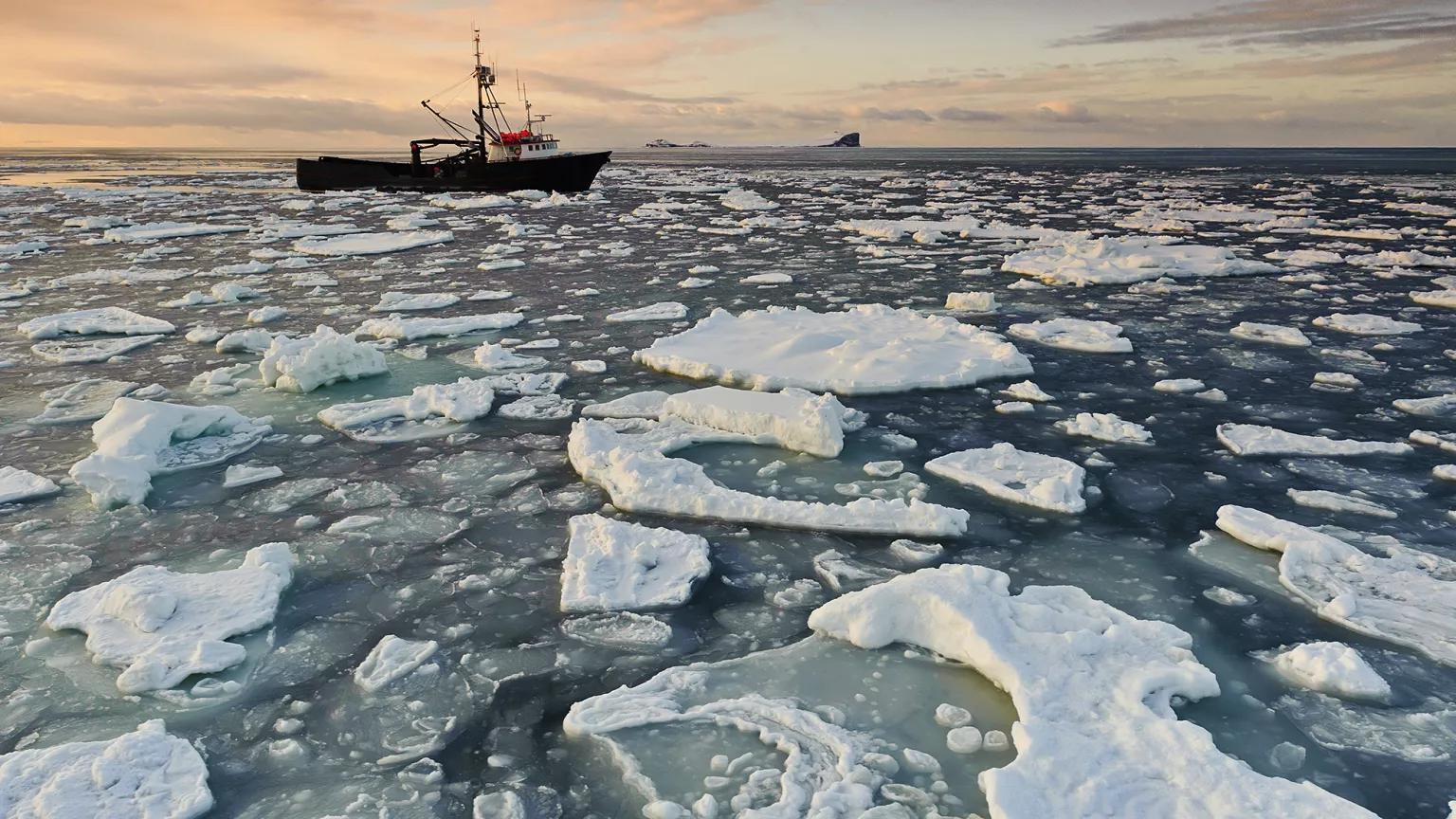
A fishing boat moving through sea ice on the eastern Bering Sea in Alaska
Chris Miller/CSM Photos

UPDATE: On April 28, 2025, NRDC joined a large coalition of labor unions, nonprofit groups, and local governments to challenge the Trump administration’s unlawful reorganization of the federal government conducted without congressional authority. Michael Wall, NRDC's chief litigation officer, says, “Americans did not vote for a federal government so hollowed out that it cannot deliver the services we all rely on.”
Everyone should be concerned about the fate of the National Oceanic and Atmospheric Administration (NOAA) right now. Current employees are certainly alarmed—not only for their jobs but also for the crucial work they do in the name of science and public safety.
Representatives of the newly created Department of Government Efficiency (DOGE), overseen by Elon Musk, startled NOAA staff last month when they entered the agency’s Maryland headquarters unannounced to gain access to its IT systems. The event was part of the Trump administration’s reckless hollowing out of the federal government under the guise of cutting costs. Within mere weeks, DOGE representatives have fired tens of thousands of government workers across more than a dozen agencies, including the wholly dismantled U.S. Agency for International Development, and frozen federal grants and loans.
Now, NOAA employees are bracing for steep budget cuts and mass layoffs too—about 10 percent of staff have already lost their jobs, and no one knows how far DOGE plans to go. Such dramatic shifts in capacity will have immediate and rippling effects on the country’s ability to understand, manage, and respond to environmental crises, from warming oceans to approaching hurricanes.
Some NOAA staff have been there for decades. “They've gained expertise that's critical for maintaining healthy fisheries and protecting some of America’s most beloved species, like whales and sea turtles. They've been entrusted with safeguarding our public waters and our publicly held food supply,” says Brad Sewell, the managing director of NRDC’s Oceans Program. “That expertise is being gutted, and we’ll simply never get it back. It's a permanent loss of our government’s intellectual capital.”

A meteorologist with the National Weather Service monitors weather conditions in Rancho Cordova, California
Rich Pedroncelli/AP Photo
NOAA’s scientific roots surveying the country’s coastlines, fisheries, and weather go back hundreds of years, before these functions came under one umbrella agency in 1970. NOAA runs the heavily relied-upon National Weather Service, conducts critical climate research, and manages the nation’s fisheries, which extend 230 miles off our coasts. Despite its wide-reaching responsibilities, NOAA’s budget is already down to the bone. “There’s not any fat to be shaved off here,” Sewell says. In fiscal year 2025, NOAA’s discretionary spending budget was $6.8 billion—far less than what’s needed to sufficiently respond to worsening storms, manage our marine fisheries, and protect ocean wildlife.
The Trump administration could restructure or fold NOAA into another agency, which could potentially allow it to still carry out its central duties—but the purging of NOAA’s expertise and resources suggests that is not the intention.
“That expertise is being gutted, and we’ll simply never get it back. It's a permanent loss of our government’s intellectual capital.”
Brad Sewell, managing director, Oceans Program, NRDC
So why is NOAA in Trump’s crosshairs? Many point the finger at Project 2025, the radical policy blueprint laid out by the Heritage Foundation, a right-wing think tank. Project 2025 labels NOAA as a main driver of the so-called “climate change alarm industry” and calls for the agency’s dissolution and privatization.
“One must assume the objective is to fragment and dispose of most of the pieces of NOAA that exist today,” says Matthew McKinzie, the senior director for data and policy analysis at NRDC’s Science Office. Below are just some of the agency’s services that millions of us rely on, which are now at stake.
NOAA provides accurate weather forecasts to the public
Every time you check the weather, you put your trust in data from the National Weather Service (NWS). This information underpins the forecasts within weather apps, news reports, hurricane path models, and extreme weather alerts—and it doesn’t just help us get ready for the day. Everyone from air traffic control centers to local authorities deciding whether to cancel schools, salt roads, or issue evacuation orders ahead of a storm relies on NWS reports.
To collect this data, NWS maintains a vast network of monitoring equipment at sites across the country, in the ocean, and up in the sky: fleets of satellites, ocean buoys, ground sensors, weather balloons, weather stations, and more.
“The physical infrastructure required to do the kinds of things we’re talking about requires human beings with expertise. Nothing is magic,” says Dr. Ticora Jones, NRDC’s chief science officer. Should DOGE gut the agency’s staff, NOAA could lose its ability to sufficiently maintain and interpret the data it collects. “You run the risk of essentially having forecasts that are useless and endangering life and limb,” she adds.


Clockwise from top left: A NOAA hurricane hunter plane flying through the eye of a hurricane; flood damage from Hurricane Helene along the Swannanoa River in Asheville, North Carolina; enhanced-color imagery of Hurricane Helene’s path from NOAA's GOES East satellite
Mario Tama/Getty Images
; 3) NOAA Satellite and Information ServiceThese stakes were evident last September when NOAA weather models predicted correctly that Hurricane Helene would veer toward western Appalachia, an area typically spared from serious hurricane damage. “If none of those capabilities were available, nobody in Appalachia would have moved anywhere. Nobody would have been prepared,” Jones says. The storm caused nearly $60 billion in damages and the deaths of more than 100 people in North Carolina alone. Such losses would be even more staggering if communities hadn’t received accurate or timely advance warnings.
Learn More


Countless livelihoods also rely on accurate NWS forecasting. Think of farmers trying to protect their crops and maximize their harvest by preparing for droughts, floods, or extreme temperatures. Think of pilots trying to steer their planes safely out of storms or utility workers anticipating fluctuations in electricity demand in order to keep the power on.
Echoing Project 2025, the Trump administration has suggested privatizing the services that NWS provides instead. Considering the size and scope of NWS infrastructure, companies would have a difficult time adequately replacing it in a timely fashion. Beyond that, Jones thinks the idea of privatizing an essential public service is “inherently problematic.”
“The government is not in the business of making money. It’s in the business of spending money on goods and services for the good of the people,” explains Jones. “Who says that the private sector and private equity would actually have the appropriate motivations to maintain the systems?”
NOAA manages populations of sea life and marine sanctuaries
With steep cuts to NOAA’s budget, the nation’s coastal ecosystems and fishing communities stand to suffer too. Housed within NOAA, the National Marine Fisheries Service (NMFS) manages populations of food species—from Pacific salmon to shrimp to sea scallops—with a goal of keeping them plentiful and profitable. The agency’s duties to prevent overfishing include conducting world-class science to monitor population fluctuations and then setting and enforcing annual catch limits.
The ecological stakes are high as are the economic ones. In 2022, the country’s commercial and recreational fishing industries together generated $321 billion in sales and supported nearly 2.3 million jobs. “Recreational fishing alone is a huge economic driver along our coasts, particularly in the mid-Atlantic, Southeast, and Gulf of Mexico,” Sewell says.

North Atlantic right whale Snow Cone, her jaw entangled in fishing lines, with her calf off the coast of Florida in 2021. Snow Cone was last sighted in poor condition in 2022 and neither she nor her calf have been seen since.
NMFS also works with the fishing industry to reduce bycatch, which is all the marine life that fishers catch unintentionally. While caught accidentally, these animals are often injured or die along with the target species. Even with NMFS intact, the agency lacks the funds to adequately measure bycatch—a problem estimated in billions of pounds of discarded sea life annually. Bycatch is not only wasteful but also a huge threat to biodiversity, and iconic animals such as whales, dolphins, and sea turtles routinely find themselves snarled in fishing nets or lines. With fewer resources to address bycatch, the outlook for some species already approaching extinction is especially grim. Sewell asks, “If a highly imperiled right whale gets caught up in fishing gear, who's going to remove it so that the animal has some chance of living and carrying on the legacy of that species?”
Finally, NOAA manages marine national monuments and national marine sanctuaries, such as the Northeast Canyons and Seamounts Marine National Monument. This protected seascape, which is approximately the size of Connecticut, lies off the southern New England coast and is home to iconic sperm whales, rare seabirds, and vulnerable deep-sea corals.
NOAA is one of the world’s leading climate research agencies
As of now, NOAA’s climate website, which contains vast repositories of publicly available and publicly paid-for climate data, is still up and running—but it’s unclear for how long. According to media reports, the Trump administration terminated the positions of the website’s entire content production staff this spring.
That’s why McKinzie has been busy downloading and archiving all the NOAA data relevant to NRDC’s work. Other organizations, universities, and individuals are taking similar steps.
And there’s certainly a lot of data to save: NOAA’s scientists are some of the world’s leaders in climate research. The agency collects decades’ worth of data on all manner of environmental phenomena: from sea level rise and average ocean temperatures to coral bleaching and the chemical composition of the oceans to wildfires and urban heat islands. “It’s really hard to think of some aspect of the climate change problem that NOAA's sensors and scientists are not involved in,” McKinzie says.
Federal agencies, regulatory bodies, journalists, advocates, teachers, students, and scientists the world over rely on this data. “Climate science is so complex,” McKinzie says. “If that core repository of data isn't available and updated, so that we can keep trying to understand what is going on with the changing climate—it's just a terrific loss.” (For the same reason, NRDC and its partners are currently suing the U.S. Department of Agriculture due to its illegal purging of climate change information that’s vital to farmers from its website.)
Without this scientific evidence detailing the climate crisis, legally challenging the Trump administration on its failure to take action on climate change could also become harder. And if NOAA’s robust climate research and recordkeeping disappear, McKinzie also worries about the ability of scientists to solve problems well into the future, as the consequences of a warming world continue to escalate.
“This vast archive contains within it the potential to understand things that we don't know right now about climate change,” he says, “and perhaps about problems that we can't yet imagine.”
This NRDC.org story is available for online republication by news media outlets or nonprofits under these conditions: The writer(s) must be credited with a byline; you must note prominently that the story was originally published by NRDC.org and link to the original; the story cannot be edited (beyond simple things such as grammar); you can’t resell the story in any form or grant republishing rights to other outlets; you can’t republish our material wholesale or automatically—you need to select stories individually; you can’t republish the photos or graphics on our site without specific permission; you should drop us a note to let us know when you’ve used one of our stories.
Biodiversity 101
What Are the Causes of Climate Change?
We Are Here to Make a Difference: Our Litigators Are at the Ready