
P&G’s New CEO Faces a Choice
Will the company take action to protect forests or continue wiping them away for disposable products?

A clearcut area encroaches on intact boreal forest near Dryden in northwestern Ontario, Canada

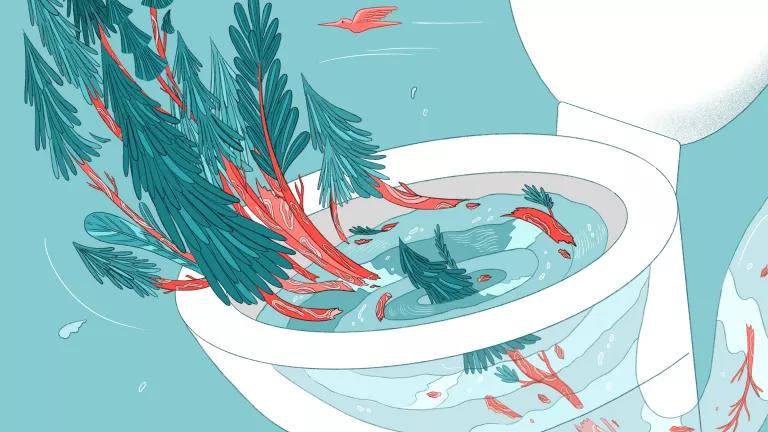
The new year has brought Procter & Gamble (P&G) into a leadership transition as Shailesh Jejurikar took over as the company’s president and CEO on January 1, 2026. This transition comes at a moment when P&G’s sustainability claims increasingly collide with the reality of its tissue supply chains, which presents a clear test: Will Jejurikar continue a business model that degrades some of the world’s most important forests, or will he address and change the tree-to-toilet pipeline behind P&G’s flagship tissue products?
Under this new leadership, P&G has an opportunity to seize this moment by adopting transparent, robust forest policies aligned with climate and biodiversity science. This must include commitments to avoiding forest degradation and ending sourcing from primary forests, alongside scaling investments in recycled and sustainable alternative fibers to support a more circular economy and long-term supply resilience. Acting decisively on these issues now will prove whether P&G is truly capable of being “a force for good,” in line with the company’s stated vision.
What's at stake
The world faces overlapping climate and biodiversity crises, with forests like the Canadian boreal at the center of both. P&G sources roughly 1.5 million metric tons of wood pulp each year, about one-third of which comes from Canada, where commercial logging is degrading the planet’s largest remaining intact primary forest. Scientists have long called for action to protect these critical ecosystems, noting that industrial logging of primary forests undermines global climate and biodiversity goals in ways that must no longer go ignored. These forests also sustain hundreds of Indigenous communities, who not only rely on the land but also actively steward it using traditional knowledge and practices that help stabilize the climate, preserve biodiversity, and support local livelihoods.
Against this backdrop, pressure on P&G has steadily intensified. For more than seven years, Indigenous leaders, scientists, environmental organizations, consumers, and shareholders have urged the company to address the impacts of its tissue sourcing on climate-critical ecosystems and the communities that depend on them. Yet P&G continues to rely heavily on forest fiber in flagship brands like Charmin and Bounty, earning consecutive F grades across all seven editions of NRDC’s The Issue with Tissue scorecard, which evaluates tissue brands’ impacts on forests and the climate. By driving demand for wood pulp, P&G embeds these harms throughout its supply chain, making a fundamental shift to more sustainable sourcing both urgent and necessary.
This destructive business model is becoming increasingly difficult to justify as expectations rise. A 2024 survey found that roughly 80 percent of consumers are concerned about the sustainability of the products they buy, up from 68 percent in 2023. For a company whose tissue brands are household staples, ignoring those expectations puts both brand trust and long-term value at risk. Meeting these expectations, however, requires more than incremental changes—it demands a fundamental rethinking of P&G’s forest sourcing practices.
The case for change
Global wood consumption has already exceeded what forests can sustainably provide, leaving forest-dependent companies with little choice but to transform their supply chains. For P&G, sourcing large volumes of wood pulp for single-use tissue products not only contributes to this imbalance but also constrains the company’s ability to meet its own sustainability goals.
Based on calculations using the EPN Paper Calculator, replacing forest fiber in products like Charmin, Bounty, and Puffs with 100 percent recycled content could reduce their carbon footprint by about 47 to 60 percent, far exceeding P&G’s current 40 percent reduction target for 2030, which excludes its tissue lines entirely. The benefits also extend beyond climate impacts. Using recycled content in place of forest fiber could cut associated water use by more than 20,000 gallons per metric ton of pulp. Realizing these gains will take time and investment, but failing to pursue them represents a missed opportunity that P&G—and the planet—cannot afford.
Importantly, this transition is already underway elsewhere in the tissue sector. In 2024, Kimberly-Clark committed to avoiding deforestation and forest degradation and set an ambition to eliminate natural forest fiber from its product line. That same year, Georgia-Pacific relaunched its Aria toilet paper brand, shifting from 100 percent forest fiber to 100 percent recycled content in response to growing consumer demand for more sustainable products.
P&G, by contrast, continues to lag behind even its closest peers. The company’s latest Forest Commodities Policy failed to address the role of tissue supply chains in driving forest degradation. Incremental steps like the Charmin Ultra Bamboo line, which earned P&G its first B grade in NRDC’s seventh, and latest, edition of its Issue with Tissue scorecard, show that better products are possible but fall far short of offsetting the company’s footprint in irreplaceable forests like the Canadian boreal. These gaps in progress further underscore the stakes for new leadership, and how the choices Jejurikar makes now will determine whether P&G can truly align its practices with the sustainability commitments it publicly espouses.
A defining moment
Jejurikar’s appointment is an inflection point. As P&G’s former executive sponsor for global sustainability, he should understand the stakes. Continuing to flush irreplaceable forests for disposable products is a choice. Under new leadership, P&G can choose differently by working in partnership with NGO communities to implement meaningful measures that reduce its carbon footprint and halt biodiversity loss.
P&G, maker of Charmin, is one of the worst exploiters of old-growth forests like the Canadian boreal.
Tell P&G’s new CEO to commit to truly sustainable tissue products!

Tell P&G to stop flushing our forests for profit!
Clearcutting for products like P&G’s Charmin toilet paper is destroying more than one million acres of the boreal forest each year. And P&G is one of the worst exploiters of these forests. Tell P&G's new CEO it's time to commit to sustainable tissue products!
RELATED CONTENT
The Best and Worst Toilet Paper, Paper Towel, and Facial Tissue Brands

What Will It Take for Ambition to Become Action? Delivering on Canada’s Nature Strategy
