Cut the Wait, Cut the Cost: Faster Grid Connections for EV Charging
New analysis shows mitigating delays in EV charging projects could save nearly $90 billion.

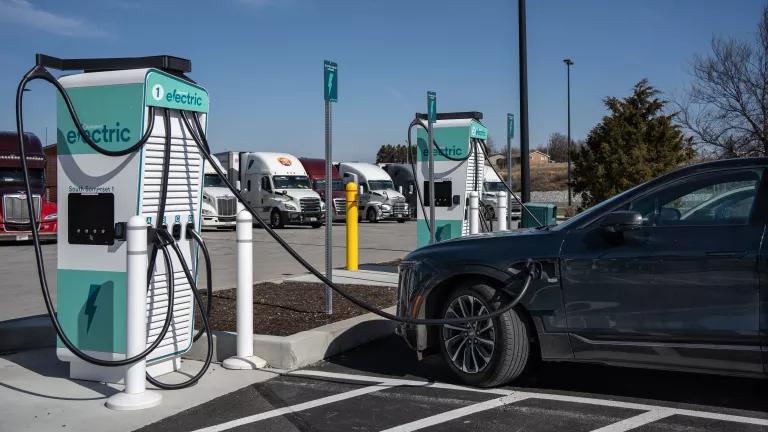
An EV charging station at the Peña Station parking facility in Boulder, Colorado

Building electric vehicle (EV) charging infrastructure in America takes too long. Not because the technology isn’t ready. Not because the demand isn’t there. But because getting a new charging station permitted and connected to the electrical grid—a process called energization—is slow, unpredictable, and challenging in ways that are significantly increasing the cost of new chargers.
A new analysis from Atlas Public Policy puts hard numbers on exactly how much: hundreds of thousands to millions of dollars per project, adding up to nearly $90 billion in potential cost savings. The findings are striking, and they make a compelling case for why state regulators and policymakers should treat energization timeline reform as one of the highest-impact tools in their transportation electrification tool kit.
A recent evaluation of the time it takes to energize a charging station in the utility service territories with the most EVs of any in the nation found that the median time from application to utility activation exceeded 950 days. Nearly three years—just to get the permit and flip the switch. And that clock doesn’t even start at the beginning; the full developer timeline experience, from site identification through energization, is longer still. That’s not an outlier. It’s a pattern, and it’s bad for consumers and public health. Further, it can discourage and delay private investments that are good for the economy and job creation.
What energization delays actually cost
Energization is the process of getting a new project—like an EV charging station—connected to the grid and operational. For the purposes of the Atlas analysis, it covers everything from site identification through engineering, permitting, construction, and utility coordination, capturing the full end-to-end experience that project developers face. It ends when the first kilowatt-hour flows.
That process is too often slow, opaque, and unpredictable. Every month that a charging station sits idle waiting for a permit or grid connection is a month of lost revenue. That’s revenue that would otherwise be funding the next charging station, repaying investors, and demonstrating that this business works. And those extra costs are passed onto consumers in the form of higher prices.
The Atlas analysis quantifies exactly what that wait is worth. For a typical public fast-charging site serving light-duty vehicles, cutting energization timelines by six months generates between $104,000 and $165,500 in net present value gains, depending on station size. For heavy-duty vehicle charging depots, where capital costs and utilization rates are higher, the numbers are far larger: An 18-month reduction in timelines yields between $1.8 million and $3.4 million in net present value gains per station.
Faster energization delivers public health benefits across the transportation sector. Heavy-duty depot charging is particularly impactful because in today’s market, each new charger directly enables a diesel truck to be replaced by an electric truck, which adds value that goes well beyond any individual project’s bottom line.
Scaled up nationally, those per-station gains add up fast. Atlas estimates that reducing energization timelines for all the charging capacity needed to support EV adoption through 2035 could unlock approximately $87 billion in cumulative net present value, with the bulk driven by heavy-duty vehicle charging. That’s more than 10 times the federal investment in EV charging under the Bipartisan Infrastructure Law. That’s not a footnote. That’s the headline.
And that could be a conservative estimate because, as more passenger vehicle charging locations are deployed with more charging ports to meet growing consumer demand, those locations will look more like existing truck charging stations. Three high-powered car charging stations is roughly equal to one big rig charging station. There are already several passenger car charging locations with 50–100 fast-charging ports, and more are being built now. So $87 billion could be a big understatement.
A solvable problem
Grid connection delays aren’t inevitable. They are the product of fragmented utility processes, limited grid transparency, the absence of clear accountability for utilities to meet reasonable timelines, and slow local permitting processes. These are policy problems with policy solutions.
States are already proving it. California led the nation by establishing the first utility energization timeline targets—a 49 percent improvement over the status quo for most public and workplace charging stations—along with maximum timelines for larger grid upgrades, utility accountability reporting, and a framework for future improvement. Colorado and Illinois have now followed, with both states enacting legislation that requires clear energization deadlines and proactive grid investments, and Colorado regulators have already begun approving the grid investments needed to make it real. In the Atlas analysis, permitting delays were consistently cited as the most significant bottleneck in the service activation timeline. In response, several states have passed legislation to streamline permitting and create consistent rules around timelines and fees to provide a more predictable process for station developers. Together, these reforms mean more charging projects getting built, more electricians and construction workers being employed, and more private investment flowing into local economies.
The Atlas analysis explains why this wave of state actions matters so much: Faster energization doesn’t just reduce frustration but fundamentally improves the economics of building and operating charging infrastructure. That means more projects get built, more investment flows, and more drivers have access to charging—a win for consumers, workers, and the broader clean energy economy.
What needs to happen next
Atlas identifies a practical set of commonsense actions that states can take now: clear energization deadlines with utility accountability; streamlined permitting; load-hosting capacity maps that give developers visibility into where the grid has room to grow; and bridge-to-wires solutions, like flexible interconnection, that allow sites to begin limited operations with available power while awaiting full infrastructure upgrades.
At a moment when federal support for EV infrastructure faces real uncertainty and the United States is falling behind in adopting superior technologies, the good news is that states don’t have to wait for Washington, D.C. These are reforms that utilities and policymakers in California, Colorado, Illinois, and other states are already beginning to implement. The question is how many more states will step up to provide a better, more affordable experience for their drivers and businesses.
To realize the full promise of transportation electrification—cleaner air, fuel savings, jobs, and increased energy security—we need to connect chargers to the grid at speed and scale. Energization timeline reform is one of the most powerful levers states have to make that happen. It’s time to use it.
Related Blogs
Congress Is Cutting Off Transportation Investments that Help Families Save Money

Getting Off the Gas Price Rollercoaster