When Red Tape Pulls the Plug on EV Charging
An overlooked regulatory barrier is making it harder and more expensive to build the EV charging network we need. New research shows how states can remove unnecessary barriers to infrastructure investment while maintaining strong consumer protections.
Robert Gumpert/Redux
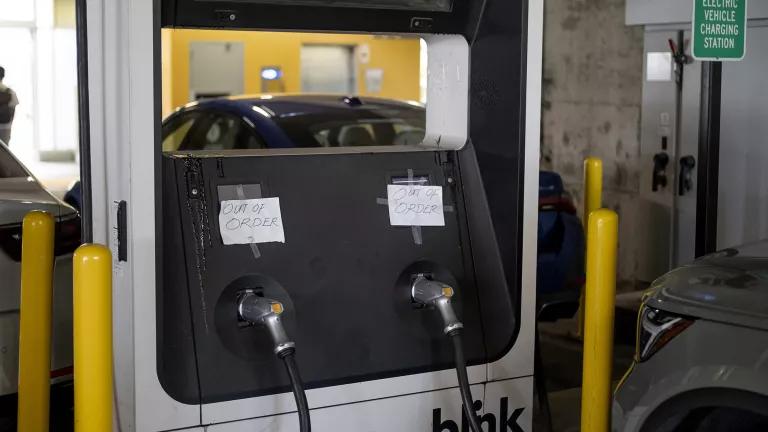
Imagine pulling up to an electric vehicle (EV) charger that can accurately dispense, measure, and charge you for the electricity needed to continue your road trip, only to find it’s been taken out of service because of a labeling issue.
Across the country, regulatory requirements that are intended to protect consumers are sometimes creating unnecessary costs, delays, and service disruptions for EV charging infrastructure.
Consumer research reveals that a lack of access to reliable EV charging is the biggest barrier to widespread EV adoption, and that the time it takes to charge is the second-biggest reason that consumers reject EVs. We cannot afford unnecessary delays and added costs that discourage investment, limit charging availability, and slow the transition to cleaner transportation. And when functioning chargers are taken offline, it's ultimately drivers who lose access to the infrastructure they depend on.
New research from Atlas Public Policy examines how an often-overlooked area of regulation—known as weights and measures—is affecting EV charging deployment across the United States. The findings point to a significant opportunity for states to modernize regulatory practices, eliminate unnecessary barriers, and protect consumers without compromising accuracy and transparency.
As the nation's largest EV market, California has taken an important step toward addressing these challenges, offering a potential model for states across the country.
When good intentions create unintended roadblocks
Most people are familiar with weights and measures requirements, even if they don't recognize the name. They're the rules that ensure a gallon of gasoline is actually a gallon, a pound of produce weighs a pound, and customers receive the amount of a product they're paying for.
These are essential consumer protections, and EV charging should be no exception. However, while the underlying principles are straightforward, implementing them for EV chargers presents new challenges.
Traditional weights and measures frameworks were developed around equipment such as gasoline pumps and mechanical scales. EV chargers, by contrast, are sophisticated electronic devices that integrate software, metering, and communications technologies. They're also being deployed across a wide range of settings, from highway charging stations and public parking lots to apartment buildings and workplaces.
National technical standards provide a common foundation, but states have considerable flexibility in determining how they implement and enforce those requirements. That includes decisions about equipment certification, inspections, testing frequency, fees, and the circumstances under which chargers must be taken out of service.
Those decisions have real consequences.
Atlas's research—informed by input from 19 organizations representing regulators, charging providers, equipment owners, service agencies, and consumer advocates—identifies several recurring challenges: costly and sometimes duplicative inspection requirements, limited testing capacity, inconsistent enforcement across jurisdictions, and insufficient coordination among government agencies.
Importantly, the research found that the primary challenge isn't whether EV chargers can meet rigorous accuracy standards; it's whether the regulatory processes used to verify compliance are appropriately designed for the technology and scale of deployment.
When a correctable compliance issue can result in an otherwise functional charger being taken offline, the costs extend beyond the operator. Drivers lose access to charging, businesses lose revenue, and the reliability of the broader charging network suffers.
The hidden costs of outdated requirements
Installing and operating public EV charging infrastructure requires substantial up-front investment, and many locations, particularly those with lower utilization, generate relatively modest revenue. Duplicative testing requirements, inspection delays, and the possibility of unexpected shutdowns can add costs that make otherwise worthwhile projects less financially viable.
Atlas highlights one California installation where weights and measures compliance costs added more than six cents per kilowatt-hour to the cost of charging. While this is an individual example rather than an industry-wide average, it illustrates how fixed compliance costs can disproportionately affect lower-utilization sites. These costs may also be passed along to drivers through higher charging prices, adding to existing affordability pressures.
This is especially concerning for charging at multifamily housing, workplaces, and other locations that can expand access for drivers without convenient home charging. These installations may initially serve relatively few vehicles, but they are important for making EV ownership a practical option for more households, particularly in communities already facing barriers to adoption.
The consequences extend beyond individual projects. When unnecessary regulatory costs and delays discourage investment or limit charging availability, they can slow the transition away from gasoline and diesel vehicles—and the associated reductions in greenhouse gas emissions and harmful air pollution. The potential benefits of that transition are substantial. An American Lung Association analysis estimated that a nationwide shift to zero-emission transportation, coupled with cleaner electricity generation, could deliver more than $1.2 trillion in public health benefits and prevent up to 110,000 premature deaths through 2050.
Smarter regulation, stronger consumer protection
Fortunately, states don't need to choose between protecting consumers and expanding EV charging infrastructure. With thoughtful policy design, they can do both. Atlas's research identifies several practical reforms that can make weights and measures programs more effective while reducing unnecessary costs and delays.
- First, modernize testing and inspection requirements. Rather than requiring duplicative field testing when chargers are first installed, states can recognize appropriate factory testing and certification. They can also adopt longer testing intervals or risk-based statistical sampling, directing limited inspection resources toward equipment and circumstances where problems are most likely to arise.
- Second, make enforcement proportional to the violation. Chargers that fail applicable accuracy standards should be subject to meaningful enforcement, including removal from service when warranted. But correctable administrative or labeling deficiencies shouldn't automatically trigger the same response. Clear notices, reasonable opportunities to correct violations, and enforcement tailored to consumer risk can preserve accountability without unnecessarily disrupting charging access.
- Third, evaluate compliance costs and improve coordination across agencies. States should assess whether inspection fees and other requirements disproportionately burden lower-utilization charging sites. They should also ensure that weights and measures officials work closely with state energy offices, transportation departments, and other agencies responsible for supporting EV infrastructure deployment.
This coordination is particularly important when one state agency is investing public funds in charging infrastructure while another is responsible for determining whether that equipment can legally operate. Aligning requirements and communicating them early can help avoid situations where projects face unexpected compliance problems after equipment has already been purchased or installed.
States should also establish clear compliance timelines, provide appropriate transitions for existing equipment, and consider whether lower-risk charging applications warrant different approaches.
None of these reforms require abandoning rigorous standards or meaningful oversight. Instead, they offer ways to make regulatory programs more effective, predictable, and responsive to the risks they are intended to address.
California offers a path forward
Governor Gavin Newsom recently signed Senate Bill 969, authored by Senator Eloise Gómez Reyes, which:
- Eliminates duplicative initial field testing for qualifying chargers that have already undergone approved factory testing and certification, allowing compliant equipment to be placed in service without additional field accuracy testing.
- Authorizes risk-based statistical sampling as an alternative to existing recurring inspection requirements, giving counties greater flexibility while preserving their ability to inspect chargers in response to consumer complaints.
- Establishes a more proportionate enforcement process, requiring chargers to be taken out of service for accuracy or type-approval failures while generally providing notice and an opportunity to correct other deficiencies before equipment is shut down.
- Improves coordination and information sharing between California's weights and measures authorities and the California Energy Commission, helping to inform future regulatory decisions.
These changes reflect a simple but important principle: Maintaining rigorous consumer protections does not require treating every piece of equipment or every type of violation in exactly the same way.
The legislation represents a significant step forward, but successful implementation will be essential. California's Department of Food and Agriculture, in consultation with the California Energy Commission, must update the relevant regulations by July 1, 2028. Continued coordination among state agencies, county officials, consumer advocates, and charging stakeholders will be critical to translating the reforms into meaningful improvements on the ground.
For other states that are developing or implementing EV charging weights and measures requirements, California offers a valuable example of how to address regulatory barriers before they become more entrenched.
The stakes go beyond regulatory compliance
Weights and measures requirements may seem like a technical regulatory issue, but their consequences extend well beyond the charging industry. Unnecessary costs, delays, and shutdowns can limit access to reliable, affordable charging—and slow progress toward reducing transportation-related climate pollution, improving air quality, and reducing dependence on fossil fuels.
Atlas's research and California's recent reforms offer a practical path forward. By modernizing testing practices, calibrating enforcement to consumer risks, and improving coordination among agencies and stakeholders, states can avoid unnecessary deployment barriers while maintaining strong consumer protections. Early collaboration can help identify and resolve potential conflicts before they delay projects rather than adding another layer of regulatory review.
Protecting consumers and accelerating clean transportation aren't competing priorities. With smarter rules, we can do both.
This NRDC.org blog is available for online republication by news media outlets or nonprofits under these conditions: The writer(s) must be credited with a byline; you must note prominently that the blog was originally published by NRDC.org and link to the original; the blog cannot be edited (beyond simple things such as grammar); you can’t resell the blog in any form or grant republishing rights to other outlets; you can’t republish our material wholesale or automatically—you need to select blogs individually; you can’t republish the photos or graphics on our site without specific permission; you should drop us a note to let us know when you’ve used one of our blogs.
Related Blogs

The EPA Continues Pushing a Gas Guzzler Mandate

Powering Up Californians Act Is Signed into Law