
Unlocking Storage Is the Solution to Data Center Strain
Battery storage may be the only way that PJM, states, and industry leaders keep up with data center demand and alleviate skyrocketing prices.

Battery units outside the Energy Systems Integration Facility at the National Laboratory of the Rockies in Golden, Colorado

In 2027, for the first time in its 99-year history, PJM—the country’s largest power grid—will not have the safety margins it needs to guarantee reliable power during the worst weather conditions.
There’s a lot to how we got here, but the immediate problem is simple: We’re building data centers faster than power plants. Data centers in PJM are projected to add more than 40 gigawatts (GW) of demand by 2030, but PJM is adding less than 1 GW of new supply each year. This means higher bills and worse reliability. The 67 million Americans in PJM are already paying more than $14 billion a year for power plants, and we’re on track to spend $100 billion between now and 2033.
This looming crisis prompted an unprecedented statement of principles signed by all 13 PJM governors and the White House, and, later that same day, PJM’s own suite of reforms. While the details differ, everyone agrees that the region desperately needs new supply. But, in their urge to take decisive action, decision-makers are falling for the same quick fixes that we already know won’t work.
Fast tracks to nowhere
The knee-jerk solution to these supply problems is to fast-track large power plants, usually fossil fuel ones. For years, power plants in PJM have been stalled by their infamous interconnection queue. So, the thinking goes, just let a few big power plants cut to the head of the line, and it’ll all be good, right?
Simple, appealing—and wrong.
It turns out queue delays are only the beginning. Projects are finally getting out of PJM’s queue only to discover yet more delays and surprise costs. More than half of the capacity that made it through PJM’s most recent queue cycle has to wait four or more years for transmission system work, called “network upgrades,” before connecting to the grid. The queue cycle currently ongoing received its first cost estimates, and many projects found out that just connecting to the grid would cost a large fraction of building the power plant itself. Unsurprisingly, large numbers of those dropped out.
Fast tracks don’t help. Even the 51 “shovel-ready” projects handpicked by PJM for a special fast track are dropping out at a similar rate as all other projects. The harsh reality is that we’ve neglected the transmission system for decades, and any new power plant could be stuck behind slow-to-build upgrades and uncontrollable costs. Pushing fast tracks again will accomplish little more than wasting years banging into the same walls.
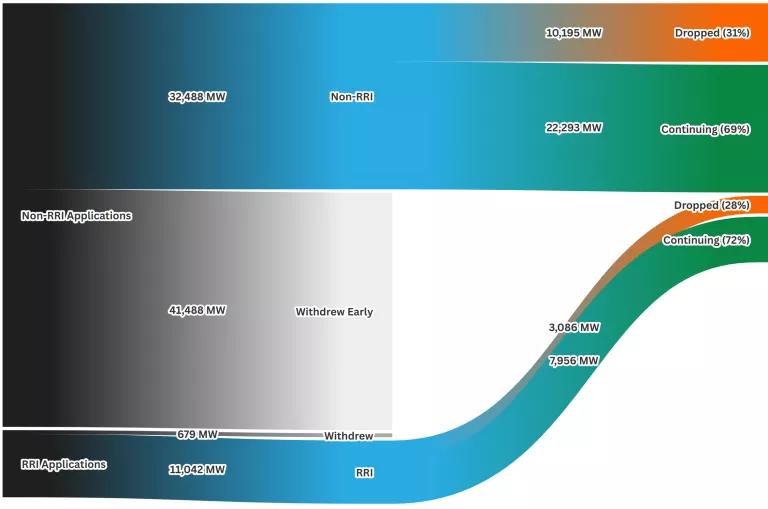
This chart shows the flow of the projects in PJM’s current queue cycle, Transition Cycle 2. The cycle included 11.7 GW of projects from PJM’s fast track, the Reliability Resource Initiative (RRI). Although PJM selected RRI projects based on their “high likelihood of completion,” two projects withdrew before being studied and eight projects dropped out at the first “decision point,” representing 28 percent of the capacity—almost exactly the same rate as projects in the rest of the queue cycle (31 percent).
All of these delays happen before projects can even begin permitting, procurement, and construction in earnest. Putting this together, it’s obvious that any plan centered on trying to build more traditional power plants is dooming PJM to high prices and unacceptable reliability well into the 2030s.
The massive, untapped potential of batteries
It’s clear that we need fast, reliable power supply that can avoid the delays that plague the queue. There may be no silver bullet here, but battery storage comes close.
Storage can be built at scale quickly. PJM estimates that it needs about 12,000 megawatts of new capacity every year, but in 2025, the nation built nearly that much storage every six months. China is considered our rival in the data center race, and it added more storage in December than PJM says it needs in a year. Building storage to meet data center needs in PJM would just mean catching up to the rest of the country—and the world.
Storage can keep the lights on. PJM proved that four-hour battery storage supports reliability as much as a combustion turbine gas plant using rigorous techniques that it spent years developing. That’s because the reliability of the grid depends on its worst hours; a battery that you can count on in the dead of winter is worth as much as a power plant that’s around the rest of the year but fails when needed most (which gas plants have done time after time after time).
Storage can move faster than other resources. Because storage can be built nearly anywhere, it can locate closer to where it’s needed, avoiding the grid constraints that are plaguing other power plants. Storage can participate as distributed energy resources (DERs), which connect to local power grids and avoid the queue. Storage can also use “surplus interconnection” arrangements—plugging in at existing power plants that have spare headroom to share—and avoid network upgrades.
These are both promising short-term solutions that exist today (we’re longtime fans of DERs) but it’s not yet clear whether either of these approaches can meet the scale and speed of the moment. To fully realize the potential of storage, we need deeper reforms from states, PJM, and the data center and power generation industries—an all-hands-on-deck situation if there ever was one.
Rowing in the same direction
States need to lead the way on this, using carrots and sticks to get data centers to go all in on storage. To do this, states can:
- Be firm that new data centers must bring new energy and capacity or may face long waits to connect, and that adding storage is one way to get faster approvals.
- Direct their utilities to erase barriers to rapidly connecting storage to the parts of the grid they control, including by pursuing DERs and virtual power plants—aggregated bits of electricity from homes and businesses that can add up to a traditional power plant’s worth of energy.
- Build on various existing state-level storage procurement programs and explore mechanisms to “count” energy from storage toward meeting clean energy targets; at least for a few years until wind and solar construction can catch up (which it will).
- Always consider storage as an alternative to costly and controversial grid upgrades.
- Adopt state tax credits for battery storage and include storage in any expedited permitting programs for renewables.
- Ensure communities and local regulators have the resources they need to safely host storage facilities.
PJM has already made a great start by ensuring data centers either bring their own new supply or are first in line to get turned off when there’s not enough power. Now it needs to allow data centers to get new supply, fast, by pursuing creative solutions that get around transmission bottlenecks. This will mean rethinking long-held assumptions about how to run the system. To start, PJM must recognize that “deliverability” requirements—the idea that new power plants should be able to support reliability anywhere on the system while accounting for local transmission contraints—should be softened to allow batteries to quickly meet specific needs. Speeding up storage that pairs directly with data centers can reduce costs and eliminate delays but will require the grid operator to take a fresh look at how it plans transmission and resource adequacy.
Tech companies need to be willing to pay for this. We won’t sugarcoat it: Storage is still more expensive than traditional power plants—but not by as much as you might expect, and data centers are changing the equation. The combined costs of a data center and enough storage to support it is about 15 percent more than using a traditional power plant, but the storage can be built years faster. When tech companies made their pledges to be carbon-neutral, they knew that wouldn’t be free. This is the time to put their money where their CSR is: Investing in storage in PJM might be the single-best thing tech companies can do to reduce carbon emissions right now.
Storage may be the only way that PJM, states, and industry leaders keep up with data center demand and reduce skyrocketing prices. We can’t afford to wait. Battery storage will be the difference between a grid that keeps up—and one that breaks down.
Related Blogs
Uncovering the Secret Documents Behind the Trump Administration's Clean Manufacturing Cancellations

We Can't Afford to Slow Down on Climate Action
