
The Disaster Resilience Investment Challenges We Don’t Talk About Enough
As public investments in disaster risk reduction increase, local leaders can work to reduce displacement and maintain affordability by asking necessary questions, starting with “Who benefits from the investments?”
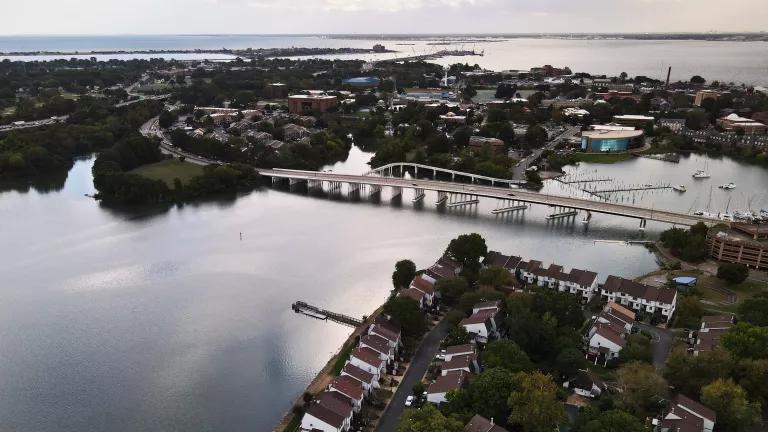
Downtown Hampton, Virginia, along the Hampton River, after heavy flooding and high winds from inclement weather, October 29, 2021
Aileen Devlin/Virginia Sea Grant

Coauthored by Shannon DeFranza (NRDC summer 2026 advocacy intern; MPP, Georgetown University) and Julie Jones (NRDC summer 2026 legal intern; JD candidate, Northwestern Pritzker School of Law)
Experts in the fields of emergency management, disaster resilience, hazard mitigation, and climate adaptation spend a lot of time working to reduce the risks from flooding, extreme heat, and other extreme weather threats. That’s great—communities across the country urgently need more investment in building disaster resilience. Such investments can catalyze economic growth and also prevent the higher costs that would accrue from disasters without hazard mitigation. At the same time, these investments must ensure the preservation of society and culture while protecting livelihoods from current and future climate impacts. State and local leaders must weigh preventing potential physical displacement of residents from disasters against the very real financial strain presented by rising property values and taxes. In other words, true resilience requires safeguarding communities from extreme weather while ensuring longtime residents can afford to stay and thrive in them.
To preserve affordability and prevent the displacement that may follow investments in disaster resilience, we must ask ourselves these important questions:
- What are the unintended consequences of making much-needed disaster resilience investments?
- Who reaps the benefits of these investments, especially public investments?
- How can we ensure investments reach the communities that need it most?
Here, we explore lessons from other cities, the necessity of planning ahead, some preliminary findings that guide our efforts, and the current challenges that disinvested communities face today in this context.
Who benefits from public investment?
When neighborhoods become safer, greener, and more attractive places to live, property values rise. New investment can bring new amenities, businesses, and residents. However, for longtime residents, especially those with limited or no financial flexibility, these changes can create new financial pressures, even as their communities begin receiving long-overdue resources.
We must ask who benefits from disaster resilience investments because simply investing money does not guarantee that resources and protections reach those who need it most. For generations, people of color have been intentionally and systematically excluded from opportunity, including disaster recovery resources, while being restricted to less desirable locations with greater exposure to environmental hazards and extreme weather. As a result of systemic racism and entrenched power dynamics, these communities have faced decades of severe underinvestment and elevated risk.
Over the last decade, an unprecedented volume of funding—particularly amplified by the Bipartisan Infrastructure Law and Inflation Reduction Act—has been targeted toward historically underserved communities. Even as the current federal administration carries forth efforts to undermine these investments, local governments and community advocates and organizers are working diligently to direct critical resources to the communities that need them most. However, when these investments are finally made, local leaders and advocates must ensure that their tangible benefits reach current residents without creating adverse impacts or displacement pressures that drive them out.
We have seen this before
This is not a hypothetical concern. Across the country, communities have grappled with the complex relationship between public investment, neighborhood change, and affordability for decades.
In Miami, researchers, journalists, and community advocates have documented concerns about climate gentrification as increased investor interest in higher-elevation inland neighborhoods threatens to raise housing costs and displace longtime residents. In New Orleans, recovery and reinvestment following Hurricane Katrina contributed to significant changes in neighborhood composition, where many majority Black neighborhoods became more white and more wealthy post-Katrina, raising concerns about the ability of displaced residents to return and remain in their communities. Even outside of climate adaptation, investments in parks, greenways, transportation improvements, and public amenities have often increased surrounding property values and housing costs, making it increasingly difficult for longtime residents to afford to stay.
NRDC’s senior director of climate adaptation, Dr. Adelle Thomas, discusses just how Hurricane Katrina was a blaring wake-up call to the nation—highlighting the urgent need for environmental justice and disaster response reforms.
None of these examples suggest communities should stop investing. Instead, they suggest local government, advocates, and community organizers alike should think more intentionally about who those investments are designed to benefit, how existing residents can share in the value that public investments create, and how to preserve communities and their cultures through these investments and their impacts.
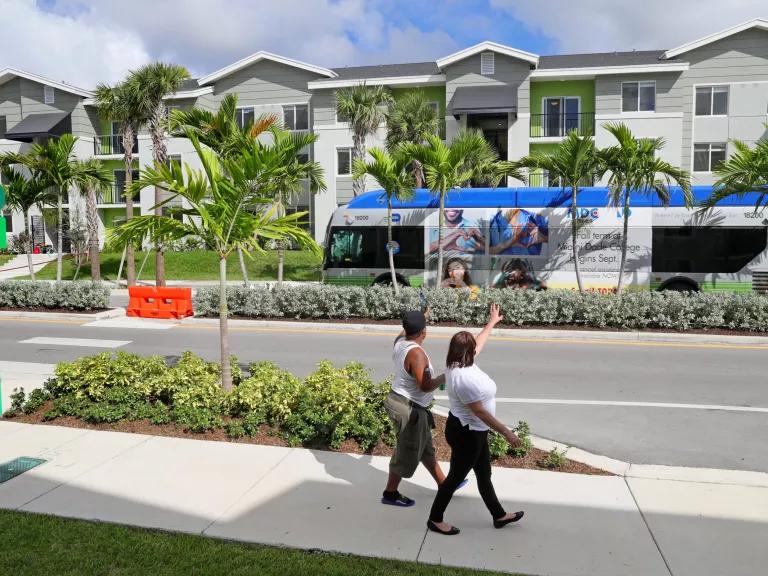
The second phase of Liberty Square, the redevelopment project by Related Urban
Planning before the problem appears
One of the challenges that communities face is that financial displacement pressures often become visible after market forces are already under way. By the time housing prices or property taxes begin to rise, speculative investments accelerate, or affordable housing stock is lost, local governments are often left responding to changes rather than proactively shaping neighborhood development and opportunity. This is ramped up to 100 in the post-disaster landscape.
Pre-emptively addressing this challenge of displacement risk before it becomes a problem is a critical imperative for communities nationwide and inspired NRDC’s recent work with Hampton, Virginia. Working alongside city staff, our team explored what anti-displacement planning and policy might look like when coupled with disaster resilience investments. Examining anti-displacement strategies across diverse regions, the legal authorities available to local governments, and state-level constraints such as Dillon’s Rule versus Home Rule provides a case study of the broader national challenge: how local leaders can preserve affordability and protect longtime residents from displacement as communities make necessary investments in disaster resilience.
The analysis begins with the recognition that no silver bullet solution is likely to exist. In fact, one of the clearest lessons from our research is that no city has fully solved this challenge, particularly when it comes to displacement pressures that may emerge in a pre- or post-disaster environment. But local governments and community leaders do not need perfect answers before they begin planning. If they wait until displacement becomes visible, opportunities for prevention may already be limited.
Reducing displacement pressures for longtime residents
NRDC’s preliminary research concludes that no local jurisdiction has solved for displacement; however, the cities we examined point toward an important lesson that reducing displacement pressures often requires more than a single policy or program solution. It requires multiple tools designed to address the different challenges facing homeowners and renters while accounting for the unique circumstances and challenges of each place.
Housing and tenant protection is one critical area where leaders can focus on stability. For homeowners, rising property values can be a double-edged sword. Flood mitigation projects, stormwater improvements, neighborhood revitalization efforts, and other public investments can reduce risk and improve quality of life and build wealth. Those same investments can also increase property taxes and housing costs. This is particularly challenging for residents living on fixed incomes, which includes but is not limited to older adults, veterans, and people with disabilities.
For cities like Hampton, targeted homeowner relief strategies could include expanding existing elderly and disability tax relief programs, establishing citywide real estate tax deferral mechanisms to cushion against sudden valuation spikes, or implementing location-specific tax relief for residents in targeted flood-mitigation improvement zones.
While these strategies may provide relief for some residents, they are far from perfect options, as they may undercut the tax base that local and city governments use to provide necessary services. Additionally, these same strategies that are used to provide relief for certain residents could also be a risky option for those same residents as certain tax relief strategies may reduce the potential net sell value for a property, something that can impact generational wealth. How should local governments proceed when balancing necessary investments to face disasters with the very real budgetary concerns to continue essential services? These challenges are prime examples of how there is no one perfect policy solution to solve this problem.
Meanwhile, renters face a different challenge that requires different solutions than homeowners. While homeowners may gain equity from increasing property values driven by nearby investment, renters are vulnerable to increased rents, building redevelopment, and displacement. Rent control and just cause evictions are two common forms of renter protections. Other strategies for renters focus on preserving and expanding affordable options: establishing community land trusts, enforcing long-term affordability covenants on publicly subsidized housing, launching targeted housing rehabilitation programs for multifamily units, and implementing tenant protections to ensure long-term stability.
Our research reveals that local governments do not all operate with the same implementation toolbox which is, of course, not surprising. The Commonwealth of Virginia operates under Dillon’s Rule, meaning local governments can exercise only those powers expressly granted by the state governing doctrine. As a result, some anti-displacement strategies available elsewhere may be unavailable to Hampton without action first being taken by the Virginia General Assembly. This means that certain types of anti-displacement solutions may be limited by state authority. And to be clear, this is not an isolated issue that only impacts Virginia cities or only the city of Hampton. Examples of other states that adhere to strong Dillon’s Rule principles include Delaware, Mississippi, Nevada, New Hampshire, Oklahoma, Vermont, and Wyoming.
Charlotte, North Carolina, offers one promising example of anti-displacement policy. With the city’s anti-displacement strategy, published in June 2023, Charlotte has pursued anti-displacement efforts at a scale that stands out among peer communities, combining strategic planning, cross-department coordination, housing investments, and targeted anti-displacement initiatives. While Charlotte’s experience does not provide a road map for addressing disaster resilience investment–driven displacement, it demonstrates that local governments can take proactive steps to reduce displacement pressures before they become crises, especially when cities work directly with impacted communities to address their specific challenges and to co-create solutions that meet their unique local needs.
Why communities need to act before disaster strikes
Timing matters. Following disasters, investors, developers, and other market actors can often move much more quickly than local governments, nonprofit organizations, and community groups. Properties change hands and development opportunities emerge as market conditions shift.
Public sector action tends to take more time as there are greater restrictions and requirements when using public dollars. Public decisions and investments are highly scrutinized compared to private investment and require a number of layers of funding approvals, public engagement processes, and permitting and procurement requirements, not to mention the amount of time it can take to access federal dollars in the post-disaster environment, although that timing challenge will hopefully improve some, thanks to new federal legislation. By the time displacement pressures become visible, opportunities to prevent them may already be limited. For that reason, anti-displacement planning should be a proactive activity that happens long before disaster response and recovery starts. It should be incorporated into disaster resilience planning and addressed as a part of project, program, and policy design long before an extreme weather event forms.
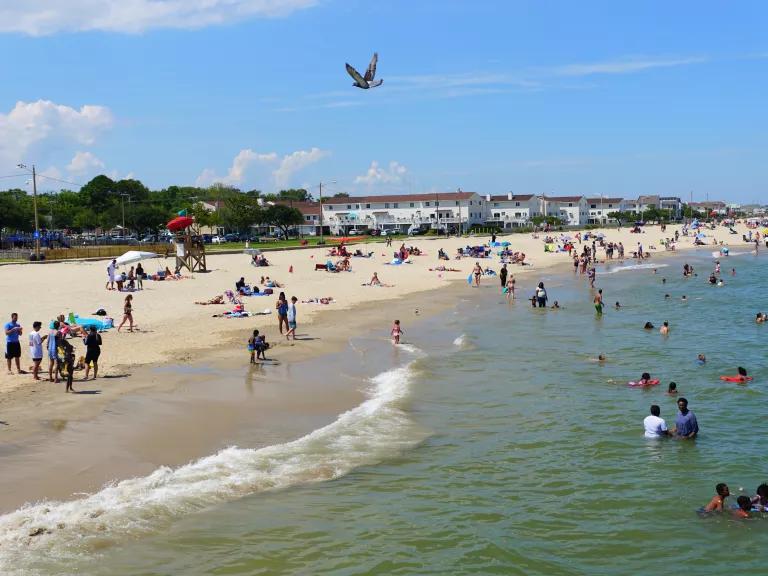
Buckroe Beach, Hampton, Virginia, June 2020
The funding challenge
Navigating disaster resilience resources necessarily requires managing shifting political and federal funding priorities. Federal programs designed to better support underinvested and highly exposed communities have faced ongoing uncertainty since the beginning of 2025. Localities, including our partners at the city of Hampton, competed successfully for federal funds only to encounter significant operational hurdles when promised funding was stalled, scaled back, or removed. These errant disruptions do not lessen extreme weather risks. On the contrary, political and funding uncertainty exacerbates extreme weather vulnerability and the potential harm and suffering that may come from it.
Newfound locally led stability is needed, where local leaders develop creative ways to pioneer innovative adaptation solutions. Tapping into a full range of public, private, and philanthropic financing options—including but not limited to public-private partnerships, different bond instruments, innovative state-driven grants, and insurance—will be critical for maintaining momentum, regardless of federal shifts.
It’s not either-or
Disaster risk reduction and affordability should not be treated as competing priorities. American taxpayers deserve protection from flooding, heat, hail, wind, and other extreme weather events. They also deserve the opportunity to remain in their neighborhoods and benefit from the public investments made there. As practitioners continue to find ways to invest in climate adaptation, we as professionals will be challenged with designing policies, projects, and programs that both advance disaster resilience and preserve affordability.
No city has solved this challenge entirely. More research is needed. More experimentation is needed. And more collaboration is needed among practitioners, advocates, planners, community development professionals, and residents themselves. But communities do not need perfect answers before they start asking better questions. Climate adaptation is not only about reducing risk but also about ensuring that the people who have lived with that risk, and with decades of underinvestment, can share in the benefits of a more resilient future.
This work would not have been possible without the trust and partnership of the city of Hampton. NRDC thanks Hampton and the Hampton staff whom our team has the pleasure to work with.
This NRDC.org blog is available for online republication by news media outlets or nonprofits under these conditions: The writer(s) must be credited with a byline; you must note prominently that the blog was originally published by NRDC.org and link to the original; the blog cannot be edited (beyond simple things such as grammar); you can’t resell the blog in any form or grant republishing rights to other outlets; you can’t republish our material wholesale or automatically—you need to select blogs individually; you can’t republish the photos or graphics on our site without specific permission; you should drop us a note to let us know when you’ve used one of our blogs.
RELATED CONTENT

More Housing or More Sustainable Housing? It’s a False Choice—Let’s Do Both!
The Law Requires States to Plan for Climate Impacts
