Ohio's Rising Utility and Insurance Bills Are a Housing Affordability Challenge
Energy-efficient and resilient homes are more affordable and must be central to Ohio’s housing strategy.


When people talk about housing affordability, they usually mean monthly rent, mortgage payments, or the up-front cost of buying a new home. But it is also what it costs to keep the lights on, the heat running, and the water flowing, year after year, and Ohio’s governor-elect inherits a housing affordability challenge that extends beyond rents and home prices.
New NRDC-commissioned research from the Ohio-based energy services company Donovan Energy shows the extent to which Ohioans may be struggling with the affordability of costs associated with their homes. The research finds that residential electricity, gas, water, and sewer bills across five major Ohio cities rose 65 percent between 2016 and 2026, and NRDC’s Insurability Crisis Tracker finds that the state’s home insurance rates rose 46 percent in the five years from 2020 to 2025. These trends clearly show housing operating costs rising far faster than inflation, and the pressure isn’t letting up: Data center demand has pushed the regional grid’s capacity prices to their maximum through May 2029, and several Ohio cities have adopted or proposed multiyear water rate increases.
Utility and insurance costs exacerbate Ohio’s housing affordability problem
Housing affordability is rightly a top issue for state and local leaders and for voters, and it’s a challenge for renters, homeowners, and hopeful homebuyers alike. In 2024, nearly half of Ohio renters and almost one in five homeowners spent at least 30 percent of their income on housing, including utilities. In 2023, about 26 percent of the state’s renters spent at least half their income on housing. According to the Ohio Housing Finance Agency (OHFA), Ohio is short more than 202,000 rental homes for renters earning half the area median income or less. Homeownership is getting harder to reach and to keep. In 2024, Ohio’s median home price hit a record $198,183, or 2.6 times the median household income, the highest ratio since 2005. Rising utility and insurance bills make these challenges worse.
In this blog, we break down the data behind each cost—electricity, gas, water and sewer, and insurance—and point to a strategy to minimize the impacts of these price spikes. Energy efficiency, water efficiency, and resilience are long-term housing affordability strategies that Ohio can put to work now. While the trends are stark, a statewide commitment to better housing standards can mitigate the impacts of rising costs on the Buckeye State’s homeowners, renters, and multifamily property owners.
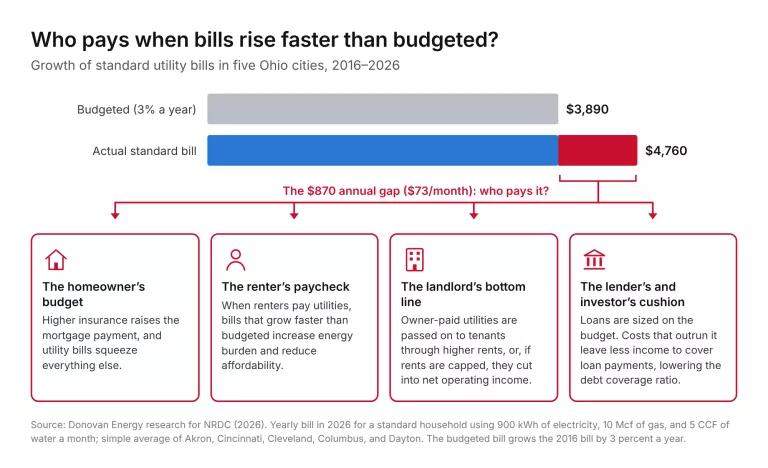
For homeowners, every expense increase comes straight out of the household budget, leaving less for other needs like food, health care, and savings. Families that are already stretched by a mortgage have little room to absorb higher bills. For renters, higher bills add to housing costs that already take too much of their income. In affordable homes, rent is set assuming a certain utility bill, so when actual bills rise faster than that estimate, renters who pay their own utilities cover the difference. For owners of apartment buildings, and especially affordable housing providers, rising utility and insurance costs cut into the income that pays the mortgage, covers repairs, and builds savings for major replacements like roofs and boilers. Bills that keep outpacing the budget can leave buildings short on upkeep, putting both residents and public investments at risk.
That is why mitigating against rapidly rising and volatile utility and insurance bills must be a key part of the governor-elect’s housing agenda. There is a better way to build and retrofit Ohio’s homes to provide that mitigation.
It’s all heading in one direction
To analyze Ohio’s housing operating expense trends, Donovan Energy tracked a standardized household-use scenario, averaged across five of Ohio's largest cities: Akron, Cincinnati, Cleveland, Columbus, and Dayton. Priced at July rates for combined utilities for a “standard” Ohio household, a year of these bills combined cost $2,890 in 2016. By 2026, those combined bills had reached about $4,760, an increase of 65 percent. Had they grown at just 3 percent per year over those same 10 years, those bills would total $3,890 today. That leaves a gap of $870 this year per home or per apartment between the trend lines for budgeted and actual utility expenses. Below are the findings.
Electricity: Up 64 percent in the past five years
Across the five cities, a standard household using 900 kilowatt-hours (kWh) per month paid $113 per month in 2021 (at July 2021 rates). Then bills took off. By 2026, that household was paying $186 per month, a 64 percent jump in five years and a difference of nearly $900 per year. That works out to an increase of more than 10 percent a year on average. Overall prices rose about 4 percent a year on average over the same period.
Gas: Up 81 percent since 2016 and highly volatile
Natural gas, which many Ohio homes use for heat and hot water, rose even faster. Across the five cities, the standard gas bill based on 10 thousand cubic feet (Mcf) a month went from $71 a month in 2016 to $128 in 2026, a difference of nearly $700 per year or an increase of 81 percent.
Gas prices also swung hard from one year to the next. The standard bill jumped 63 percent in 2022, then fell 39 percent in 2023. Since then, it has climbed almost 12 percent a year. Swings that large make gas bills hard for households and multifamily property owners alike to budget for—let alone absorb—in a peak year.
Water and sewer: Up 45 percent since 2016
Water and sewer bills make up a smaller part of household utility costs than energy bills, but they have still risen steadily. For a standard household using about 3,700 gallons a month, the average water and sewer bill across the five cities rose from $57 a month in 2016 to $83 a month in 2026 or more than $300 per year, up 45 percent. Over the past three years alone, the increase has averaged about 6 percent a year, twice the rate of inflation.
Water and sewer costs vary greatly from city to city. In 2026, the standard bill is $104 a month in Cleveland and $56 in Dayton. What is consistent is that water and sewer bills rose in all five cities from 2016 to 2026, and in Cleveland, Columbus, and Dayton, they rose faster than inflation. The cost of aging and growing water systems is passed on to every customer. Columbus, for example, raised water rates 18 percent and sewer rates 8 percent in January 2026, in part to pay for a fourth water plant that cost $2 billion. Cincinnati may be following close behind: Greater Cincinnati Water Works has proposed raising water rates 9.5 percent a year from 2027 through 2031 to replace lead pipes, remove PFAS “forever chemicals” under federal rules, and repair aging water mains.
Insurance: Rising fast in Ohio and nationally but assumed flat in developers’ projected budgets
The state’s homeowners are already feeling the insurance squeeze. According to NRDC’s Insurability Crisis Tracker, home insurance premiums in Ohio rose 46 percent from 2020 to 2025—nearly twice the rate of inflation—and 12.7 percent of homes now go without insurance altogether. The tracker places Ohio at “elevated risk” of an insurance crisis, with hail as the state’s biggest hazard: FEMA estimates hail causes about $97 million of damage in Ohio in an average year, nearly all of it to buildings.
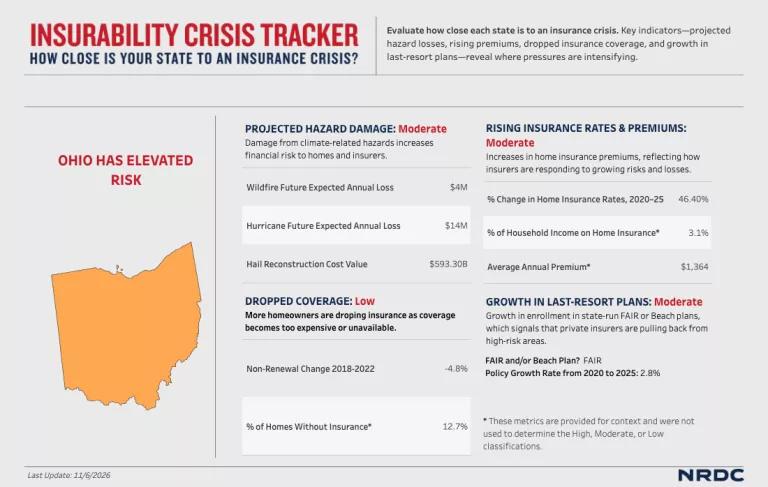
Source: NRDC, Insurability Crisis Tracker (2026). Ohio figures cover homeowner’s insurance.
National evidence clearly shows that insurance is another rapidly rising expense that’s making housing less affordable, including across Ohio. A Federal Reserve analysis found that the average cost to insure an apartment rose more than 75 percent in the five years from 2019 to 2024, even after adjusting for inflation. Landlords passed some of that increase on to tenants through higher rents but absorbed nearly three-quarters of it as lower profits.
In particular, affordable housing providers (the landlords who run income-restricted apartments) are seeing this firsthand. In a 2023 testimony to the U.S. Senate Committee on Banking, Housing, and Urban Affairs, Columbus-based National Church Residences reported that premiums for the 12 large nonprofit housing providers in the Stewards of Affordable Housing for the Future network had risen 10 to 40 percent year over year in each of the previous three years. They are paying in other ways too. In a 2023 national survey, two-thirds said they had raised their deductibles to manage rising premiums. A higher deductible means the owner pays more out of pocket when a pipe bursts or a storm damages a roof. In the Upper Midwest, some owners report that insurers have stopped covering affordable housing altogether.
Despite the dramatic trends in actual insurance cost escalation, an analysis of budgets included in Low-Income Housing Tax Credit applications to the Ohio Housing Finance Agency (OHFA) shows the continued use of rule of thumb insurance expense assumptions; in applications for the 4 percent tax credit from 2023 to 2026, developers budgeted approximately $600 per apartment per year, with little change in the base year assumption from one year to the next. In other words, Ohio developers appear to be budgeting as if insurance costs are standing still, even as premiums climb for homeowners and apartment owners alike.
Lower long-term operating costs by rewarding efficient, resilient buildings
Strong building standards lower long-term operating costs. Cleveland has required homes that receive its residential tax break to meet the city's Green Building Standard since 2010, and from 2017 to 2021 alone, the city granted 1,128 tax breaks covering 6,321 homes. Ohio developers have also shown that affordable housing can be built to above-code efficiency and resilience standards:
- Fairwood Commons, a 54-unit senior community in Columbus by Woda Cooper Companies and East Columbus Development Company, opened in 2018 as the state’s first multifamily building built to Passive House standards, a very high energy efficiency and resiliency building standard.
- POAH (Preservation of Affordable Housing), which owns more than 1,000 units of housing in Ohio, has developed new Passive House multifamily properties in the midwest and northeast. While a property built to Passive House may cost 0–3 percent more up front, POAH’s data shows that energy consumption and costs are 63 percent lower for its Passive House properties when compared to code-standard housing in its portfolio for each year for the life of the asset.
Until this year, OHFA’s design standards have required new affordable tax credit developments to earn a Green Building certification, but its new standards, set to take effect on December 1, 2026, will roll back that requirement, keeping only an energy rating requirement for rehabilitations. This is a step backward for long-term affordability, as the above data clearly demonstrates. As OHFA continues to evolve its requirements, it can look to other states for ideas:
- Pennsylvania’s housing finance agency began awarding points for Passive House design in 2015. In the first two years, 58 proposed developments planned to meet the standard, and 17 of those were awarded tax credits. Data from the PA Housing Finance Agency shows that the market, developers, builders, and suppliers quickly adapted; in the first year of 2015, Passive House properties were nearly 6 percent more expensive to build. That premium shrunk to less than 2 percent within one year, and reached cost parity with conventional building within three years.
- Louisiana’s tax credit plan requires storm-resistant FORTIFIED roofs and awards extra points for buildings that go further with resilience measures, such as protecting windows and doors and creating enhanced structural ties.
- Massachusetts paired bonus points in its tax credit plan with utility incentives, and by mid-2022, 8,500 homes in the state were on track for Passive House certification.
For existing housing, energy efficiency upgrades can avoid a meaningful share of these rising costs. A recent analysis from the Brattle Group illustrates the potential household savings from the efficiency measures commonly included in energy efficiency building standards. It estimated that weatherizing a poorly insulated Columbus home—by adding attic insulation and sealing air leaks—would cut its energy use by about a quarter and lower its bills by about $450 a year. At about $2,000 per home, the upgrade would pay for itself in under five years. For Columbus homes heated with electric resistance heat, Brattle estimated that switching to heat pumps for heating and hot water would save about $1,200 a year, more than covering the $870 gap.
Where Ohio can go from here
Building on these examples, leaders at every level of Ohio government can reward efficient, resilient new housing construction, the rehabilitation of existing housing, and the conversion of other properties into housing. They can do this through funding streams and municipal benefits programs, such as competitive points in funding applications and embedded standards in public benefits like residential property tax breaks. The state can add higher, incentivized standards to state housing programs, including OHFA’s tax credit and lending programs. Counties and cities can attach incentive-based efficiency and resilience standards to the housing dollars and land they control, from property tax breaks and gap funding to land bank sales, as Cleveland has done with its residential property tax break.
Energy-efficient, resilient buildings that control long-term operating costs must be a key strategy to address housing affordability in Ohio—and the Buckeye State does not need to start from scratch. Cities and developers have already shown what these buildings look like, and states like Pennsylvania, Massachusetts, and Louisiana offer ideas that Ohio can build on. Ohio’s governor-elect campaigned on making life in Ohio more affordable, and what it costs to keep a home running is part of that picture. As the new administration develops a housing agenda, Ohio can make tangible progress by focusing on efficient, resilient building practices.
Ohio can build more homes without locking residents and housing providers into decades of rising operating costs. Treating efficiency and resilience as long-term affordability tools will ensure that the state’s housing investments remain affordable long after construction ends.
City-specific findings, the data, and methodology
This NRDC.org blog is available for online republication by news media outlets or nonprofits under these conditions: The writer(s) must be credited with a byline; you must note prominently that the blog was originally published by NRDC.org and link to the original; the blog cannot be edited (beyond simple things such as grammar); you can’t resell the blog in any form or grant republishing rights to other outlets; you can’t republish our material wholesale or automatically—you need to select blogs individually; you can’t republish the photos or graphics on our site without specific permission; you should drop us a note to let us know when you’ve used one of our blogs.
Related Blogs

Community Climate Finance in Uncertain Times: Strategies Emerging from the Field

COP29: Key Outcomes Signal Need to Deliver Greater Climate Action
