As Climate Overshoot Looms, Did COP31 Deliver Progress on Climate Action Where It Matters Most?
In a year defined by climate extremes and growing geopolitical uncertainty, COP31 tested what climate action and an “implementation COP” is looking like in an “overshoot” world.
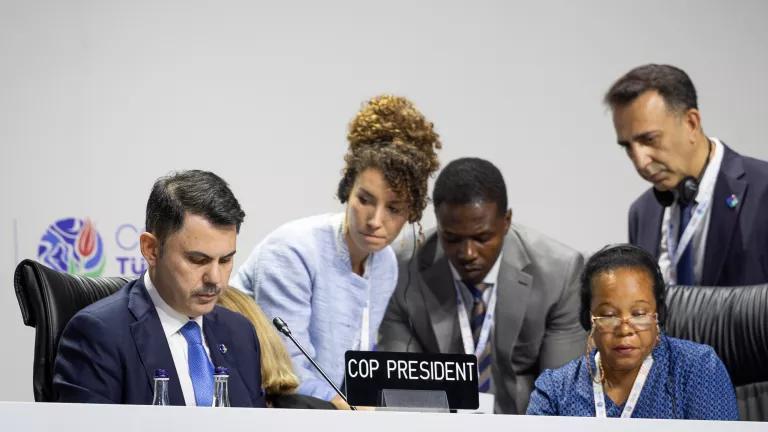


The United Nations Climate Change Conferencein Antalya, Türkiye, COP31, was defined by and set against three stark realities: the reckoning that the world is overshooting 1.5 degrees Celsius (2.7 degrees Fahrenheit), shifting into a phase where much more aggressive implementation is needed to translate promises into action, and entering an era where the consequences of our inadequate inaction is becoming starker for communities around the world. Underneath these factors is a crosscurrent of challenging geopolitics, mixed with an entrenched fossil fuel industry trying to stall progress wherever it can. As a result, COP31 failed to meet the moment on several fronts, despite some real-world momentum.
The physical layout of the conference itself became a metaphor for the broader climate movement—on one side there was energy, innovation, and commitment on display through the Action Agenda, but then on the other side, an ongoing struggle to translate that momentum into consensus and action at the ministerial and negotiation level at the pace that the crisis demands, as evidenced by the failure to reach agreement in the final days. COP31 was a good litmus test to see if the summit is still fit for its purpose and effective at moving forward the kind of progress that is needed in the pivotal years ahead.
So, where did COP31 land on some of the core issues shaping the state of global collective progress on climate action?

Shruti Shukla, senior advocate for NRDC’s International Energy program, speaking during a panel discussion at an event about integrating electricity and cooling requirements into permitting, public finance, and industrial policy at COP31, November 16, 2026
On electrification
COP31 demonstrated burgeoning global support for electrification as a cornerstone of energy security, economic competitiveness, and climate action; however, the real test will be how it is underpinned by clean energy to displace the demand for fossil fuels. By the end of COP31, around 90 countries and 180 companies had committed to accelerating electrification toward a global goal of 35 percent of final energy consumption by 2035, up from just above 20 percent today. Critical for that success, a coalition of governments, development banks, and private financiers launched the Electrify Now Finance Coalition at COP31 to surge investments in developing countries by 2028.
Electrification can deliver significant benefits through greater energy efficiency, improved energy security, and expanded access to modern energy services. Going forward, the electrification drive needs clean power, enhanced grids, affordable finance, and targeted efforts to reach underserved countries and communities. Clean electrification is a central strategy to displacing demand for fossil fuels and should form a foundation for the development of national road maps to transition away from fossil fuels.
Energy storage is a lynchpin technology that enables clean electrification; like a bank account, it allows power to be “saved” when it’s generated and “spent” later when it is needed most. At COP31, NRDC released fact sheets detailing the steps that China, India, and the United States are taking with energy storage to ensure that electricity is reliable, affordable, and resilient to help countries as they expand this critical tool.
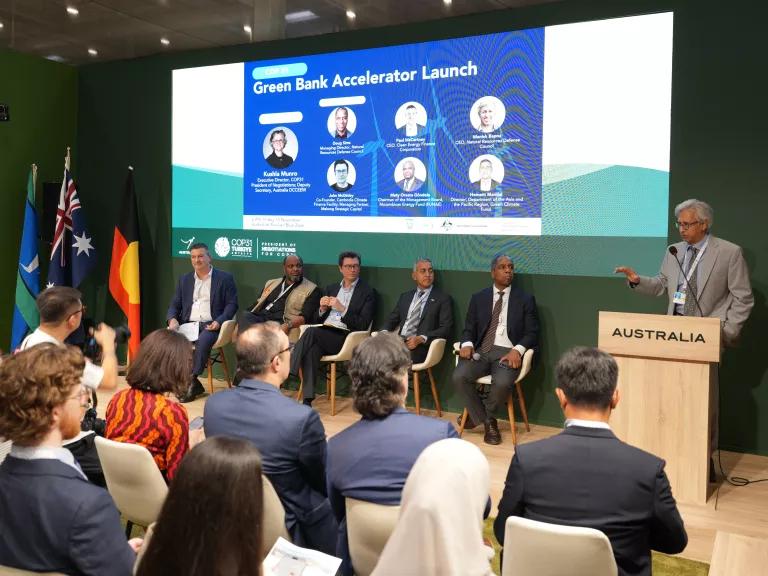
Manish Bapna, NRDC president & CEO, speaking during a Green Bank Accelerator launch event at COP31, November 13, 2026
On climate finance
COP31 did not make significant advances on finance. Developed countries and wealthy emerging economies engaged in finger-pointing over how to fairly share the effort. Meanwhile, the most vulnerable countries suffer the compounding effects of climate disasters, debt burdens, and the stifling bureaucracy of international institutions. While climate finance flows continue to rise—especially through multilateral development banks that reiterated their projection that they'd reach $185 billion in climate finance by 2030—the refusal of most contributors to talk about their future efforts has increased uncertainty and distrust.
The United Nations climate funds saw their lowest fundraising in many years. Progress on defining how much the COP30 agreement to triple adaptation finance by 2035 would amount to was halted due to the collapse of negotiations over other issues.
A bright spot in finance negotiations was the agreement to transition the Adaptation Fund to the Paris Agreement's governance, which enables the fund to receive a share of carbon trading proceeds under the Paris Agreement Crediting Mechanism, which will not be subject to the politics of national budget processes. Outside the negotiation rooms, there was progress on advancing new tools to mobilize finance, including NRDC’s launch of the Green Bank Accelerator and the announcement of the first vanguard projects of the Fostering Investable National Implementation initiative to boost investments for adaptation and resilience, in collaboration with the Atlantic Council’s Climate Resilience Center and a growing number of partners.
Going forward, wealthy countries need to move beyond the finger-pointing and show that they will all step up to deliver the tripling of adaptation funding that the world's most vulnerable need, make multiyear climate pledges as they have done in the past, contribute to the Green Climate Fund and Fund for Responding to Loss and Damage replenishments, and grapple seriously with reforming the climate finance architecture so that funding is more easily accessible to the most vulnerable.
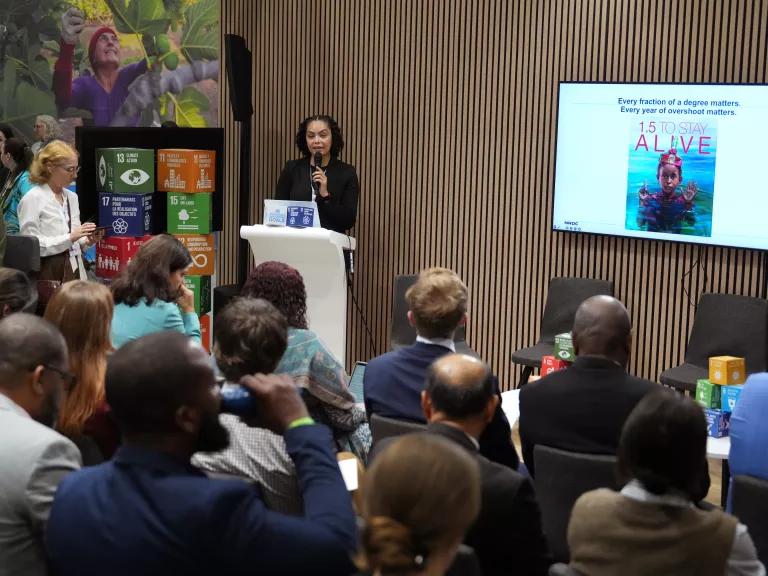
Dr. Adelle Thomas, senior director of climate adaptation for NRDC’s Environmental Health program, speaking during the Keeping 1.5°C Alive: A Safer Future for Small Island Developing States event at COP31, November 12, 2026
On adaptation, resilience, and loss and damage
As climate impacts accelerate and overshooting 1.5 degrees Celsius becomes a reality, adaptation and loss and damage can no longer be treated as secondary issues. While adaptation remained a priority throughout the negotiations, progress on National Adaptation Plans and adaptation indicators continued to lag behind the urgency of growing climate risks, reflecting persistent gaps between recognition and implementation.
At the same time, countries made progress in operationalizing the Fund for Responding to Loss and Damage, but fundamental questions of equity remain unresolved, including who pays, how much finance is needed, how quickly support can be delivered, and whether resources can keep pace with rapidly escalating demand.
These discussions reinforced the need for adaptation and loss and damage efforts to be guided by both the best available science, including from the Intergovernmental Panel on Climate Change, and a clear understanding of unequal vulnerabilities and capacities.
Looking ahead, the challenge is no longer designing new frameworks but delivering results: translating adaptation plans into action, scaling finance for adaptation and loss and damage, and ensuring that support reaches communities on the frontlines. Ultimately, the success of international climate cooperation will be measured not by negotiated text but by whether more people are protected from climate impacts through stronger resilience, greater food and water security, effective early warning systems, measures to cope with extreme heat, and timely support when disasters strike.
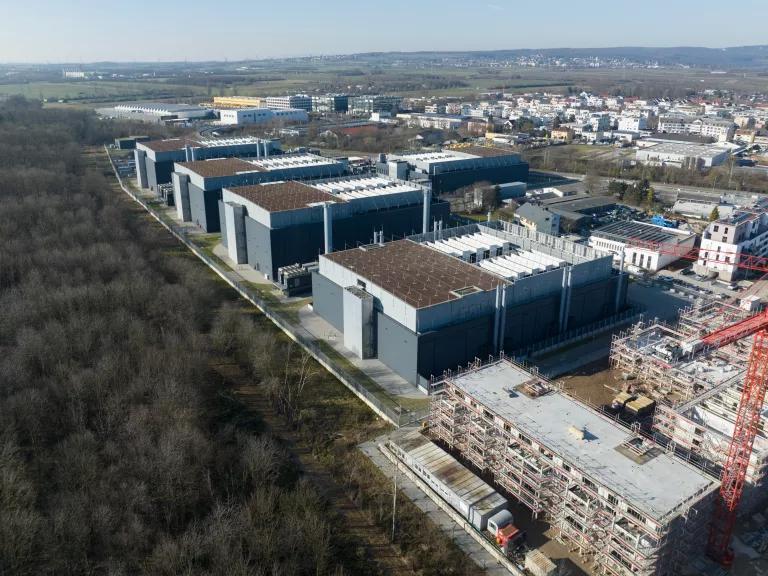
A data center under construction in Frankfurt, Germany
On AI and digital infrastructure
COP31 brought the environmental footprint of AI and data centers more firmly into international climate discussions with the launch of the Antalya AI Pledge by the Türkiye's COP31 presidency and the International Telecommunication Union (ITU). Joined by some governments, private sectors, and civil societies, the pledge recognizes the importance of cleaner power, energy and water efficiency, environmental transparency, and support for AI-enabled climate solutions in developing countries. Brazil, ITU, and UNESCO also launched the operational phase of the AI Climate Institute, aimed at strengthening developing countries’ capacity to design and govern their own resource-efficient AI solutions for climate action.
However, the pledge’s voluntary commitments leave significant gaps in robust accountability, implementation, and meaningful community participation. AI digital infrastructure must advance clean energy and development priorities without locking in fossil fuels or shifting environmental and infrastructure costs onto communities. Translating these broad commitments into credible environmental disclosure, clean energy and grid planning, community protections, and accountability for infrastructure costs will be important for turning this initial pledge into meaningful progress.
Changing landscape for climate action
Around the world, we are witnessing the continued march toward more clean energy but not at the pace and scale necessary to address the climate challenge. At the same time, we are seeing more investment to build resilience to the climate impacts we are feeling today and will feel in an overshoot era, yet the finance to support the most vulnerable in facing these threats is woefully low.
Countries are embracing new commitments to electrify their economies, tackle the impacts of AI infrastructure, rapidly scale up clean electricity and nature-based solutions, protect our oceans and forests, and transition away from fossil fuels, but they aren’t yet delivering the necessary actions to embrace those bold ambitions. More countries came forward at COP31 with road maps on how they plan to transition away from fossil fuels, and efforts to tackle deforestation and forest degradation received an additional boost with new injections of resources into the Tropical Forest Forever Facility fund.
But this meeting also witnessed a breakdown in the formal negotiations as countries weren’t able to translate that momentum into an overarching resolution—the “cover decision”—with a large majority of countries deciding that no cover decision was better than one that backtracked on previous commitments.
The world is in urgent need of greater ambition, stronger implementation, and accelerated investment. COP31's final outcome does not match the demonstration of climate action and innovation on the ground. Leadership is becoming more distributed, equity and justice are becoming critical parts of domestic policies and global cooperation and trade, and a growing number of actors are helping to drive implementation outside formal negotiations, based on the compelling economics of climate solutions.
COPs extend far beyond the negotiating rooms. In Antalya, new coalitions were built. Commitments were announced. Solutions were shared. Partnerships were strengthened. As we turn to COP32 in Ethiopia next year, the message is for countries and the groundswell of non-state actors to: roll up their sleeves and deliver what they have committed to, recognize that the world hasn’t yet done enough, and get together to respond more courageously and more equitably to tackle the climate crisis with the urgency that is needed.
This NRDC.org blog is available for online republication by news media outlets or nonprofits under these conditions: The writer(s) must be credited with a byline; you must note prominently that the blog was originally published by NRDC.org and link to the original; the blog cannot be edited (beyond simple things such as grammar); you can’t resell the blog in any form or grant republishing rights to other outlets; you can’t republish our material wholesale or automatically—you need to select blogs individually; you can’t republish the photos or graphics on our site without specific permission; you should drop us a note to let us know when you’ve used one of our blogs.
Related Blogs

U.S. 2035 Climate Target Is Ambitious, Achievable & a Call to Action

COP29: Key Outcomes Signal Need to Deliver Greater Climate Action
