
AI for Sustainable Development: When Bigger Is Not Better
AI is increasingly promoted as a tool for climate action and sustainable development. But its infrastructure should be planned as part of the energy transition, supporting clean, affordable, and resilient energy systems while incorporating strong environmental safeguards and delivering clear public benefits.
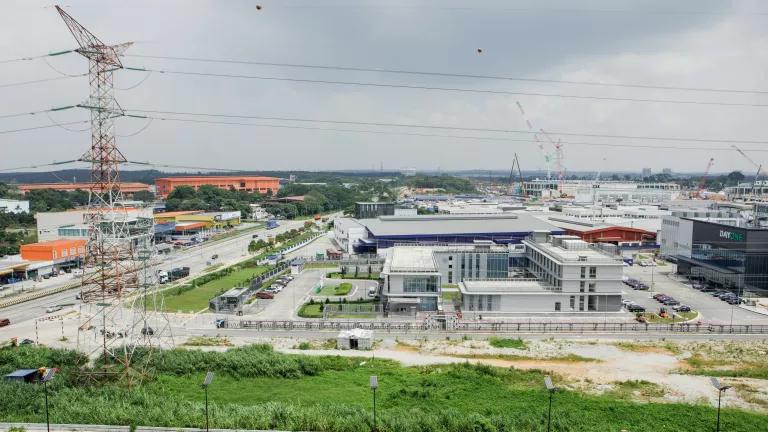
Data centers—such as this DayOne Data Centers Ltd. campus in Johor—are projected to account for 31 percent of electricity consumption in Malaysia by 2035.

The AI race is usually described in superlatives: larger models, more chips, and more data centers. But the build-out is not confined to the technology sector. It requires power plants, substations, transmission lines, cooling systems, water, and land, with consequences for energy systems, communities, and public budgets.
That does not diminish AI’s potential. It changes the question. What useful outcomes will this infrastructure deliver, and can those outcomes be achieved by accelerating rather than undermining the transition to clean, affordable, and resilient energy systems?
The starting point is transparency. When it comes to responsible digital infrastructure, environmental impacts should be visible early enough to inform energy planning and local decisions. The next step is to use that information to make better choices.
The goal should not be to build the most AI infrastructure possible. The right approach will differ by place: Countries should be able to tailor AI investment to their development priorities, infrastructure constraints, and environmental limits. That means choosing technology and infrastructure that are proportionate to the task, building the capabilities needed to use them well, and ensuring that the infrastructure supports clean, affordable, and resilient energy systems while delivering public benefits that justify its demands on energy, water, and public budgets.
Start with the development outcome
AI is already being tested to improve efficiency in tax administration, health care, legal services, agriculture, and public programs. A recent World Bank survey of governments in 60 economies found that 44 percent of reported internal government use consisted of individual officials using AI for discrete tasks such as searching for information or summarizing documents. These uses may save time and improve services. They also illustrate that many useful applications do not require the largest or most resource-intensive AI systems.
Consider electricity forecasting. AI can help grid operators anticipate demand and variable renewable generation, but better forecasts matter only if utilities have the transmission, storage, operational, and institutional capacity to act on them. The same principle applies elsewhere. An agricultural advisory tool must reflect local crops and conditions and reach farmers in a form they can use, while an early-warning system needs communications networks and public agencies capable of reaching people before a disaster.
AI is one part of each system. It cannot substitute for the infrastructure, data, skills, and institutions needed to deliver results.
The World Development Report 2026 distinguishes among three pathways: adopting existing AI tools, adapting them to local conditions, or advancing frontier models. Each requires a different level of investment. Adoption and adaptation can often draw on existing models and more limited computing capacity, while developing frontier models requires much larger investments in energy, data, specialized skills, and computing infrastructure. Countries therefore do not need to pursue the same infrastructure strategy to benefit from AI.
Investment patterns make these choices increasingly consequential. The 2026 World Investment Report from the United Nations Conference on Trade and Development finds that announced investment in new AI infrastructure projects grew by an average of 47 percent a year between 2020 and 2025, reaching nearly $350 billion in 2025. Yet in many developing regions, investment in data centers is rising while investment in basic connectivity has stagnated or fallen. The challenge is therefore not simply to attract more computing capacity but to ensure that digital investment strengthens the energy, connectivity, and institutional systems needed to deliver broader development benefits.
Match the technology to the task
Progress in AI is too often equated with larger models and more computing capacity. But neither is, by itself, a measure of development. Many useful applications do not require the largest general-purpose models. Translation, document processing, agricultural advice, and some forms of forecasting can be handled by smaller systems designed for a specific task. Research published by UNESCO and University College London examined the energy used when already-trained models respond to requests. In the applications tested, smaller task-specific models used up to 90 percent less energy while maintaining strong performance. Training and adapting models also require energy and computing resources and should be assessed separately.
However, smaller will not always be better. Some scientific, research, and climate applications will need considerable computing power. The principle is proportionality: Choose an approach that can do the job reliably without demanding more computing capacity, energy, or supporting infrastructure than the outcome warrants. Sometimes that will mean adapting an existing model, using a smaller model on a local device, or sharing computing capacity. Sometimes an ordinary digital tool will be enough.
Countries also have legitimate concerns about control over sensitive data, continuity of essential services, and dependence on external providers. Domestic computing capacity may therefore carry strategic value even when it is not the cheapest option. But a data center does not remove every dependency; it may still rely on imported chips, foreign platforms, and outside expertise.
Data centers can support research, services, and local innovation. They can also require public incentives and major investments in electricity, grids, land, and water. The World Investment Report notes that the surge in digital infrastructure investment is occurring as investment in renewable energy and other basic infrastructure has weakened, raising concerns about the competition for capital in constrained markets. From an energy transition perspective, the test is whether a facility brings additional clean power, strengthens rather than strains the grid, pays its fair share of infrastructure costs, and produces benefits that extend beyond the facility itself.
A development test for AI infrastructure
Before governments or development institutions commit public resources, four questions should travel together.

Four questions that governments should ask before supporting AI infrastructure: A simple development value test for AI and digital infrastructure investment
The test is not which option is smallest but which one is proportional to deliver the required result with the least pressure on energy, water, and public infrastructure over its lifetime. That means looking beyond a single efficiency rating to the resources needed to train or adapt the model, operate it at the expected scale, and provide the necessary hardware and supporting infrastructure.
AI can improve public services, widen access to expertise, and help manage more complex energy systems. Those possibilities deserve serious investment. But development value does not flow automatically from more computing capacity, and digital infrastructure does not become sustainable simply because it supports an AI application.
This is where an environmental and energy transition perspective is essential. The question is not only whether AI can help address climate change. It is also whether the infrastructure behind it supports clean, affordable, and resilient energy systems.
From transparency to better choices and outcomes
The international conversation is beginning to connect these issues. In June 2026, U.N. Secretary-General António Guterres proposed an AI Environmental Transparency Initiative, calling on major companies to disclose the carbon, water, and land footprints of their AI systems. At COP31, the proposed Antalya Artificial Intelligence Pledge can carry the discussion into how AI is designed, procured, powered, deployed, and measured. Meanwhile, the UNFCCC Technology Mechanism’s AI for Climate Action initiative is supporting practical applications for mitigation and adaptation, particularly in developing countries.
These initiatives should reinforce one another. Transparency can make resource demands visible. Climate commitments can shape how systems are powered and procured. Development policy can help determine which applications and infrastructure proposals merit investment or other forms of public support.
The decisions being made now will shape electricity systems, public budgets, and development pathways for years. We should therefore ask what kind of AI is appropriate, what infrastructure it requires, and whether the expected benefits justify the resources committed.
If AI is to serve sustainable development, the standard should be straightforward: useful outcomes, proportionate infrastructure, clean and affordable energy, and public benefits that justify public costs. Bigger may sometimes be necessary. But the measure of better is the outcome delivered, not the computing capacity deployed.
This NRDC.org blog is available for online republication by news media outlets or nonprofits under these conditions: The writer(s) must be credited with a byline; you must note prominently that the blog was originally published by NRDC.org and link to the original; the blog cannot be edited (beyond simple things such as grammar); you can’t resell the blog in any form or grant republishing rights to other outlets; you can’t republish our material wholesale or automatically—you need to select blogs individually; you can’t republish the photos or graphics on our site without specific permission; you should drop us a note to let us know when you’ve used one of our blogs.
Related Blogs
10 Years After Kigali: What Comes Next for the Global HFC Phasedown?
Accounting for AI: Environmental Transparency for a Responsible Digital Future
