
10 Years After Kigali: What Comes Next for the Global HFC Phasedown?
As world leaders meet in Rwanda to mark the treaty’s anniversary, attention must be turned to stronger implementation and faster climate action.
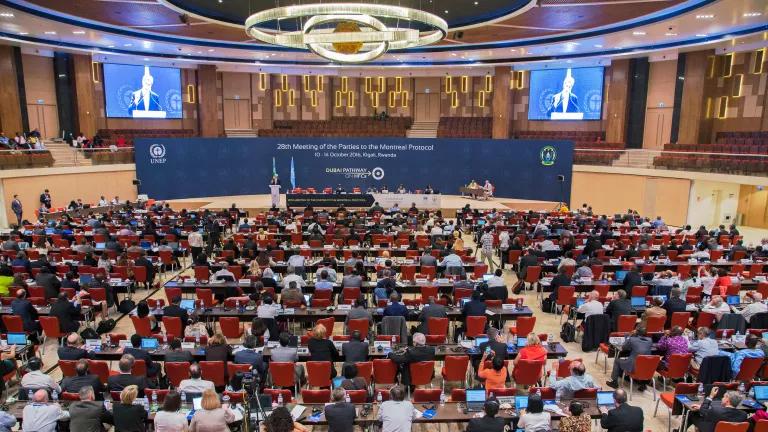
The 28th meeting of the Parties to the Montreal Protocol in Kigali, Rwanda, October 2016, where envoys from nearly 200 nations worked on an agreement to phase out HFCs


Yajing Zhou, NRDC China, contributed to this blog.
Delegates from across the world will meet this November in Rwanda to celebrate the 2016 Kigali Agreement, the global treaty adopted there 10 years ago to phase down the climate super pollutants known as hydrofluorocarbons (HFCs). NRDC will be there.
The Kigali Agreement transformed the Montreal Protocol on Substances that Deplete the Ozone Layer, already the world’s most successful environmental treaty, into a key instrument for climate protection. Every country in the world is a party to the Montreal Protocol. As of today, 174 countries, including the United States, China, and India, have ratified the Kigali Agreement.
Now it’s time for diplomats, businesses, and environmental organizations to take stock and start thinking about ways to accelerate climate progress. That includes ways to strengthen and better finance the current HFC phasedown and how to accelerate the transition to climate-safe cooling.
Look behind: How we got the Kigali HFC agreement
Back in 2008, NRDC was among the first to propose amending the Montreal Protocol—the same treaty that successfully ended the reign of chlorofluorocarbons (CFCs), the HFCs’ ozone-destroying predecessors—to phase down HFCs. It took nearly a decade, until 2016, to forge global agreement at Kigali.
Ten years later, HFC consumption is down 40 percent in developed countries and is capped in most developing countries. Scientists tell us that replacing HFCs will spare the world almost 0.5 degrees Celsius of added warming between now and 2100, on top of the nearly 2 degrees of avoided warming thanks to phasing out the ozone-depleting chemicals.
Climate action is more urgent than ever. A major United Nations report last month, Limiting Overshoot, confirms that the world will overshoot 1.5 degrees Celsius (2.7 degrees Fahrenheit)—the target countries set in the 2015 Paris Agreement for limiting the increase in global temperatures. The report puts it starkly: “Every fraction of a degree avoided and every year by which overshoot is shortened will save lives, protect ecosystems and reduce economic losses.”
So, we need to do more on all fronts. The main and indispensable lever is curbing greenhouse gas emissions. This means carbon dioxide but also climate super pollutants like methane and HFCs. Though these pollutants are emitted in smaller amounts than CO2, they pack a bigger warming punch per ton compared to CO2 and are short-lived. That means reducing them pays off faster—making HFCs the emergency brakes on warming. Controlling short-lived super pollutants like methane and HFCs in addition to CO2 can not only help reduce the amount of warming, but it can also slow the rate of warming and thus the speed with which we hurtle toward an increasingly inhospitable climate. For these reasons, we’re going to Kigali again in November to push for going faster and farther.
Look ahead: What to expect at Kigali?
First, we want to see more countries ratify the HFC amendment by then, moving closer toward universal ratification. We have 23 more countries to go to get there.
Second, countries need to agree on how much money to invest in the Multilateral Fund (MLF), the vehicle through which developed countries have successfully helped developing countries phase out CFCs and other chemicals over the past three decades. Countries decide how much money the MLF needs three years at a time, and the next period will focus on supporting two things: the HCFC phaseout and the HFC phasedown. The money is needed to speed up the transition to clean cooling—air conditioning in heat-stressed countries and refrigeration for the food and medicine supply chains. These investments have been an absolute bargain, at a cost equivalent to seven cents per ton of carbon dioxide equivalents avoided.
Third, delegates will work on measures to ensure compliance with the Montreal Protocol and the Kigali Amendment. They will discuss steps to combat illegal trade; avoid dumping obsolete products in developing countries; expand the network of atmospheric monitoring stations to detect emissions of controlled substances; and fund the agreements’ basic operations.
In the last month, we’ve seen the launch of two exciting initiatives under the umbrella of the U.N.’s Climate and Clean Air Coalition, a fusion of governmental, business, and civil societies. First, there is the Accra-Helsinki Group for Sustainable Cooling, a North-South governmental collaboration advocating 10 concrete steps that can be taken under the Montreal and Kigali frameworks. And second, governments and philanthropies have combined to form the Friends of the Kigali Amendment to push for many of the same measures.
Where are the United States, China, and India?
NRDC teams work in each of these three giant countries. Here’s a brief rundown on how each is approaching HFCs.
United States
The United States ratified the Kigali Amendment in 2022 and remains a party even while the Trump administration is withdrawing from tens of other international agreements. The United States recently delivered a large, but overdue, contribution to help fund the MLF and basic operations of the agreements. The United States’ remaining in and continuing to support the Montreal Protocol helps both protect the environment and keep global markets open and competitive for U.S. technology producers. U.S. participation is also important to help detect and remedy the relative instances of noncompliance by other countries that hurt the ozone layer and climate. At home, the U.S. phasedown of HFC supply is locked into law under the bipartisan American Innovation and Manufacturing (AIM) Act, enacted in 2020 and signed by President Trump in his first term. On the other hand, the U.S. Environmental Protection Agency has unlawfully weakened demand-side measures adopted under the AIM Act in the Biden years. NRDC and industry have joined forces in going to court to challenge these rollbacks.
China
China became a party to the Kigali Amendment in 2021. China’s HFC system for limiting HFCs and its ongoing industrial transition have already driven HFC reductions faster than required by the Kigali schedule. Because China is the world’s largest producer and consumer of HFCs, as well as the largest exporter of air-conditioning equipment, a broader shift toward production and use of refrigerants with ultra-low climate impact in the country could bolster Kigali Amendment implementation. NRDC is working with industry associations to promote non-HFC alternatives and support a faster HFC phasedown. China’s new 2035 Nationally Determined Contribution (its plan of action under the Paris Agreement) covers all greenhouse gases, including HFCs, and its 15th five-year plan includes quantitative targets for reducing non-CO₂ greenhouse gas emissions for the first time. These developments create new opportunities for NRDC to better address HFC emissions in China, including through improved emissions monitoring and refrigerant reclamation and reuse.
India
India has established strong foundations for successfully transitioning away from climate-warming HFCs. Since ratifying the Kigali Amendment in 2021, India has established an HFC import-export licensing system and initiated drafting its national phasedown strategy. Its most significant technology success has been in room air conditioners, where Indian manufacturers moved directly from HCFC-22 to lower-GWP HFC-32, leapfrogging the potent warming chemical HFC-410A. Industry is also piloting use of R-290 (a low climate-impact hydrocarbon) and the equipment and compressors to use it. Industry has also expanded cyclopentane applications and demonstrated conversions in commercial refrigeration and light commercial air-conditioning. Priorities in India include raising manufacturers’ awareness of technically and economically viable low-GWP options; harmonizing safety standards and expanding training and certification for the safe adoption of A2L and A3 flammable refrigerants; promoting energy efficiency; assessing market readiness through stakeholder consultations; and preparing a detailed, sector-informed transition roadmap.
India is updating regulatory frameworks by amending its Ozone Depleting Substances (Regulation and Control) Rules (2000). As cooling demand accelerates, timely action—coupled with leak prevention and reclamation and circular-economy approaches—can limit HFC growth while expanding access to sustainable cooling. India has built the launchpad; the coming decade must build the ecosystem that enables the transition at scale.
***
This November, let us celebrate the Kigali Amendment and resolve to strengthen it.
This NRDC.org blog is available for online republication by news media outlets or nonprofits under these conditions: The writer(s) must be credited with a byline; you must note prominently that the blog was originally published by NRDC.org and link to the original; the blog cannot be edited (beyond simple things such as grammar); you can’t resell the blog in any form or grant republishing rights to other outlets; you can’t republish our material wholesale or automatically—you need to select blogs individually; you can’t republish the photos or graphics on our site without specific permission; you should drop us a note to let us know when you’ve used one of our blogs.
RELATED BLOGS
Accounting for AI: Environmental Transparency for a Responsible Digital Future
The People Behind Climate-Friendly Cooling
