Five Things to Watch on Climate Finance at COP31
The U.N. climate talks in Türkiye can be a turning point to shift from negotiating climate finance goals to delivering them.
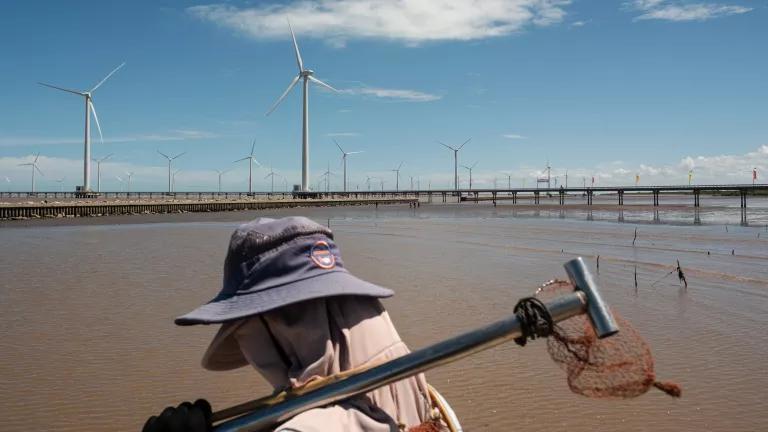
The first offshore wind farm in Vietnam, which is now home to nearly 70 wind farms

Climate finance is confusing at the best of times, and these are not the best of times. Geopolitical and economic ruptures—some exacerbated by climate impacts—are stretching government budgets at exactly the time we need to be accelerating investment in the transition to clean and resilient economies.
Despite those pressures, climate finance did reach record levels in 2024, the latest year for which there is comprehensive reporting available. Global climate finance flows reached $2 trillion for the first time while funding mobilized by developed countries for developing countries reached $136.7 billion.
However, funding is a long way off the international climate finance goals that countries agreed to in 2024: $300 billion per year in mobilized climate finance for developing countries by 2035 and total international climate finance from all public and private sources to developing countries to reach $1.3 trillion the same year. NRDC is keeping track of progress through our International Climate Finance Goals Tracker.
Most of the decisions that affect whether these goals will be met happen far away from the negotiations—in finance ministries and the boardrooms of public and private financial institutions. But the annual climate Conference of the Parties (COP) negotiations (and the CMA, the governing body of the Paris Agreement) still have an important role. Here are five key things to watch on climate finance at COP31, which will take place in Antalya, Türkiye, from November 9–20, 2026.
1. Where’s the money? Clarity on the future of public climate finance
In recent years, wealthy countries have made significant cuts to development aid, leading developing countries to voice understandable concerns about how climate finance goals will be met. Developing countries called for a dedicated space in the CMA to discuss developed countries’ obligation under the Paris Agreement to provide climate finance, and at COP30 last year, governments agreed to create a two-year Climate Finance Work Programme.
There has been intense wrangling about the timing, status, and content of this Work Programme. COP negotiations have limited sway on national legislatures and finance ministries, where decisions about allocating public climate finance are made, but the underlying question—How much international public climate finance will there be?—does deserve greater clarity.
Recent reporting from the European Union and its 27 member states, the largest block of climate finance contributors, has shown that their public climate finance continued to grow to a record €32.3 billion in 2025. And the multilateral development banks (MDBs), the largest channel for climate finance, reached a record $103 billion in climate finance for emerging markets and developing economies in 2025. NRDC has also been keeping track of how MDBs’ clean electricity finance is growing. These figures provide some reassurance, though questions remain about whether this trend will continue.
In prior years, developed countries would announce multiyear climate finance pledges to build confidence that their climate finance commitments would be met. In 2015, when the Paris Agreement was being negotiated, most developed countries announced pledges leading up to 2020, and in 2021, most again announced pledges up to 2024 or 2025. But only a handful of wealthy countries have announced new multiyear climate finance pledges for the post-2025 period. Among the G7, who have historically contributed around 80 percent of climate finance coming from developed countries, only Canada and the United Kingdom (U.K.) have made new multiyear pledges. Even Australia, the COP31 co-presidency, has yet to announce a new multiyear climate finance pledge.ge.
This is shortsighted. Developed countries cannot be expected to fully fund the rest of the world’s transition to clean energy and resilient economies, but they would be wise to show how they are continuing to lead on climate finance. Firstly, this is not charity but rather a strategic investment in a safer and more prosperous world. It delivers economic and security benefits to both contributors and recipients. This is something a growing number of nontraditional contributor countries clearly recognize, as they have begun to step up their international climate funding. Secondly, by making clear how they will continue to be leading contributors, developed countries can enhance the power of their example to spur other wealthy and high-emitting countries to contribute their fair share. At present, these other countries can deflect criticism by pointing to developed countries’ lack of clarity on future contributions.
As debates around the Climate Finance Work Programme continue, the CMA could call on developed countries and other contributors who have yet to do so to announce multiyear climate finance pledges. These could be included in countries’ fourth Article 9.5 Biennial Communications, which are due by the end of 2026. While they may not be as sizable as those announced in 2015 and 2021, they can still provide reassurance that public climate finance will continue to flow and correct some of the more catastrophic aspersions about climate finance that have been made in the absence of many clear announcements. NRDC and E3G are tracking new multiyear pledges and comparing them to countries’ previous commitments in our Climate Finance Commitments Tracker.
2. Stay the course: Sending the right signals to the broader financial system
Public climate finance from wealthy countries plays an important role, but it is part of a broader financial system that will need to be mobilized to ensure the larger climate finance target of $1.3 trillion by 2035 is met.
Last year, the COP29 and COP30 presidencies produced the Baku to Belém Roadmap to $1.3T which set out actions that could be taken to help achieve the goal. CMA.7 took note of the road map, and this year, the presidencies are expected to publish an update on progress as well as a compass for tracking how different investments are being scaled up toward the goal. the goal.
The Paris Agreement’s long-term goal on climate finance, “Making finance flows consistent with a pathway towards low greenhouse gas emissions and climate-resilient development” (Article 2.1c), also requires shifting finance flows away from fossil fuels and other polluting activities and toward clean and resilient investments. Throughout 2026, the Brazilian COP30 presidency has been convening the Veredas Dialogue and Xingu Finance Talks to allow governments to discuss concrete steps to implement this goal, and there will be further discussions at COP31. The Brazilian efforts to broaden this conversation beyond UNFCCC negotiators—to include the wider range of actors that influence finance flows, including finance ministries, central banks, investors, and credit ratings agencies—are commendable. The COP31 and future COP presidencies should continue this approach.
COP can send important signals to the wider financial system about the role it must play. At COP27 and COP28, governments called on MDBs and other financial institutions to further scale up their climate investments. In 2024, the MDBs jointly announced that they expected to provide $120 billion in climate finance for emerging markets and developing economies by 2030, and that they’re aiming to mobilize a further $65 billion in private investment. The MDBs’ announcement was key to clinching the new international climate finance goals agreed to in 2024. But in 2026, some MDBs are facing U.S. pressure to renege on their climate commitments. In its cover decision, COP31 could call on MDBs to reaffirm their 2030 climate finance commitments. With a call coming from virtually every other government in the world, it would help empower MDB leadership to stand up to U.S. pressure.
3. Tripling what? Understanding the new adaptation finance goal
Last year, governments agreed to a new goal of tripling adaptation finance by 2035. But the decision did not set a clear baseline for this goal. Some developing countries have called for this baseline to be clarified at COP31, and the African Group of Negotiators has requested a new agenda item to give a dedicated space to discuss this goal.
Improving shared understanding of the baseline for the goal will be important for both contributors and recipients. Since the previous adaptation finance goal was to double 2019 levels by 2025, and the decision to triple was taken in 2025, the most logical reading is that it is from 2025 levels. If the previous goal of doubling adaptation finance from 2019 levels by 2025 is met, it will mean the new goal is at least $120 billion per year by 2035. A decision by the CMA clarifying the baseline year would be welcome but may be politically contentious. The CMA could also call for contributors to make adaptation finance pledges (alongside their overarching climate finance pledges, as discussed above), as well as call for a collective delivery plan by contributors.
4. More wallets don’t make you richer: Making existing multilateral climate funds work
One of the areas where the COP has direct influence on climate finance flows is through the multilateral funds it has helped establish. When the climate convention was adopted in 1992, the Global Environment Facility (GEF) was tasked with providing climate funding to support developing countries in undertaking climate action. A common response to growing climate finance needs has been for the COP to create climate funds. Over the following 30 years, the COP has created five additional climate funds to support developing countries: the Least Developed Countries Fund (LDCF), the Special Climate Change Fund (SCCF), the Adaptation Fund (all three established in 2001); the Green Climate Fund (GCF, 2010); and the Fund for Responding to Loss and Damage (2022).
Once created, these funds often develop well-intended yet sprawling bureaucratic requirements that hamper their ability to deliver for the communities they are supposed to serve. Rather than doing the painstaking and often boring work to fix these problems, the temptation is to create a new fund in the hope that it’ll avoid the pitfalls of previous efforts. But having more wallets doesn’t make you richer. Almost inevitably, the new fund follows the same trajectory, and the fundamental constraint of inadequate resources to go around isn’t fixed. Money is just spread more thinly.
COP31 can take some tangible steps to help break this cycle:
A key task is agreeing on the Adaptation Fund serving the Paris Agreement. The Adaptation Fund is one of the nimbler climate funds, providing grant funding to developing countries for adaptation projects. It pioneered the principle of direct access: channeling funding directly to developing country institutions rather than having to go through international entities like the World Bank, which is the case for a lot of international climate finance. The Adaptation Fund can receive a 5 percent share of proceeds from carbon trading that takes place under the Paris Agreement’s Crediting Mechanism. This could yield hundreds of millions—and potentially billions—of dollars for adaptation. Critically, this funding would not be reliant on national budgets and political cycles. But these proceeds can only flow once the fund, which was created to serve the Kyoto Protocol, undergoes governance reforms so that it can serve the Paris Agreement.
The Fund for Responding to Loss and Damage was established in 2022 to help countries deal with climate impacts that go beyond their ability to adapt. It has received more than $800 million in pledges but has not yet approved any funding. The devastating Bhote Koshi flash floods that hit Nepal and China in August 2026 have been a key test of the Fund’s ability to deliver. The board held an extraordinary meeting in October and agreed to set aside $21.6 million for Nepal. This is an important milestone, but Nepal still needs to have a proposal approved by the board to receive this funding. At COP31, there is likely to be discussion on how the fund can deliver for countries in need, including how it strikes the right balance between responding to rapid disasters like flooding and slow-onset events like sea level rise. The fund is also due to begin its first replenishment in 2027, and the COP can set expectations around the scale of funding needed to support developing countries in responding to escalating levels of loss and damage.
The Green Climate Fund, the world’s largest multilateral fund dedicated to climate, will have its third replenishment in 2027. Its previous replenishment rounds have generated around $10 billion in pledges each time, but with the United States pulling out in 2025, the U.K. retroactively cutting its pledge earlier in 2026, and the GEF having a disappointing replenishment this year, the signs for the GCF are not positive. COP31 can make decisions to better position the GCF for a successful replenishment, including by setting out what it wants to see in the fund’s next strategic plan that will be adopted next year and suggesting names for a high-level facilitator for the replenishment, a figure who plays an important diplomatic role in drumming up pledges.
COP is also the place where governments often make pledges to climate funds, especially to the Adaptation Fund, LDCF, and SCCF, and NRDC will be tracking these in our Climate Funds Pledge Tracker.
5. Bringing the outside in: Non-negotiated climate finance initiatives
The previous four areas all relate to formal COP and CMA decisions. But as the governments shift from negotiating agreements, goals, and tracking systems to implementing these commitments, the non-negotiated or “outside” initiatives are taking on a greater role at COP.
As co-president of COP31, Australia has been working on the Access to Climate Finance for Small Island Developing States (SIDS) and Least Developed Countries (LDCs) Statement and Action Plan. The climate finance architecture is complex and difficult to navigate, and this has been a particular challenge for capacity-constrained vulnerable countries like SIDS and LDCs. There is broad agreement that access to climate finance needs to be significantly improved. To move the needle, the Statement and Action Plan must build on previous pledges and initiatives, such as the Taskforce on Access to Climate Finance, and include new measurable commitments, such as increasing the share of climate finance flowing through direct access modalities; and it must develop common metrics for measuring access, like the time between proposal submission, approvals, and disbursements, along with clear and consistent reporting on these metrics by climate finance institutions. Some international climate finance institutions have been resistant to implementing access reforms, and they cannot be allowed to limit commitments to the lowest common denominator. Instead, ambitious governments, climate finance institutions, the private sector, and civil society organizations can work to craft strong and effective commitments on access, then advocate to ensure the laggards catch up.
In another approach to addressing access challenges, Pacific Islands Forum leaders have created their own climate finance institution, the Pacific Resilience Facility (PRF), owned and operated by Pacific governments, which will provide grant funding to community resilience projects. The PRF aims to raise $500 million in initial capitalization by COP31. Funds will be invested internationally and regionally, with the aim of generating sustainable annual returns to finance projects. So far, the PIF has received $180 million in pledges.
COP31 will also see the Turkish co-presidency launch its Climate Implementation Bridge initiative, which aims to strengthen the connection between national climate priorities, investment opportunities, and financing partners. This should build on country platforms and initiatives like the NAP Implementation Alliance and the Fostering Investable National Implementation for adaptation and resilience (FINI). Launched at COP30 and co-led by NRDC and the Atlantic Council’s Climate Resilience Center, FINI connects businesses, insurers, banks, government officials, philanthropies, and civil society leaders to test solutions that translate national adaptation priorities into clearer investment opportunities with credible financing pathways.
From negotiating to implementing: The hard work begins
At the past two COPs, governments agreed to major new goals on climate finance for developing countries. Now, the focus must turn to how to deliver them. This requires a different role for COP31: one focused on sending the right signals to the global financial system, on improving transparency of commitments, on reforming the climate funds the COP has created to make them more effective, and on building an ecosystem of outside initiatives to support climate finance delivery.
This NRDC.org blog is available for online republication by news media outlets or nonprofits under these conditions: The writer(s) must be credited with a byline; you must note prominently that the blog was originally published by NRDC.org and link to the original; the blog cannot be edited (beyond simple things such as grammar); you can’t resell the blog in any form or grant republishing rights to other outlets; you can’t republish our material wholesale or automatically—you need to select blogs individually; you can’t republish the photos or graphics on our site without specific permission; you should drop us a note to let us know when you’ve used one of our blogs.
Related Blogs
Overshoot Demands a New Era of Adaptation, Loss and Damage, and Climate Justice
Finance Beyond the COP: How India Is Rebuilding the Case for Global Climate Finance