
Midway Through a Tumultuous 2026, Where Do We Stand on International Public Climate Finance?
Climate finance is in a period of flux, but there are pathways to scaling up funding to meet the moment.
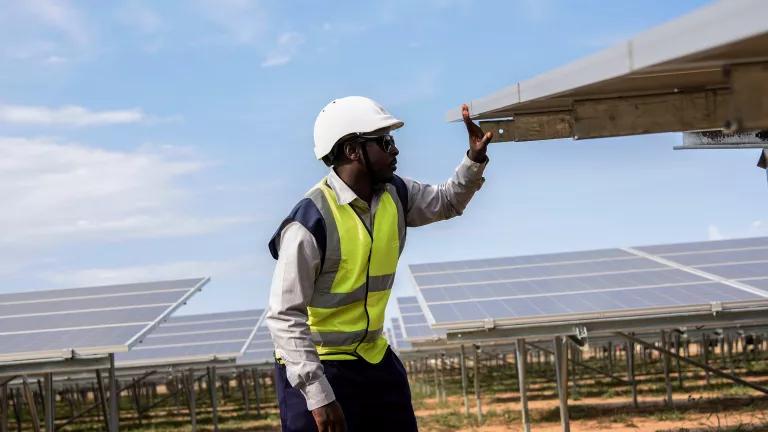
Ambrose Kamukama, an Operations and Maintenance Engineer from Access Uganda Solar Ltd., works at Soroti Power plant in Soroti District, Uganda, on December 12, 2016.

International climate finance is in an extremely challenging period. As climate impacts intensify and the imperative to finance the transition to resilient and net zero economies becomes more pressing, political support for public funding for this is waning. The challenging global political and economic situations—including the COVID-19 pandemic and wars in Ukraine and the Middle East that have driven supply chain disruptions, budget deficits, and a cost-of-living crisis—have meant richer countries are deprioritizing international climate funding.
This will impact the ability of the world to hit the global climate finance goals agreed to in United Nations (U.N.) climate negotiations, which are designed to catalyze broader efforts to raise climate investment to the levels needed for developing countries to combat the climate crisis. NRDC’s new International Climate Finance Goals Tracker keeps tabs on progress toward the four quantified post-2025 targets and will be updated as new climate finance data becomes available.
To complement the tracker, this piece reviews recent developments across the international public climate finance landscape. The bottom line: It’s a mixed bag.
International public climate finance
- Cuts to development assistance by many donor countries have raised concerns that climate finance may also fall: Total official development assistance fell 8.5 percent in 2024 and 23.3 percent in 2025—the largest single-year drop on record, 70 percent of which was attributable to the United States—and is projected to decrease a further 6.9 percent in 2026. While many developed countries have attempted to protect climate finance within shrinking international assistance budgets, the depth of recent cuts has led to fears that a decline in climate finance will be unavoidable.
- Public climate finance dropped slightly in 2024: The latest report by the Organisation for Economic Co-operation and Development (OECD), released in May 2026, on developed to developing country climate finance showed a slight drop in public finance from $109.9 billion in 2023 to $106.2 billion in 2024, the first time that levels have ever fallen. This may be evidence of development assistance cuts starting to impact climate finance.
And yet…
- Developed to developing country climate finance hit record levels in 2023 and 2024: The OECD’s latest report found that developed countries reached more than $130 billion in mobilized climate finance for developing countries in both 2023 and 2024, above the $100 billion per year goal agreed for the period 2020–2025. Developed countries failed to hit this goal in 2020 and 2021, meeting it only in 2022, so overachieving in subsequent years is critically important. Notably, while the $100 billion goal was a mobilization goal—meaning both public funding and the private investment that this catalyzes can count toward it—developed countries were able to exceed $100 billion in solely public finance in 2023 and 2024, an increase of more than $10 billion from 2022 levels. It is almost certain that the $100 billion will once again be exceeded in 2025, and eyes now turn to the new goal of mobilizing $300 billion by 2035.
Multilateral development banks (MDBs)
- The World Bank retired its overarching climate finance target: Under pressure from the Trump administration, in June 2026, the World Bank Group announced it was dropping its target for 45 percent of its financing to include climate co-benefits. The World Bank is the single-largest entity providing climate finance to developing countries. The World Bank and other MDBs collectively pledged to provide $120 billion in public climate finance and mobilize a further $65 billion in private finance by 2030. The United States is a major shareholder in most MDBs and has significant influence. If MDBs’ ability to deliver climate finance is undermined, it will make global climate finance goals much more challenging to deliver.
And yet…
- The World Bank’s other climate finance targets and Climate Change Action Plan remain in place: The Trump administration had been pushing for a more widespread gutting of the World Bank’s climate work, but other shareholder countries resisted this. More than 100 emerging market and developing economy countries circulated a letter calling for the World Bank to retain its Climate Change Action Plan. Together with developed country shareholders, they were successful in getting an agreement to continue the action plan indefinitely. This means the World Bank’s commitments to align all finance with the Paris Agreement goals and to continue reporting on its climate finance remain. Furthermore, while the overarching 45 percent target has been retired, there are still climate finance targets for individual World Bank Group institutions: 45 percent for the International Development Association, which provides grants and loans to low-income countries, through 2028; 30 percent for the International Bank for Reconstruction and Development, which lends to middle-income countries, through 2030; and 35 percent for the International Finance Corporation, which focuses on private sector development, through 2030. These provide a backstop against the bottom falling out on the World Bank’s climate finance. The World Bank Group had already exceeded its 45 percent climate finance target in 2025, reaching 48 percent of commitments, which are worth more than $50 billion. Shareholders will need to hold World Bank leadership accountable for meeting the remaining targets and commitments and for delivering the increased clean energy and resilience investments that developing country governments are saying are their priority for MDB financing.
- MDB climate finance reached record levels in 2025: The latest joint reporting by all MDBs shows that their climate finance for low- and middle-income countries rose 21 percent to $103 billion in 2025, their highest level ever, putting them on course to deliver their pledge to deliver $120 billion in public climate finance by 2030, which is critical for staying on track to meeting the goal of mobilizing $300 billion from bilateral and multilateral sources by 2035. With agreed reforms set to unlock tens of billions more in lending capacity in MDBs annually, their climate finance should rise in line with this. It will be important for other government shareholders to continue to stay vigilant to U.S. efforts to undermine MDBs’ climate work, prevent the management of these institutions from obeying in advance, and push for more ambition in the future to reach the 2035 climate finance goals.
Multilateral climate funds
- A disappointing Global Environment Facility (GEF) replenishment: The GEF’s ninth replenishment in April 2026 garnered just $3.9 billion in pledges from a reduced group of donor countries. This is the lowest replenishment round in 20 years, even as the institution is charged with supporting a growing number of multilateral environmental agreements. In addition, funding allocated to the GEF’s climate change focal area was cut from 16 percent of resources in GEF-8 to 9 percent in GEF-9.
- The United Kingdom cuts its Green Climate Fund (GCF) contribution: In May 2026, the U.K. informed the GCF that it would be retroactively cutting its 2023 pledge of £1.6 billion ($2 billion) to the fund by 50 percent. This cut has taken the U.K. from being the largest cumulative pledgor to the GCF to fourth place. This follows the United States canceling all of its future GCF pledges in 2025 (it had already paid in $2 billion). The United States never signed contribution agreements to make the full value of its pledges official, so the fund did not bank on the money arriving. The U.K. had signed contribution agreements, so the GCF had planned on this funding being delivered, and the cut has upended the fund’s budgeting.
And yet…
- U.N. multilateral climate fund approvals reached a record high in 2025: The GCF, GEF, Adaptation Fund, Least Developed Countries Fund, and Special Climate Change Fund collectively approved $3.9 billion for climate projects in 2025 (86 percent through the GCF). As agreed at COP29 in 2024, these funds are supposed to triple outflows from 2022 levels ($1.9 billion) by 2030, which would be $5.7 billion. Assuming a straight-line trajectory to the goal, they are currently ahead of track. However, the four-year replenishment cycles of the two biggest funds, the GCF and GEF, mean that funding approvals follow a sawtooth pattern, with pronounced peaks after a replenishment and troughs as funds run low on resources ahead of their next replenishment. Therefore, past trend lines are not necessarily predictive of the future; they depend on renewed contributions by governments and/or funds finding innovative sources of capital.
- Fund innovations are unlocking additional capital: The GCF’s board recently agreed to reforms in how it accounts for loans and guarantees that will free up an additional $4.3 billion of financing over the next two years, without the need for new contributions. Similar to those undertaken by many MDBs in recent years, these reforms involve reducing the amount of money the fund needs to hold as a capital reserve in the case of nonperforming projects. The GCF will also be exploring a long-delayed policy that would enable it to receive contributions from nongovernmental entities, including the private sector and philanthropies. The Adaptation Fund has long been able to accept such donations and also receives a share of proceeds from U.N. carbon trading mechanisms. The Adaptation Fund will receive 5 percent of credits generated from the new Paris Agreement Crediting Mechanism. Depending on the scale of credit generation and carbon prices, it has the potential to raise significant grant-based financing for the Adaptation Fund that is not dependent on national budget decisions.
Adaptation finance
- Reporting for 2024 suggests that developed countries were not on track to double adaptation finance from 2019 levels by 2025: OECD reporting shows that while adaptation finance rose to $34.7 billion, it has been increasing more slowly than mitigation finance. Adaptation finance growth was not on track to reach the agreed-upon goal at COP26 in Glasgow of doubling adaptation finance from 2019 levels (around $20 billion) by 2025.
And yet…
- MDB adaptation finance increased in 2025, putting the doubling goal back within reach: MDB adaptation finance for low- and middle-income countries rose by 31 percent to $35 billion in 2025. Around 70 percent of MDB climate finance is attributable to developed countries, around $25 billion. Bilateral adaptation finance was $14.5 billion in 2024, so if this remained stable, reaching $40 billion looks to be within reach. Full data on 2025 bilateral climate finance will not be available until 2027, at the earliest. And to reach the new goal of tripling adaptation finance by 2035 will require increased effort.
Bilateral climate finance
- Most developed countries haven’t announced new climate finance commitments: In the past, developed countries have announced multiyear climate finance pledges that detail how they will contribute to the collective climate finance goals. Many countries announced multiyear commitments in 2015 and then again in 2021. These announcements helped build confidence that governments were taking collective climate finance goals seriously and helped both recipients and providers plan ahead about how best to use resources. However, as NRDC and E3G’s Climate Finance Commitments Tracker shows, few countries have announced new climate finance pledges for the post-2025 period. This has contributed to increasingly strained climate finance negotiations in the last few years, with developing countries concerned about how future climate finance goals will be met and pushing for a dedicated space to discuss Article 9.1 of the Paris Agreement, which speaks to developed countries’ obligation to provide climate finance.
And yet…
- Every country that has announced a new public climate finance commitment so far has increased their funding: Since 2024, only seven countries have announced new overarching multiyear climate finance pledges, but every one of them has committed to overall increases. While these have been more modest increases than previous multiyear announcements in 2015 and 2021, it is notable that even in a fiscally constrained environment with many competing priorities, countries are continuing to increase their international public climate finance. In years past, countries made these announcements with significant fanfare, often at the G7 or G20 summits, or the U.N. General Assembly. This time around, they have been buried deep in government policy documents, a sign that governments no longer see such commitments as a point of diplomatic pride, and potentially, could view them as a domestic political liability.
Where next?
What is clear from these mixed signals is that we’re in a period of flux. The climate finance system is experiencing growing pains as it moves from negotiating new targets to meeting them. And this comes amid massive geopolitical and economic ruptures affecting both contributor and recipient countries.
Given such challenges, we need to craft a politically feasible path to scale up international climate finance to meet the moment. This will mean grappling honestly with how global shifts affect the climate finance regime that has been negotiated over the past three decades, engaging in contributor countries to make the strategic case for greater climate investment, and working seriously on mechanisms to increase public revenues to fund these increases.
This NRDC.org blog is available for online republication by news media outlets or nonprofits under these conditions: The writer(s) must be credited with a byline; you must note prominently that the blog was originally published by NRDC.org and link to the original; the blog cannot be edited (beyond simple things such as grammar); you can’t resell the blog in any form or grant republishing rights to other outlets; you can’t republish our material wholesale or automatically—you need to select blogs individually; you can’t republish the photos or graphics on our site without specific permission; you should drop us a note to let us know when you’ve used one of our blogs.
Related Blogs
Overshoot Demands a New Era of Adaptation, Loss and Damage, and Climate Justice
Finance Beyond the COP: How India Is Rebuilding the Case for Global Climate Finance
