
LNG in the Aquarium of the World: A Direct, Existential, and Unacceptable Risk
Renowned Mexican and international scientists condemn industrialization of the Gulf of California for LNG, urging protection of the region’s exceptional natural heritage.

A school of fish swimming in the Gulf of California, May 2025


This week, in a compelling expression of “profound concern,” more than 100 leading marine scientists from Mexico and around the world voiced their unequivocal opposition to the proposed construction and operation of liquefied natural gas (LNG) projects in the iconic Gulf of California (also called the Sea of Cortez). Published on September 23, 2026, in the Mexican newspapers Reforma (Mexico City), El Norte (Monterrey), and Mural (Guadalajara), and grounded in unimpeachable scientific consensus, the 800-word scientists’ statement concludes with crystal clarity that “because of its ecological sensitivity, and consistent with [the region’s] global recognition, the Gulf of California is the wrong place to develop LNG.”
The scientific signatories of the statement not only include renowned oceanographer Dr. Sylvia Earle—former chief scientist at the National Oceanic and Atmospheric Administration (NOAA)—but are anchored by some of Mexico’s most respected leaders in marine and conservation science over many decades, including:
- Julia Carabias Lillo, former secretary of Mexico’s Secretariat of Environment and Natural Resources and currently, professor of restoration ecology at the National Autonomous University of Mexico;
- Exequiel Ezcurra, former president of Mexico’s National Institute of Ecology and Climate Change and chair of the scientific committee of the Convention on International Trade in Endangered Species of Wild Fauna and Flora;
- Lorenzo Rojas-Bracho, past chair of the International Whaling Commission’s Conservation Committee and chair of the International Committee for the Recovery of the Vaquita;
- Rodrigo Medellín, former director general of Wildlife of the Mexican government and an advisor to the Mexican government on wildlife issues for more than 30 years;
- Octavio Aburto, professor of marine biology at Scripps Institution of Oceanography, a National Geographic Explorer, and winner of the Mexican ministry of the environment’s Conservation of Nature Award; and
- Jorge Urban R, professor of the Department of Coastal and Marine Sciences of the University of Baja California Sur (UABCS), president of the Mexican Marine Mammologist Society, and founder of the Marine Mammal Research Program at UABCS.
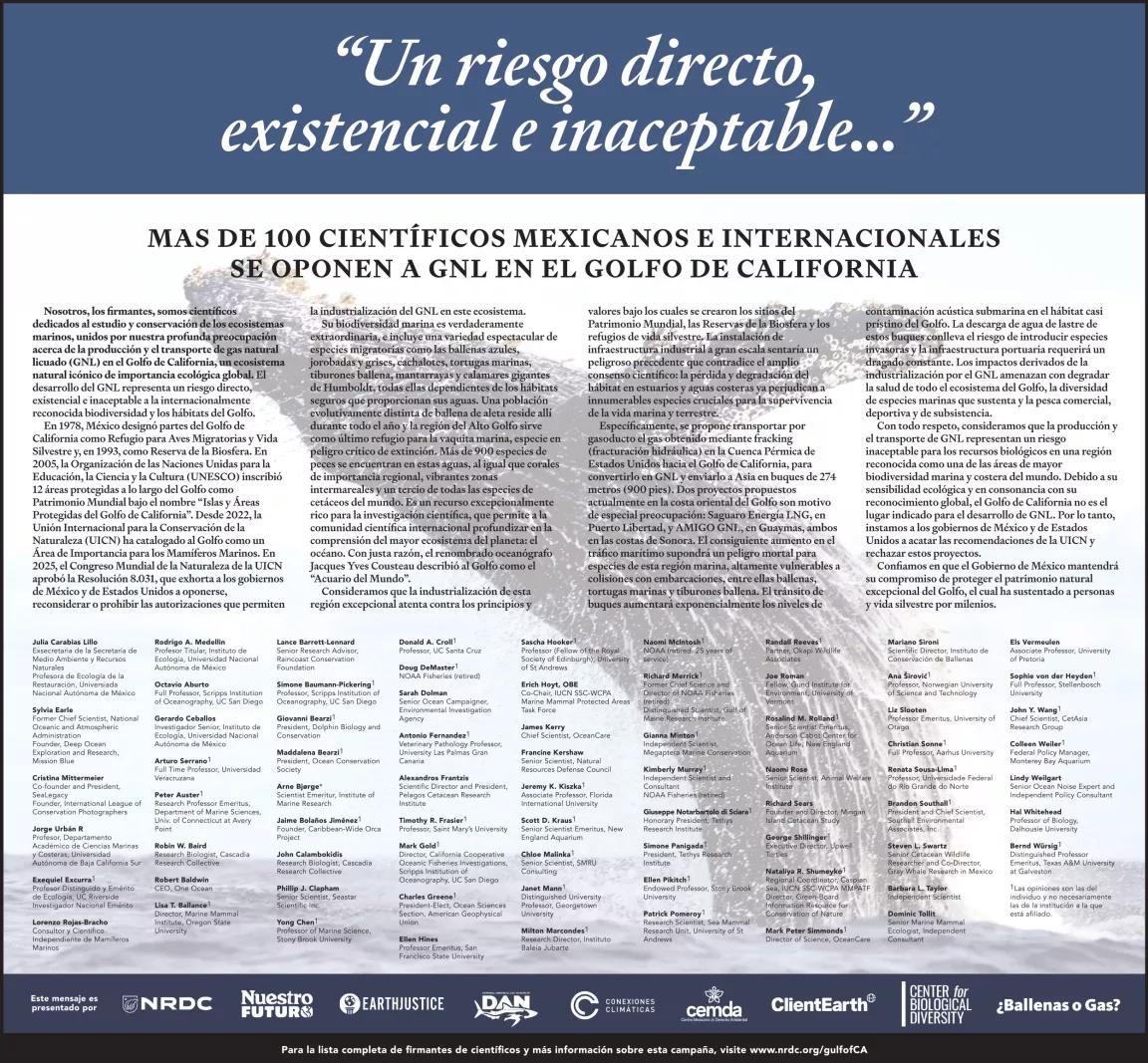
Print ad published in Mexican newspapers, including Reforma, El Norte, and Mural
In their joint statement, these and scores of other senior marine and conservation scientists rest their concerns, first and foremost, on the repeated international recognition of the Gulf of California as an ecosystem of “extraordinary” species diversity—recognized by Mexico as both a Biosphere Reserve and a Migratory Bird and Wildlife Refuge and by UNESCO as the “Islands and Protected Areas of the Gulf of California” World Heritage site. They cite, most recently, the October 2025 resolution of the IUCN’s World Conservation Congress calling on the governments of Mexico and the United States to “oppose, reconsider, or prohibit authorizations permitting LNG industrialization of the Gulf.”
The scientists note that this unique history of formal international recognition has supported “a spectacular array of migratory species, such as blue, humpback, sperm, and gray whales, sea turtles, whale sharks, manta rays, and giant Humboldt squid—all dependent on the safe habitat that the Gulf provides.” They cite also “an evolutionarily distinct population of fin whales [that] resides there year-round,” the more than 900 species of fish found in Gulf waters, and the presence of one-third of all cetacean species on earth.
“With good reason,” they observe, “renowned oceanographer Jacques Yves Cousteau described the Gulf as the ‘Aquarium of the World.’”
From this factual foundation of biodiversity flows the statement’s central contention that industrialization in such a place is “contrary to the principles and values that World Heritage sites, biosphere reserves, and wildlife refuges were created to uphold.” According to the scientists, disregard of those globally respected “principles and values” is irreconcilable with recognized science:
“Siting of major industry will create a dangerous precedent at odds with the broad scientific consensus that the loss and degradation of habitat in the world’s estuaries and coastal waters is already harming innumerable species crucial for sustaining both marine and terrestrial life.”
The scientists then focus their “particular concern” on two LNG projects currently proposed along the eastern Gulf: Saguaro Energ´ia LNG, at Puerto Libertad, and AMIGO LNG, at Guaymas; both conceived entirely to receive and process fracked gas from the Permian Basin region of western Texas. Piped across the border to the Gulf for conversion to LNG, this U.S. gas would then be transported for decades to come to Asia on 900-foot-long LNG vessels, causing “existential” harm to the sensitive Gulf ecosystem: Mortal risks of ship strikes, exponential increase in levels of harmful underwater noise pollution “in the Gulf’s near-pristine acoustic habitat,” and the introduction of invasive species as a result of the discharge of ballast water from tankers. All of these threatened impacts “risk degrading the health of the entire Gulf ecosystem, the diversity of species it sustains, and commercial, recreational, and subsistence fisheries.”
Citing these inevitable impacts of industrialization and recalling the recommendations of the IUCN’s World Congress just a year ago, the scientists urge the Mexican and U.S. governments to reject both projects, concluding that “the production and transport of LNG pose an unacceptable risk to biological resources in a region renowned as one of the world’s most important areas of biodiversity.” They urge the government of Mexico to continue its long-standing commitment to protection of “the Gulf’s exceptional natural heritage, which has sustained the people and wildlife of the region for millennia.”
A complete list of signatory scientists can be viewed here. In addition to NRDC, publication of the statement in Reforma is sponsored by Defensa Ambiental del Noroeste, Centro Mexicano de Derecho Ambiental, Nuestro Futuro, Conexiones Climáticas, Ballenas o Gas, Earthjustice, Center for Biological Diversity, and ClientEarth.
This consensus of scientific condemnation is just the latest in a sequence of significant setbacks that have plagued LNG industrialization of the Gulf of California:
- First, over the past 18 months, Saguaro Energía LNG has suffered seemingly endless legal and financial challenges.
- Second, although its CEO has repeatedly promised imminent investor support needed to reach a Final Investment Decision (or FID) to proceed with project construction, AMIGO LNG has failed to do so and is instead facing litigation from a range of opponents in Mexico.
- Third, just last March, a third project—Vista Pacifico LNG—was canceled by Sempra.
- And, finally, just this week, in a release of new data compiled through its latest national poll on “Latinos and the Ocean,” Azul documented overwhelming levels of support among U.S. Latino voters for protection of our oceans and coasts:
- “90 percent say clean beaches and clean oceans are essential to both our economy and our quality of life.”
- “76 percent support banning offshore drilling and replacing it with renewable fuels such as solar and wind.”
- “80 percent say a candidate who supports stronger policies to protect the coastline and ocean would make them more likely to vote for that candidate.”
With growing intensity, and from all directions, the tide is turning against the U.S. fossil fuel industry in the Gulf of California. And the science is in: The risk to biodiversity from LNG in the Aquarium of the World is “existential, direct, and unacceptable,” and it must be stopped.
This NRDC.org blog is available for online republication by news media outlets or nonprofits under these conditions: The writer(s) must be credited with a byline; you must note prominently that the blog was originally published by NRDC.org and link to the original; the blog cannot be edited (beyond simple things such as grammar); you can’t resell the blog in any form or grant republishing rights to other outlets; you can’t republish our material wholesale or automatically—you need to select blogs individually; you can’t republish the photos or graphics on our site without specific permission; you should drop us a note to let us know when you’ve used one of our blogs.
Our seas aren’t gas stations!
Mexico Pacific has been trying to turn a marine sanctuary into a gas station and shipping channel for dirty liquefied natural gas. Tell it to reverse its plans.

Our seas aren’t gas stations
U.S. energy company Mexico Pacific has been trying to turn a marine sanctuary—home to nearly 40 percent of all marine mammal species—into a gas station and shipping channel for liquefied natural gas. Tell Mexico Pacific to reverse its plans to export dirty energy out of the Gulf of California.
Related Blogs

Wrong Technology, Wrong Waters

Sempra Cancels Vista Pacifico LNG in the Aquarium of the World
