Weakening Fuel Economy Standards Will Cost You More Money
In fact, they will cost drivers more money. Big Oil gets richer. Americans get poorer.


In his first action as secretary of the U.S. Department of Transportation (DOT), Sean Duffy signed an order to “immediately initiate a rulemaking to rescind or replace all existing CAFE standards.” The press release then goes on to cherry-pick data to support untrue claims that the standards are raising prices for drivers.
The truth is, today’s fuel economy standards save you money. In fact, fuel economy standards updated last year are estimated to save drivers $23 billion in fuel costs and avoid the consumption of about 70 billion gallons of gasoline through 2050. And counting new vehicles’ initial cost, individual car owners will save $630 to $840 over the life of a vehicle.
Weakening these standards will cost drivers more money. They will make your new vehicle guzzle more gas, and you’ll pay more at the pump than whatever you might save on the car lot.
Big Oil gets richer. Americans get poorer.
Here are the facts.
What are CAFE standards?
No, CAFE standards have nothing to do with your morning coffee. CAFE stands for "Corporate Average Fuel Economy" standards. Fuel economy standards have been saving you money for 50 years. Way back in 1975, Congress enacted legislation to reduce energy and oil usage by setting higher miles-per-gallon standards for cars and trucks under the Energy Policy and Conservation Act.
Since 1975, these standards have saved more than two trillion gallons of gasoline, enough to run every car and light truck in the United States for more than 15 years.
The DOT's National Highway Traffic and Safety Administration (NHTSA) is supposed to strengthen the standards as gas-saving technology improves. According to the DOT, “When these standards are raised, automakers respond by creating a more fuel-efficient fleet, which improves our nation’s energy security and saves consumers money at the pump.”
Back in the 1970s, vehicles on average got 13 miles per gallon. The standards passed last year by the Biden administration would bring real-world fuel economy to more than 38 miles per gallon in model year 2031. To put that in a different way: In 1970, a car with a 10-gallon gas tank could go 130 miles before refilling. In a 2031-model car with the same size tank, you'll be able to go more than three times as far—380 miles—without stopping at a gas station. That saves you both money and time.
What Trump (and oil companies) want
President Trump’s January 20 executive order instructed agencies, including NHTSA, to weaken or eliminate any regulations that “impose an undue burden” on the use of oil and other fossil fuels. Secretary Duffy’s memorandum sets in motion the process to weaken the existing standards. That can happen, however, only after NHTSA issues a proposal, takes and responds to public comments, and issues final rules change.
While Duffy’s memo does not say by how much the agency will weaken the CAFE standards, the writing is on the wall. Project 2025—the administration’s playbook that Trump deceptively pretended not to know about during his presidential campaign—advocates rolling them back to the level set in 2007.
That will cost you and your family more money.
Clean cars expand consumer choice
The Duffy memo makes many outlandish claims that do not stand the sniff test, including that the DOT will end the federal “EV mandate,” which, like the energy emergency, simply does not exist.
CAFE standards do not require automakers to sell more electric vehicles—in fact, the law largely restricts NHTSA from considering EVs when setting standards. Ultimately, the law requires NHTSA to set standards at the maximum feasible level manufacturers can achieve. The current rules do that; weaker ones won’t.
Indeed, automakers can meet the CAFE standards without EVs, just by making gasoline-powered and gas-electric hybrid cars more fuel efficient. Data from the Alternative Fuels Data Center shows this in action: Manufacturers have increasingly developed new models of alternative fuel vehicles (AFV) and hybrid electric vehicles (HEV)—but not at the expense of gasoline options. As the charts below show, it’s clear that innovation in AFVs is not harming customer choice but actually increasing it.

Source: Alternative Fuels Data Center
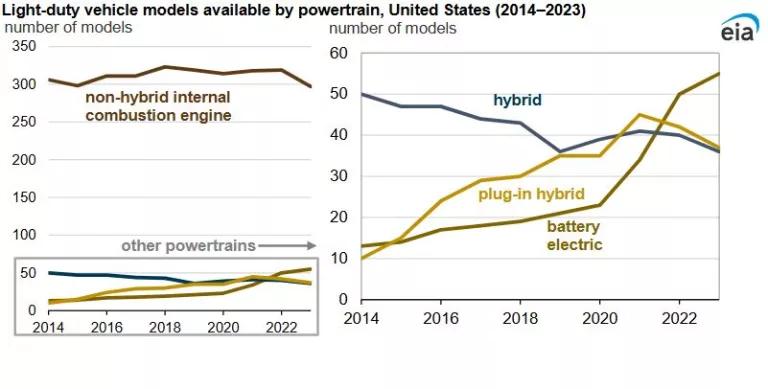
The Cox Automotive Study quoted in the memo supports this as well, stating that “At the start of March, new-vehicle inventory in the U.S. stood near 2.74 million units, a 52 percent increase from one year earlier,” and “…2024 remains on track to be the best new-vehicle sales year since 2019.”
And while Duffy claimed that the “EV mandate” and CAFE standards are making new vehicles unaffordable, his own memo links to a source showing that car prices are falling. The Cox Automotive report notes, ”New-vehicle average transaction prices (ATP) in March 2024 declined from February and were lower year over year by 2.7 percent; new-vehicle ATPs are now down 5.4 percent from the December 2022 peak.”
That’s to say nothing of the fact that the CAFE standards haven’t even kicked in yet—they start in 2027. The argument that a standard that won’t take effect for a few more years has increased yesterday’s car prices is ridiculous.
We agree there need to be more affordable vehicle models available—and automakers can and should do that. The CAFE standards will then help ensure that the cars they sell will be cheaper to keep fueled up.
This is just the start of the misinformation that the Trump administration will use to justify rollbacks of clean vehicle standards and incentives, all with the intention to line the pockets of the fat cat oil executives. American drivers, unfortunately, will have to pay the cost. That’s more nonsense.
Related Blogs
The EPA Cooks the Books in Trying to Cook the Planet
The EPA Continues Pushing a Gas Guzzler Mandate