What Trump Gets Wrong About the Electricity Grid
President's Trump efforts to prop up dirty coal plants ignores the reality that clean energy is the fastest-growing power source—and with the right policies, it will deliver a more reliable grid.

Workers installing a rooftop solar panel array in Silver Springs, Maryland, as part of a community solar project

Demand for electricity is growing in the United States—driven not only by AI data centers but also by increasing consumer interest in electric vehicles (EVs) and in electric heating and cooling systems for our homes and businesses, as well as the onshoring of manufacturing. The electricity grid needs to expand to meet this demand. The smart way to do this is by powering up the U.S. economy with clean, affordable, reliable electricity as well as by building out the country’s transmission system.
The United States is well positioned to meet new electricity demand with clean energy. There has been an exponential growth in U.S. solar and wind power in recent decades, augmented more recently by increasing amounts of large-scale battery power. In 2024, for the first time, U.S. solar and wind power produced more electricity than coal-fired power generation, and renewable energy—including solar, wind, hydropower, and other forms of renewables—produced nearly a quarter of electricity in the country.
This growth will continue. The U.S. Department of Energy’s (DOE) Energy Information Administration recently predicted that 93 percent of new electricity capacity built in 2025 will come from solar power, battery storage, and wind power. Clean energy jobs are also on the rise: The industry added new jobs at three times the rate of the overall economy in 2023.
The Trump administration is attempting to turn back the clock with efforts to bail out unprofitable coal plants and to obstruct renewable energy. Just last month, Energy Secretary Chris Wright took to the stage at the largest national gathering of the energy industry to amplify the inaccurate message that “everywhere wind and solar penetration have increased significantly. Prices on the grid went up.” And this week, President Trump signed a slew of executive orders aimed at propping up the coal industry and threatening states with strong climate and clean energy policies.
If this sounds familiar, you aren’t experiencing déjà vu, as Trump attempted a similar effort to revive coal power in his first term. Those efforts failed spectacularly, and ultimately, these will fail too. Why? Because of economics and the realities of today’s electricity grid in a time of climate change–induced extreme weather events.
Clean energy lowers electricity system costs—and fossil fuel power increases them
One of the great strengths of clean power is that its fuel—the sun, the wind—is free and abundant. Zero-marginal cost renewables reduce wholesale power prices. When gas- and coal-powered plants run less often because of greater reliance on clean energy and energy efficiency, wholesale prices—the blended cost of all the plants that are operating—go down because fuel is the largest cost of fossil plants. Energy efficiency measures also help to reduce peak demand for power in the summer and winter.
We are experiencing a rapid increase in natural disasters and extreme weather, driven by fossil fuels and climate change. Electricity prices have become volatile because of overdependence on fossil fuels, which can fail in cold weather, and our lagging pace in installing new renewables, which keep prices low. Combined with the costs to replace and maintain aging grid infrastructure and rebuild after disasters, some states have seen sharp increases in electricity rates. The key driver of these costs is not renewable energy. The capital costs to build new solar and battery storage are now competitive with new gas plants, and solar energy is free to produce once it is built.
A recent NRDC report found that wildfire-related costs are the primary cause of spiraling electricity costs for the California utility PG&E. And utilities across the United States are incurring additional costs as they attempt to make electricity resilient against extreme weather events. In effect, climate change itself is driving up the cost of electricity.
The Trump administration, however, ignores the role that climate change and other factors are playing in increasing electricity costs; instead amplifying the myth that clean energy is the cause of rising electricity prices. That sweeping claim is unsupported by data and contradicted by observable facts. It’s a fact that renewable energy resources reduce wholesale electricity prices. And research has found that many of the states with the largest increases in wind and solar generation since 2010—including Iowa, Kansas, New Mexico, and Oklahoma—have seen retail electricity rates rise slower than inflation. Indeed, in 2024, three of the states with the lowest retail electricity rates in the United States had among the largest portions of wind power in their in-state electricity generation: North Dakota (34.7 percent wind power), Oklahoma (40.6 percent wind power), and South Dakota (59.1 percent wind power).
Rising electricity rates and bills produce a significant energy burden for low- and middle-income consumers, who are often forced to choose between paying their electricity bills and paying the rent or other basic needs. We need to address the needs of these communities with targeted low-income policies such as percentage of income payment programs (PIPPs), which cap energy payments at a percentage of income, and energy efficiency, electricity bill discount, and community solar programs. In contrast, the Trump administration is harming low-income communities by trying to push for higher-cost fossil fuels and even, shockingly, by firing the entire federal staff responsible for the Low Income Home Energy Assistance Program, which assists the states in helping communities keep warm in the winter and cool in the summer.
Clean energy supports grid reliability
Contrary to the myths being pushed by the Trump administration, clean energy supports grid reliability, and fossil fuels often fail the tests of reliability. For power grids that regularly operate with a high amount of renewable energy, older fossil fuel power plants generally turn on only when the grid is most stressed. When new renewable resources are sited nearby, renewables provide continual energy to the grid, and these legacy units can be retained until no longer needed.
Summer 2024 was the hottest summer on record. Despite this, solar and battery storage met record peak power demand in regions where temperatures repeatedly passed triple digits. In extreme heat, afternoons have been the riskiest and most expensive times for the grid, due to spiking demand for air-conditioning. But because this is also when solar production is highest, risks have diminished, and prices have gone down.
Meanwhile, two of the largest failures of the nation’s power grid happened in 2021 and 2022 when natural gas infrastructure across the country failed. This failure had fatal consequences.
The DOE has also found that offshore wind power with interconnected transmission systems can enhance electricity reliability by providing high capacity-factor power close to urban centers with congested grids.
Grid planners know how to operate high-renewable grids
On March 2, 2025, Texas’s power grid broke its own record when it met more than 76 percent of the state’s electricity demand with wind and solar. Texas’s new record tracks with other grids with access to world-class wind and solar, like California (150 percent of demand was met with renewables, meaning it was exporting power) and the Southwest Power Pool (90 percent of demand was met with renewables). As a result, customers have a reliable power grid while benefiting from reduced exposure to dirty emissions and lower wholesale electricity prices when fossil power is displaced. These trends are expected to continue; in the Southwest, by 2050, 70–90 percent of power is expected to be emission-free, reliable power while remaining affordable for consumers.
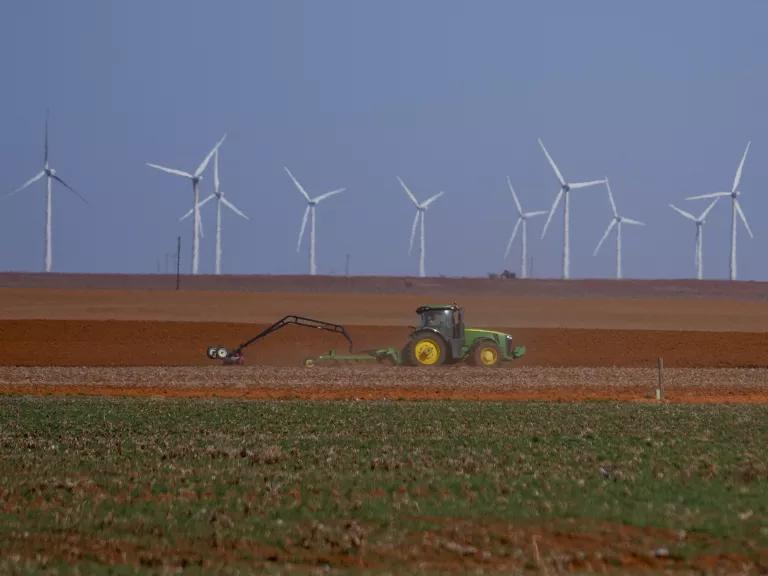
Wind turbines in Lamesa, Texas
Grid operators already account for the intermittent nature of renewables. They calculate renewables’ reliability value on a regular basis and plan accordingly. Battery storage provides similar reliability value to natural gas plants and can replace gas generation if deployed at sufficient scale. Since its commercial inception, lithium-ion battery prices have dropped 97 percent and will likely be even more cost-competitive in the future. For example, since 2022, Texas and California have installed more than 13 gigawatts of grid-scale battery storage. This has kept their systems reliable, even while temperatures and power demand broke records, and even as Texas has retired 61 percent of its coal fleet.
In extreme weather, gas infrastructure fails while renewables deliver
Gas power plant outages during winter storms threaten reliability. Winter Storms Uri (2021) and Elliott (2022) caused major failures of the bulk power system when natural gas power plants and wellheads froze, and pipelines could not operate. Their failures were due not to a lack of domestic natural gas supply but to insufficient weatherization throughout the natural gas system.
After these historic outages, grid operators across the United States have “de-rated” gas based on its inability to deliver power in extreme weather. This has caused multibillion-dollar price spikes as grid operators have scrambled to arrange backup for unreliable gas plants. Meanwhile, wind power delivered nearly four times what was expected during Elliott, minimizing blackouts.
We need to build fast and smart
To meet the growing demands for electricity and to try to stay on track with climate progress, we need to speed the build-out of clean energy and transmission. And we need to do this in a smart way, as NRDC outlined in a recent report. This means building community support for clean energy and making sure that developers follow best practices for community benefits and ecosystem protection. We need to minimize the impact of transmission build-out by using existing rights of way and relying more on grid-enhancing technologies that can expand the capacity of the existing transmission system. And we need to speed the process of interconnecting clean energy to the grid.
Fossil fuels impact our health and well-being
Every effort to promote fossil fuels and slow down clean energy growth hurts Americans. Globally, natural gas was the single-largest driver of increased emissions in the energy sector in 2024, the warmest calendar year in data records going back to 1850.
Reliance on fossil fuel energy causes premature death and severe health impacts on hundreds of thousands of Americans. Coal pollution alone was responsible for 460,000 deaths between 1999 and 2020, according to researchers at the National Institutes of Health, and it killed 6,700 people in 2019 alone.
Many of the states where remaining coal plants are concentrated lack adequate environmental controls, and these super-polluter coal plants also produce mercury and other heavy metals, particulate matter, and toxic runoff from coal combustion residuals, disproportionately harming human health in surrounding regions. Mountaintop removal for coal mining has devastated communities and economies in central and southern Appalachia. Too many former coal miners are suffering from black lung disease and other health impacts. And negligence by coal executives have led to disasters in coal mining communities like the 2010 Massey Energy explosion in West Virginia that killed 29 miners.
The path forward is clear
The momentum for the continued growth of U.S. clean energy is strong. The economics are on the side of the energy transition and private investment has started a movement that cannot be stopped, with investments in clean energy equaling $239 billion in 2023. The Trump administration’s efforts to turn back the clock will inevitably fail. But in the meantime, their efforts to force their ideological agenda, if allowed to move forward, could cause significant collateral damage to the health and pocketbooks of the American people.
Related Blogs

We Can't Afford to Slow Down on Climate Action

Can Trump Block State Climate Action?