Why Strong Climate Action Needs a Strong Energy Department
Department of Energy layoffs threaten the agency’s ability to spur industrial innovation and modernize the electric grid.

A Century Aluminum smelter in Hawesville, Kentucky, May 2019

There’s a reason the United States hasn’t seen a new aluminum smelter in 45 years. Producing this soft, pliable metal from scratch consumes astronomical amounts of electricity, and the costs of keeping a smelter open and running, let alone building a new one, are just too high.
But Century Aluminum, a U.S.-based company, hopes to change that by building a first-of-its-kind green aluminum smelter in the Ohio-Mississippi basins. Through improved energy efficiency and the use of renewable energy, the proposed facility could emit 75 percent less climate pollution than a typical smelter and, potentially, rejuvenate the domestic aluminum industry.
Made possible by $500 million in funding from the U.S. Department of Energy (DOE), the project could also create 5,500 construction jobs. And yet, the future of the smelter, along with dozens of the DOE’s other multimillion-dollar climate and clean energy projects, is in jeopardy.
Around 8,500 DOE staffers risk losing their jobs due to the roughshod reorganization efforts by the Department of Government Efficiency (DOGE), and thousands more have accepted voluntary resignation offers.
The Elon Musk–led office has already fired tens of thousands of federal workers and substantially shrunk or altogether shuttered multiple federal agencies, including the U.S. Agency for International Development, the National Oceanic and Atmospheric Association, and the National Park Service.
"They should be turbocharging the Energy Department. Instead, they're pumping the brakes.”
Christina Theodoridi, policy director, industry, Climate & Energy program, NRDC
The Trump administration is coming for the DOE’s budget too. The proposed 2026 federal discretionary budget reduces DOE funding by $19.3 billion, with the deepest cuts to renewable energy and decarbonization programs. When excluding the National Nuclear Security Administration, which received a 25 percent increase, the proposed cut is nearly 20 percent of the DOE’s remaining budget.
Learn More


While DOGE’s efforts face widespread public scrutiny and mounting legal pushback, including by NRDC and partners, the work of the DOE remains in limbo. Here’s why an intact Energy Department is essential to solving some of the toughest challenges of a rapidly changing, and warming, world.
OCED: Because industry needs innovation
Heavy industries, such as steel, concrete, and chemical production, are notorious carbon polluters. In fact, in addition to spewing large amounts of local air pollution, industry contributes 30 percent of total U.S. greenhouse gas emissions. Often, the production methods in these industrial sectors haven’t changed in decades, and the pollution solutions that work for one industry don’t necessarily work for another.
“These have always been called ‘hard-to-abate’ industries, which meant sweep them under the rug and ignore their pollution,” explains Christina Theodoridi, head of NRDC’s industrial policy team.
This is where the innovations spurred by the DOE’s Office of Clean Energy Demonstrations (OCED) come in. OCED works to speed up the commercial adoption of innovative cleaner technologies—the kind that have made it past the R&D phase but aren’t yet ready to go fully commercial. Private investors typically see such projects as too high risk, so the federal government’s initial support and cost-sharing is essential to getting big polluters to modernize without breaking the bank.

A map of proposed OCED projects awarded or selected for negotiations for Phase 1 or 2 activities as of January 2025
OCED launched its $6 billion Industrial Demonstrations Program (IDP) last year. The program provides funding for groundbreaking projects that test new means of electrification, low-carbon production, and energy efficiency, among others. IDP projects vary widely. Current initiatives include new ways to make cement, glass, and steam, several with little or no fossil fuels.
The American Council for an Energy-efficient Economy, a nonprofit research organization, estimates IDP could funnel $14 billion in private investment to communities within 20 states. But, with OCED’s future now uncertain, so is its $25 billion portfolio of projects.
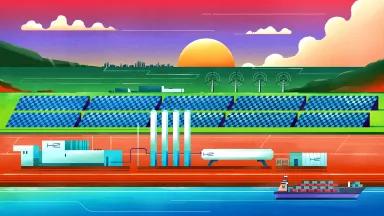
Among them are the proposed regional hydrogen hubs—a network of facilities planned at sites throughout the country dedicated to advancing this burgeoning clean energy industry. The department had earmarked $8 billion for the program to develop innovative ways of producing hydrogen, which has a variety of end products, from jet fuel to fertilizer. Two other OCED endeavors are the direct air capture (DAC) hubs slated for Louisiana and southern Texas. These hubs aim to find ways to scrub carbon dioxide from the air for either storage underground or for new uses.
Learn More

Both the hydrogen and DAC hubs appeared on DOGE’s short list of proposed canceled projects leaked in March.
Many local leaders expressed frustration with the decision. “Investing in DAC will generate demand for American-made steel, concrete, and advanced equipment, revitalizing U.S. manufacturing and ensuring that innovation and jobs remain here at home,” wrote Louisiana Secretary for Economic Development Susan Bourgeois in a letter to the state’s representatives in Washington, D.C., urging them to tell Energy Secretary Chris Wright to reconsider the defunding.
According to the Center for Climate and Energy Solutions, a nonprofit organization that advocates for clean energy, OCED programs would support roughly 290,000 jobs and fuel nearly $70 billion in economic output. The DOE’s many private sector partners could also be left in the lurch.
“A lot of the work that the DOE does, especially when it comes to the commercialization of breakthrough tech, is through public-private partnerships,” Theodoridi explains. “The federal government is now letting go of its end of the bargain. It erodes confidence in our nation’s ability to be a partner—and it's going to take a long time to build it back.”

Reliability coordinators monitoring the Texas Interconnection grid—which supplies power to more than 25 million customers but currently has no connections to neighboring states—at the Electric Reliability Council of Texas command center.
A resilient electric grid to keep the lights on
The grid is also in need of an overhaul. “If you started from scratch, you’d never build the system the way we have it today,” says Cullen Howe, a senior policy advocate at NRDC whose work focuses on improving the country’s transmission system and decarbonizing the power sector.
For starters, the grid needs double its transmission capacity—that is, its ability to move large quantities of electricity over long distances. “Right now, we don't have an equivalent to the interstate highway system for the transmission system, but that's what we need,” Howe says. With extreme weather of all varieties increasing the occurrences of power outages, upgrading our transmission capacity has grown more urgent than ever.
The DOE, and specifically its Grid Deployment Office (GDO), are central to this work. In 2023, the GDO launched its Transmission Facilitation Program, a $2.5 billion effort to build or upgrade high-voltage transmission lines that crisscross the country and connect previously separated regions of the grid.
In a recent round of contracts, the GDO awarded funding to four new projects that would together add nearly 1,000 miles of new transmission infrastructure and 7,100 megawatts of capacity to the grid. This kind of big-picture planning for the country’s transmission system is some of what the GDO does best.
For example, every three years, the office releases its National Transmission Needs Study, a look at what kind of infrastructure the country needs to meet its growing electric demands. The study informs investment and planning decisions by regional transmission operators, utilities, and local governments, among others.
“If a nonprofit puts out a study that says, ‘This is the amount of transmission we're going to need over the next 20 years,’ that's useful,” Howe says. “But it doesn’t carry the weight of a nonpartisan federal agency.”
During severe winter storms or heat waves, the grid must be able to move electricity around to meet regional demand spikes or address service interruptions. Further, because solar and wind energy generation tends to occur in rural areas, adequate transmission is vital to getting that power to wherever consumers need it.
Meanwhile, energy demand is expected to keep growing substantially, in large part due to the electrification of the building and transportation sectors and the expansion of power-hungry data centers, especially with the rise of AI.
With sweeping staff and budget cuts, the DOE won’t be able to build the modern, resilient power grid essential to meeting the electric needs of the coming decades. “My sense is that most of the work that the Grid Deployment Office was doing—if they even staff the office at all—is probably not going to be done,” Howe says.

National Renewable Energy Laboratory staff working on a research turbine at NREL's National Wind Technology Center in Boulder, Colorado
Renewable energy is energy independence
Climate and clean energy investments are at the top of DOGE’s hit list. In its proposed 2026 budget, the administration eliminates more than $19 billion in funding for “climate change–related activities,” such as the Biden administration’s Justice40 initiative and what it falsely dubs “Green New Scam funds committing to build unreliable renewable energy.”
The DOE’s Office of Energy Efficiency and Renewable Energy faces a $2.6 billion cut, along with the downsizing of the National Renewable Energy Laboratory (NREL), a research lab that focuses on energy systems research and development. NREL, located in Golden, Colorado, laid off 114 employees in May, but there are fears of more to come.
These cuts would hobble the United State’s ability to scale up its renewable energy output at a moment when the world needs to double down on it, in order to avoid the most devastating effects of climate change.
Take for example the U.S. offshore wind industry, which could supply up to a quarter of the nation’s total electricity by 2050. A growing stretch of proposed offshore wind farms along the Atlantic Coast are poised to generate much of this power. Yet they need the DOE to help bring that electricity ashore—a complicated job involving laying cable deep in the sea, navigating harsh ocean environments, and coordinating ports, vessels, and crews.
So, over the course of two years, the Energy Department held a series of workshops to hear from state representatives, Tribal leaders, regional transmission operators, and energy experts (including those from NRDC), and other stakeholders. The result was the 2024 Atlantic Offshore Wind Transmission Study and a subsequent Action Plan, which now serves as a guide for decision makers up and down the coast.
Complex infrastructure projects like these have the potential to transform the U.S. power sector and make it more resilient, but they require ongoing collaboration with dozens of parties across federal, state, and local jurisdictions—each with their own interests and sensitivities. For DOE staff to succeed, they need to understand how the bureaucracy works, along with all the relevant laws, codes, standards, and stakeholders.
“These aren’t things that can just run on autopilot,” says Jennifer DiStefano, director of innovation and technology for industry at NRDC. And managing them is not a task that a brand-new DOE staffer could handle on day one. “Ultimately, the agency needs experts in order to do its job effectively.”
Turning our back on renewable energy investments now would not only spell climate disaster but also make the United States less of a player on the world stage.
In recent years, thanks to federal investments from the Bipartisan Infrastructure Law and the Inflation Reduction Act, the United States was about to reclaim some of the solar manufacturing it had lost to China and Southeast Asia over the past 20 years. That comeback is in jeopardy now. Meanwhile, other countries, including those that the administration says it cares to compete with, are investing dozens of times more into renewable projects.
“We need to figure out how to deploy as much clean energy as possible so that we have reliable, affordable, abundant energy for all Americans,” Theodoridi says. “They should be turbocharging the Energy Department. Instead, they're pumping the brakes.”
This NRDC.org story is available for online republication by news media outlets or nonprofits under these conditions: The writer(s) must be credited with a byline; you must note prominently that the story was originally published by NRDC.org and link to the original; the story cannot be edited (beyond simple things such as grammar); you can’t resell the story in any form or grant republishing rights to other outlets; you can’t republish our material wholesale or automatically—you need to select stories individually; you can’t republish the photos or graphics on our site without specific permission; you should drop us a note to let us know when you’ve used one of our stories.
Help block the Trump administration's agenda!
Your donation will power the work of our lawyers, scientists, and policy advocates as they defend against a wave of attacks on the environment.
Venezuela’s Oil Resources Are Vast (and Should Stay Underground)
What Are the Solutions to Climate Change?
A Consumer Guide to the Inflation Reduction Act