
DOGE’s Attacks on National Parks Let Public Lands Slip from Public Hands
Laying off thousands of park service employees and BLM staff makes it a lot easier to exploit public resources for profit.

A park ranger at Jackson glacier overlook in Glacier National Park, Montana
Eric Anderson thought it was strange when, in late January, his employer, the National Park Service (NPS), called him and his crew back to their home offices in Indiana, Montana, and Colorado. They had been right in the middle of conducting a prescribed burn in the Florida Everglades.
Prescribed burns prevent out-of-control wildfires from tearing through a landscape by encouraging the growth of some vegetation (like native wetland grasses) and inhibiting others (such as woody brush). They are just one of many activities the NPS carries out in its management of 433 parks across the country. Based in Indiana Dunes National Park, Anderson, a biological science technician, had overseen burns at more than a dozen parks over the course of the past year, his first as a full-time employee with the service.
“I love being able to work on land—to do a project and come back the next season, or later that season, and see the results of the work that you did,” he says.
But Anderson and his crew wouldn’t see the fruits of their labor in the Everglades. The Trump administration’s Office of Management and Budget had frozen his project’s funds, along with those for dozens of other federal programs and grants. And soon after Anderson returned home, he became one of the 2,300 employees at the U.S. Department of the Interior (DOI) who were laid off in February under the direction of Elon Musk’s so-called Department of Government Efficiency (DOGE).
Learn More

The layoffs have prompted legal action, including a lawsuit filed by a large coalition of unions, local governments, and nonprofits, including NRDC. Plans of the Trump administration have also surfaced that call for even deeper cuts across the federal government—with one in four Interior staff potentially losing their jobs. Such extreme reductions in the federal workforce prevent agencies from providing essential public services; not least among them, managing the country’s vast collection of public lands.
The cuts would likely hit two DOI bureaus particularly hard: The NPS and the Bureau of Land Management (BLM). Together, they oversee about 330 million acres, with the purpose of sustaining the nation’s natural resources for generations to come.
“The employees across the federal land management system—whether in the NPS, BLM, or the Fish & Wildlife Service—are being set up to fail,” says Bobby McEnaney, director of land conservation and nature for NRDC. “I think that is part of the plan here, to fundamentally create a situation where they’re dysfunctional.”
Sabotaging the agencies that manage public lands
For every NPS employee, there are roughly 4,720 acres of land under the service’s purview. When it comes to the BLM, the number of acres per employee jumps to 24,500. McEnaney says the bureau is the largest land management agency with the fewest employees, and it oversees some of the most critical ecological and cultural landscapes.
For 245 million acres of public land—including wilderness areas and national monuments—and 700 million acres of mineral resources belowground, the BLM makes decisions regarding everything from conservation and recreation projects to mining, oil and gas drilling, and wind and solar development. The agency’s duties, as laid out in the Federal Land Policy and Management Act, entail generating economic opportunities through the land while also protecting natural, cultural, and historic resources that are too precious to lose.
“This move to gut BLM is all about taking away any discretion that a BLM staffer may have in trying to meet the multitude of contrasting and conflicting goals,” says McEnaney. “They’re being put in a position where they will not be able to implement the conservation safeguards required by law.”
The latest DOGE cuts resulted in 800 people (out of a staff of 10,000) losing their jobs. “Not only will the impact of this not be clear for some time yet, but fixing it is going to be a massive job that might even take a generation or two to fix,” says Mary Jo Rugwell, who worked at BLM for 46 years before retiring in 2019. BLM employees often have a lot of technical expertise and “are very hard-working people who have, over time, learned how to get stuff done, despite the fact that they don’t have the resources to do it,” says Rugwell, who now serves as president of the nonprofit Public Lands Foundation. “These are the folks that manage the lands that belong to all of you,” she says.
“When you start reducing services, you start creating a self-fulfilling prophecy that the parks can’t be managed by the federal government, that they’re failed enterprises, and that the only option is to privatize them.”
Bobby McEnaney, director of land conservation and nature, NRDC
This was not the first time a Trump administration has taken aim at the BLM. In 2020, then interior secretary David Bernhardt moved the bureau’s headquarters from Washington, D.C., to Grand Junction, Colorado. Of the 328 career employees who worked in the nation’s capital at the time, all but 41 chose not to move across the country. According to a Government Accountability Office report published in 2021, the number of the bureau’s job vacancies also doubled.
While the Biden administration returned the headquarters to the nation’s capital, the damage had already been done. Former BLM director Tracy Stone-Manning called the whole process “wildly disruptive.”
National parks are profitable and popular—why mess with them?
The NPS is perhaps the most public-facing of the Interior bureaus, with as many as 332 million people visiting the national parks each year. In fact, a PEW research survey published last year showed that the park service is the most popular of all federal agencies—with a 76 percent approval rating.
It should come as no surprise, then, that the parks are also huge moneymakers. With an already meager budget of $3.57 billion (a mere one-fifteenth of 1 percent of the national budget), national parks bring in $55.6 billion each year. That revenue is now in jeopardy—in the name of “efficiency.”
“I have been looking for a place to invest my money where I can get that kind of return,” says Phil Francis, a former park superintendent who now heads the nonprofit Coalition to Protect America’s National Parks.
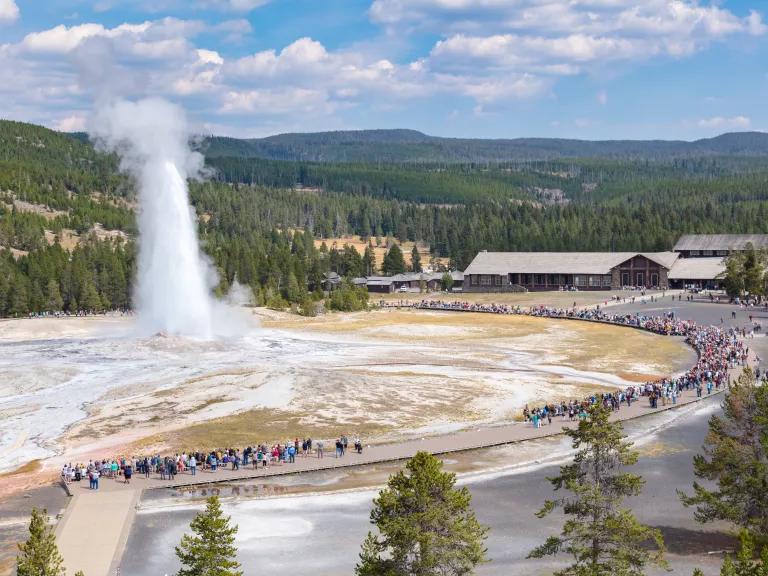
Yellowstone National Park recorded 4.74 million visits in 2024.
NPS employees keep visitors safe and informed while also protecting the plants, animals, and geological structures that comprise the parks’ unique, and often iconic, ecosystems. Managing the visitors to the parks is another critical task—akin to serving as a city manager—says Sheridan Steele, who spent three decades in the service before retiring in 2015. “You put a lot of people in a small space, and you essentially have all the problems of a city,” he says.
Learn More


Visitors’ cars break down, hikers get lost, the wastewater management needs fixing, and all of these problems fall to the NPS staff. Right now, employee credit cards are frozen, so they can’t purchase anything to help maintain their park’s infrastructure and operations—items like toilet paper, parts for repairing windows and bathrooms, or even the ropes used to rescue climbers.
In addition to layoffs and buyouts, the NPS is, perhaps unsurprisingly, having difficulty filling other vacancies. In all, the service’s workforce dropped about 20 percent in just a few months. Further weakening the park service’s impact, DOGE plans to eliminate dozens of NPS grants, many of which concern the effects of climate change on public lands.
Laid-off park service employees took to social media to detail what would be at risk without their service and expertise. With the firings and funding freezes, former park superintendents also worry what the summer will bring: fewer rangers to ensure visitor safety; no one to train the seasonal employees who manage crowds; and dirty, broken-down facilities.
“That doesn’t save money,” says Steele. “It just makes it miserable for visitors who encounter the aftermath of poor decisions.”

An oil pumpjack near an entrance for public lands in Utah's Uinta Basin
A push to privatize national parks and public lands?
Critics of the Trump administration’s reshaping of the federal government say hamstringing the NPS and BLM by cutting their funding and workforces—and then pointing out problems with the resulting management shortfalls—may help the administration make a case for selling off public lands.
“When you start reducing services,” says NRDC’s McEnaney, “you start creating a self-fulfilling prophecy that the parks can’t be managed by the federal government, that they’re failed enterprises, and that the only option is to privatize them.”
Doing so, however, has historically been very unpopular. Utah Representative Jason Chaffetz introduced legislation in 2017 that would have sold off 3.3 million acres of public land in 10 states, but the public outcry that ensued caused him to bail on the bill. Then last year, Utah legislators tried to bring federal lands under state control, claiming that 18.5 million acres of BLM land should be Utah’s. Under its control, Utah would be able to develop the land according to state and local interests—an attempt, critics said, to privatize shared resources. Utah officials asked lawmakers from other states, such as Montana, to join the effort, but it ultimately failed because their constituents wanted to keep public lands in public hands.
Even if the public lands stay in federal control, the current administration wants to open up more to extractive industries. During his first day on the job, building on the president’s “Unleashing American Energy” executive order, Interior Secretary Doug Burgum took swift action to make public lands ground zero for drilling and mining.
In court, lawsuits have been challenging the legality of the Trump administration’s restructuring of federal agencies and the mass layoffs that come with it. In March, two judges from separate cases ordered the administration to reinstate fired employees. A U.S. Supreme Court decision in April stopped those rehirings, at least temporarily—but not before many employees, like Eric Anderson, went back to work.
But by the time Anderson and his crew resumed their jobs at the end of March, it was too late to conduct many of the prescribed burns they’d planned for the spring. The result? Lots of vegetative fuel on the landscape ahead of wildfire season.
Anderson, of course, is not feeling confident that the administration won’t lay him off again. So he has renewed his liability insurance in case he has to work as a contractor for a while. “I have opportunities. I have other directions that I can go,” says Anderson. “My concern is the systematic dismantling of the apolitical civil service system.”
A timeline of the Trump administration's attacks on public lands
Interior Department pushes to mandate coal leases near iconic national parks and monuments
In the latest attempt to privatize our public lands, the U.S. Department of the Interior is pushing to offer coal leases near Zion, Bryce Canyon, and Capitol Reef national parks, as well as Grand Staircase-Escalante National Monument. This move ignores precedent set by the Bush administration that established that most of the region is unsuitable for coal mining and operations.
Trump administration advances Ambler Mining Road through Gates of the Arctic National Park
The administration approved the Ambler Access Project, ordering federal agencies to expedite permits for a 211‑mile private industrial mining road that would cut through the Brooks Range and Gates of the Arctic National Park, reversing prior findings that any route would cause significant and irreversible harm to wildlife and permafrost, while also dismissing the concerns and objections of 89 Tribes and First Nations that oppose the project.
Interior Department moves to repeal landmark Public Lands Rule
The U.S. Department of the Interior proposed repealing the Public Lands Rule, which ensures that conservation is considered alongside mining, drilling, timber, and grazing across 245 million acres of public lands. It strengthens tools to address climate change, safeguard wildlife habitat and watersheds, incorporate Indigenous knowledge, and manage lands sustainably. In addition, outdoor recreation, which depends on healthy public lands, generates more than $1.2 trillion in economic output annually—far outpacing oil, gas, and mining. This move to repeal the rule threatens this economic engine while prioritizing short-term corporate profits over long-term land stewardship.
USDA pushes to open nearly 50 million acres of national forests to disastrous logging and road-building
The U.S. Department of Agriculture proposed rescinding the 2001 Roadless Area Conservation Rule, which protects 45 million acres of National Forest land from road-building and logging. The move undermines one of the nation’s most important conservation safeguards. If finalized, it would open vast stretches of old-growth forest to logging, threatening wildlife and communities that rely on intact forests for subsistence, tourism, and recreation.
BLM issues a series of regulatory changes to expand oil and gas development on public lands
In line with provisions in the Senate budget reconciliation bill, the Bureau of Land Management issued a series of regulatory changes to expand oil and gas development on public lands. These changes amend permitting procedures; eliminate fees for nominating land for leasing; align the definitions of “eligible” and “available” lands for drilling; and limit the types of environmental protections like stipulations and mitigation measures that can be included in leases. Taken together, these changes amount to a sweeping rewrite of federal oil and gas policy—designed to lower costs for industry, reduce environmental oversight, and open more public lands to drilling.
Interior takes first step to revive the Twin Metals mine
The U.S. Department of the Interior is withdrawing a 2022 legal opinion that had enabled the cancellation of leases for the proposed Twin Metals copper-nickel mine in Minnesota. This reversal is the first step toward reviving a project that scientists, advocates, and local businesses have warned could permanently pollute the watershed and damage the region’s ecosystem and outdoor economy. The Twin Metals mine was blocked for violating environmental protections and threatening Boundary Waters, one of the most visited and pristine wilderness areas in the country.
BLM reopens door to new leasing in the Powder River Basin
The Bureau of Land Management (BLM) initiated the rollback of a coal leasing ban in the Powder River Basin, the largest coal-producing region in the United States, reopening the door to new leasing on more than 1.6 million acres across Wyoming and Montana. Reversing this ban could unleash nearly three billion tons of carbon pollution, according to previous BLM estimates.
Energy Tax becomes law, authorizing the biggest giveaway of public lands in U.S. history
President Trump signed the tax and spend budget reconciliation legislation, mandating vast tracts of public lands be leased for oil & gas drilling, logging and coal mining—an unprecedented giveaway for these extractive industries. It also slashes the royalty rates these industries must pay, and allows them to pay to get an expedited environmental review. For Alaska specifically, the law mandates four 400,000-acre lease sales in the Arctic National Wildlife Refuge and at least five 4-million-acre lease sales in the National Petroleum Reserve-Alaska within the next decade.
BLM fast-tracks expansion of oil loadout facility
The Bureau of Land Management approved an expansion of a Utah oil loadout facility just nine days after beginning its review, clearing the way for an additional 70,000 to 80,000 barrels of oil per day to be shipped from the Uinta Basin to Gulf Coast refineries. The decision—which bypassed standard public input processes and raised alarm among environmental advocates for ignoring potential threats to clean air, public safety, and endangered species—reflects the Trump administration’s broader push to accelerate fossil fuel extraction and infrastructure without adequate environmental review.
USDA sets stage to open 58 million acres to logging
The U.S. Department of Agriculture announces it would rescind the 2001 Roadless Rule, which generally prohibits commercial logging and road construction on 58.5 million acres across the country. This would clear the way for destructive extractive activities in wildlands such as the Tongass National Forest, which stores more carbon per acre than almost any other forest on the planet and provides habitat for more than 400 species, including Alexander Archipelago wolves (found only in southeastern Alaska), brown and black bears, bald eagles, and all five species of Pacific salmon.
Interior Department seeks to undo protections for millions of acres of the Western Arctic
The U.S. Department of the Interior wants to rescind a rule put in place last year that permanently protected some 13 million acres of the National Petroleum Reserve-Alaska—in one of the most ecologically important and culturally significant landscapes in the United States. Rolling back the Special Areas Rule would lead to destruction of fragile Arctic environments, exacerbation of climate change, and impacts on Indigenous communities who rely on the land for subsistence.
Fiscal year 2026 budget proposal slashes $1.2 billion from National Park Service

Through this proposed budget, the Trump administration is marking the largest reduction in the National Park Service's (NPS) 109-year history. The proposal includes cutting $900 million to the operations budget of the NPS. This would threaten the maintenance and preservation of national parks, potentially leading to reduced visitor services, delayed infrastructure repairs, and compromised conservation efforts. In addition, DOGE plans to eliminate dozens of NPS grants, many of which concern the effects of climate change on public lands.
Interior Department invokes "emergency" authority to fast-track fossil fuel and mining projects

The U.S. Department of the Interior announces a new—and unprecedented—approach to energy and mining permitting on public lands and federal waters. Under the guise of a “national energy emergency,” the department is slashing permitting timelines and overriding safeguards under the National Environmental Policy Act, Endangered Species Act, and National Historic Preservation Act. In short, it strips the public of its right to be informed and heard, allowing polluters to drill, mine, and destroy without oversight, science, or accountability.
White House releases preliminary list of mining projects for expedited approval

Following up on the March 20 executive order, the White House releases a list of 10 proposed mines on public lands that it would like the Federal Permitting Improvement Steering Council to review and permit under an expedited permitting process. The list includes a range of projects, some of which are highly controversial and opposed by Indigenous and frontline communities.
Millions of acres across the West and Alaska may lose protections

The Trump administration moves to rescind two key rules that advanced protections for millions of acres across the West and Alaska’s North Slope. Finalized by the Bureau of Land Management in 2024, the rules placed conservation and restoration on equal footing with drilling and mining, and limited oil development in ecologically sensitive areas like Alaska’s North Slope. Marking these protections to be repealed, possibly without public input, signals a clear intent to sideline science, gut public process, and open public lands to industrial exploitation.
Attempt to revive dying coal industry threatens lands

If successful, this executive order could lead to a rush to lease public lands for new coal mines concentrated in Montana and Wyoming. The order also puts up to 570 million acres across the country at risk of being developed under an expedited permitting regime that could hide potential environmental impacts from frontline communities.
USDA further accelerates deforestation

In response to Trump’s directive, the U.S. Department of Agriculture issues an “Emergency Situation Determination” that would open more than 100 million acres of national forests to accelerated logging. The move tries to sideline environmental reviews and limit public input on projects across a majority of lands managed by the Forest Service.
Executive order aims to fast-track and expand domestic minerals mining and processing

The executive order included directives that would undermine the multiple use mandate that guides management of our shared public lands. The order risks opening cherished public spaces to massive extraction projects, limiting public access to public lands, and polluting critical freshwater resources.
Plans are put forth to increase logging in federal forests
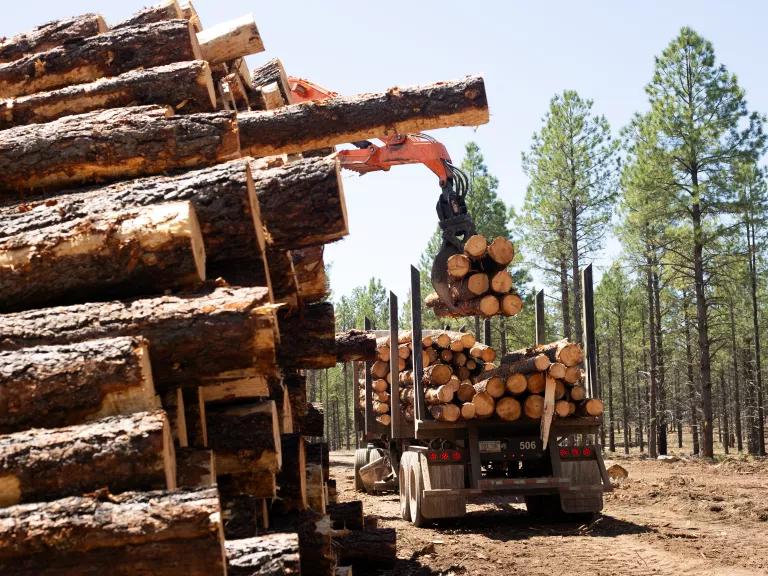
Trump issues two EOs to dramatically expand logging across federal forests. Under the pretense of enhancing national security, these policies seek to weaken environmental protections to supercharge timber harvest and benefit wealthy corporate interests.
Administration slashes federal workforce overseeing public lands

Under the direction of Elon Musk's Department of Government Efficiency, 2,300 employees of the DOI are laid off. The department oversees more than 400 million acres of public lands.
National monuments are up for dismantling

Following the EO to expand energy production, U.S. Department of the Interior (DOI) Secretary Doug Burgum calls for a review and potential revision of national monuments as part of a suite of actions to expand drilling and mining on public lands. At stake are protections for such cherished places as Bears Ears and Grand Staircase–Escalante in Utah and Baaj Nwaavjo I’tah Kukveni-Ancestral Footprints of the Grand Canyon in Arizona.
“Drill, baby, drill” trumps environmental protections

Trump issues an “Unleashing American Energy” EO to make it easier for extractive industries to expand energy exploration and production on federal lands (and in federal waters). The order eliminates or restricts a number of policies designed to protect the environment and ensure smart decision-making, such as the social cost of carbon metric for assessing climate impacts and key National Environmental Policy Act regulations.
Alaskan wilderness is turned into a sacrifice zone

On his first day in office, President Trump issues an executive order (EO) that singles out Alaska, dealing over much of the state as a sacrifice zone for oil, gas, mining, and timber companies to exploit for industry profit. The order targets three treasured and irreplaceable landscapes: the Arctic National Wildlife Refuge, the National Petroleum Reserve in Alaska, and the Tongass National Forest.
This NRDC.org story is available for online republication by news media outlets or nonprofits under these conditions: The writer(s) must be credited with a byline; you must note prominently that the story was originally published by NRDC.org and link to the original; the story cannot be edited (beyond simple things such as grammar); you can’t resell the story in any form or grant republishing rights to other outlets; you can’t republish our material wholesale or automatically—you need to select stories individually; you can’t republish the photos or graphics on our site without specific permission; you should drop us a note to let us know when you’ve used one of our stories.
Stop our wildlands & waters from being auctioned off to corporate polluters!
The current administration is planning to allow companies to drill and mine with little oversight—with practically no say from the public. But we won't ignore this.

Stop our wildlands & waters from being auctioned off to corporate polluters!
The Trump administration announced a plan that would allow companies to drill and mine with little oversight—with practically no say from the public. Plus, the Interior Department is looking to slash protections for several of our national monuments. Tell Interior Secretary Burgum to stop giving away our public lands and waters to corporate polluters!
Our Public Lands Are on the Chopping Block Again
The Endangered Species Act Under Attack
A Weakened USDA Will Hurt Small Farmers (and Everyone Else)