
Our Public Lands Are on the Chopping Block Again
Another assault on America’s natural heritage puts cultures, wildlife, tourism, and our climate at risk.

River House Ruin, which is about 1,000 years old, near the San Juan River, Shash Jaa Unit, Bears Ears National Monument, Utah
Jon G. Fuller/VW Pics/Universal Images Group via Getty Images
On workdays, Louis Williams rises with the sun and makes a short drive into Bears Ears National Monument in southern Utah. There, guides from his Ancient Wayves River and Hiking Adventures company take visitors rafting down the meandering San Juan River or past the monument’s soaring cliffs and rock art. Williams is Navajo, and his Indigenous team represents various local Tribes, including Zuni and Hopi. They each have their own distinct origin stories, but all trace their roots back to these lands, which encompass more than 100,000 Native American archaeological and cultural sites, including petroglyphs that date to 7,000 BCE.
The beauty of Bears Ears—named for two buttes above a high plateau—animates the Tribes’ cultural and spiritual lives. That’s a message they strive to impart to their clients, says Williams. “I can literally see Bears Ears when I walk out the door in the morning, and it reminds me of my ancestors. It’s a sacred place, a place of healing.”
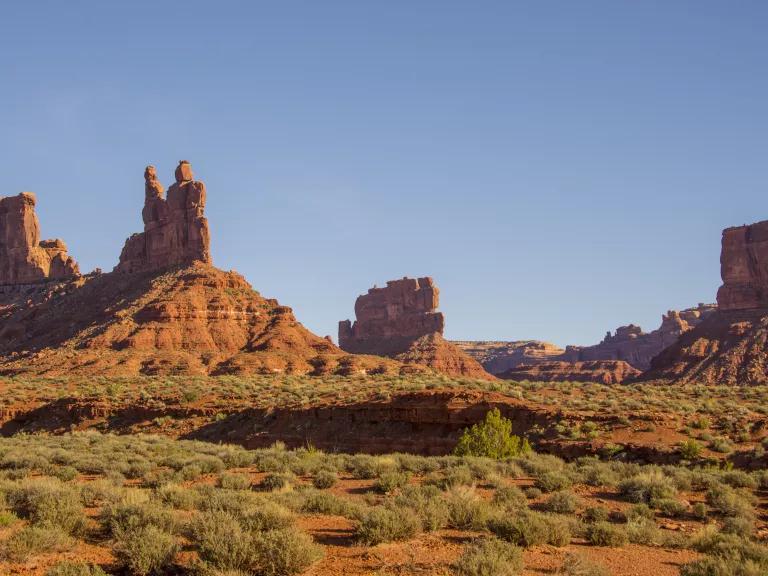
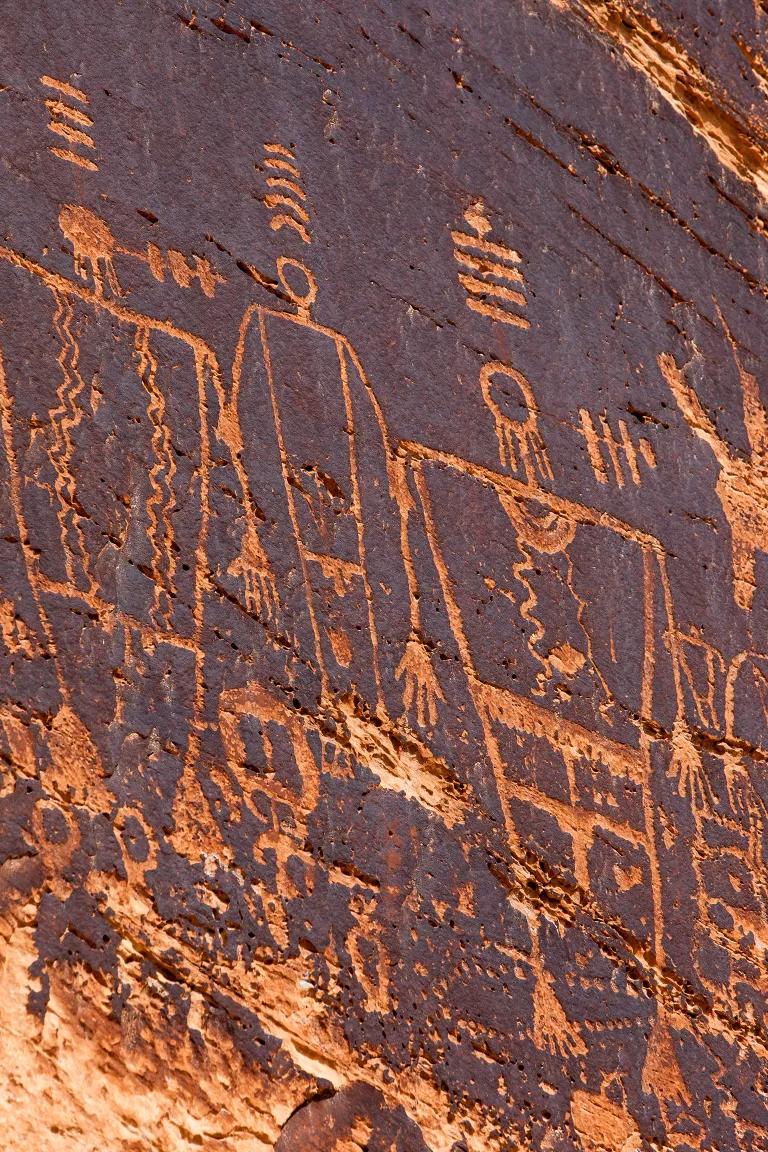
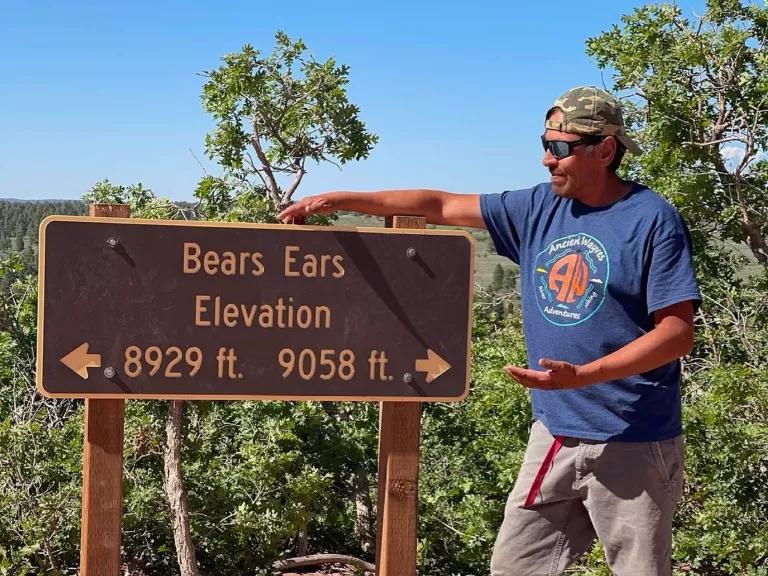
Clockwise from top left: Valley of the Gods at Bears Ears National Monument; ancient Native petroglyphs of the basketmaker culture of about 2,000 years ago chipped into the black desert varnish of a cliff face at Bears Ears; Louis Williams at Bears Ears
Jon G. Fuller/VWPics/Universal Images Group via Getty
; 3)Courtesy of Louis Williams/Ancient Wayves Touring and Hiking Adventures
It’s also among America’s vast public lands that the Trump administration is intent upon opening for oil and mining or simply selling off to the highest bidder. That agenda began just a year after President Barack Obama first designated it as a monument, when President Donald Trump took steps to shrink Bears Ears National Monument by a whopping 85 percent. President Joe Biden later restored the monument’s protections, but in his second term, Trump is attacking Bears Ears once again. A pair of presidential proclamations issued in July 2026 virtually eliminated the Bears Ears and nearby Grand Staircase-Escalante national monuments.
The future of these public lands—as well as Utah’s $12.7 billion tourism industry—are once again on the line. The gravity of what could now unfold registers when Williams’ tour groups notice the monument’s unsightly gravel pits, remnants of uranium mines that once dotted the region. “People look through their binoculars and say, ‘My goodness, this place really needs to be protected. We don’t want that to happen again,’” Williams says.
Up for sale: National landmarks and cultural heritage
What’s at stake, for Bears Ears and other mineral- and fuel-rich public lands, was spelled out clearly in Project 2025, an ultraconservative policy guide created by the Heritage Foundation. Its authors include William Perry Pendley, who served as acting director of the Bureau of Land Management (BLM) during the first Trump administration and who called for an immediate boost in coal, oil, and natural gas production on public lands. In a National Review op-ed from 2016, Pendley even argued that the federal government should sell all of its lands.
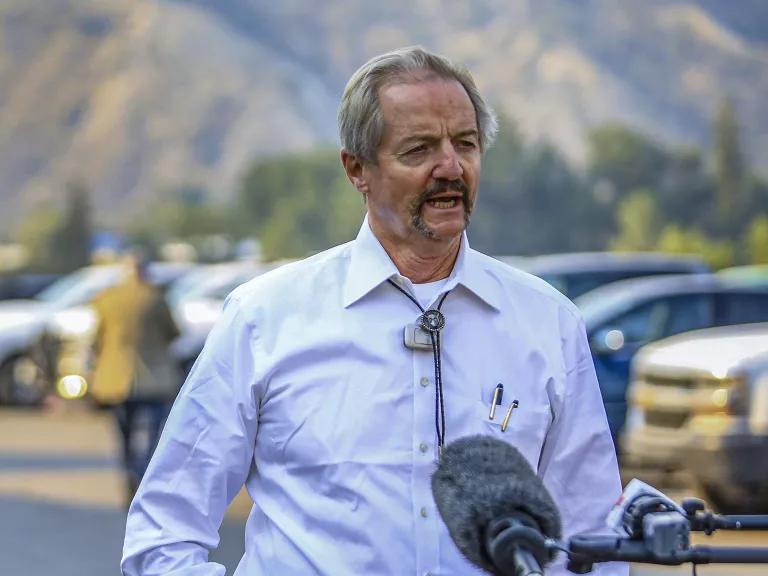
William Perry Pendley, acting director of the Bureau of Land Management from 2019 to 2021
Chris Dillmann/Vail Daily via AP
In his role leading the U.S. Department of the Interior, Secretary Doug Burgum has gotten straight to work enacting this agenda. Using his authority overseeing nearly 500 million acres of public lands, Burgum has delivered a series of political handouts to the fossil fuel industry—from opening more of these lands to drilling in Arkansas, Colorado, Louisiana, Michigan, Mississippi, and Nevada to repealing the BLM’s Public Lands Rule.
That rule, put into place in 2024, recognizes that conservation is a core responsibility of public land management and the agency must consider it alongside uses like mining, grazing, and oil and gas development. Adopting the rule was one of several ways that the BLM had made strides in improving the federal government’s relationships with 574 federally recognized Tribes, including the Hopi, Navajo, Zuni, and others, with deep connections to public lands.
In that spirit, and as required under the original monument proclamation, a 2024 Bears Ears management plan had included input from five Tribal nations and incorporated their traditional ecological knowledge. Abandoning the plan, considered the first of its kind, “would be the continuation of a historic practice that has excluded Native people from being able to access their traditional homelands and their sacred places to practice their religious and cultural beliefs,” says Matthew Campbell, deputy director of the Native American Rights Fund and an enrolled member of the Native Village of Gambell on St. Lawrence Island in Alaska. (Campbell has been part of the lead counsel team representing the Tribes in multiple rounds of litigation to defend Bears Ears since 2017.) “Tribal Nations put an immense amount of effort into the creation of Bears Ears, utilizing that as a tool to protect historic sacred places,” he adds.
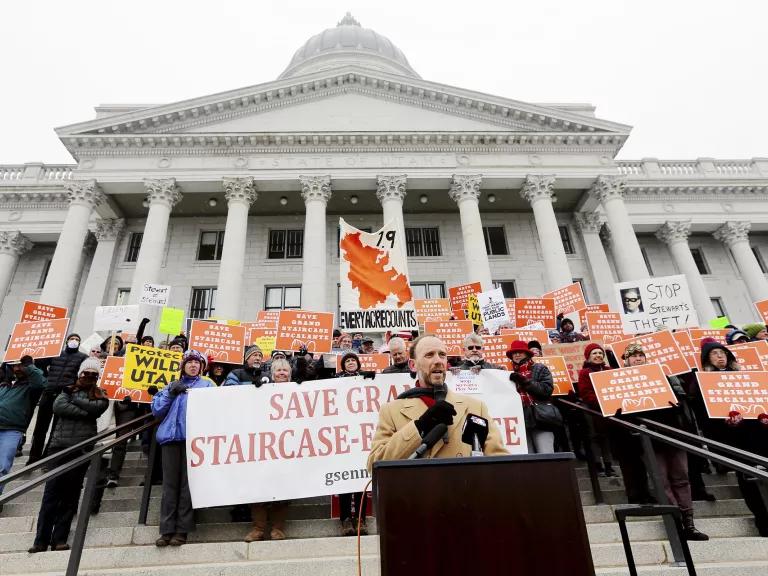
Protesters at the capitol building in Salt Lake City opposing legislation that would negatively impact Grand Staircase-Escalante National Monument
Scott G Winterton/The Deseret News via AP
Bears Ears became a national monument under the Antiquities Act—a law adopted in 1906 to protect “objects of historic or scientific interest” found on federal lands. NRDC intervened in court to defend the monument when the first Trump administration threatened it. In addition to returning Bears Ears and Grand Staircase–Escalante to their original sizes, Biden also designated 10 new monuments. Among them was the Baaj Nwaavjo I’tah Kukveni–the Ancestral Footprints of the Grand Canyon National Monument, lands that the Grand Canyon Tribal Coalition had long been fighting to safeguard from encroaching uranium mining. That landscape now forms part of one of the largest swaths of connected protected lands in the Lower 48, the Moab to Mojave Conservation Corridor.
But all of those added protections began to fall away in 2025. The Trump administration has rolled out a series of new regulations across multiple federal agencies—including the U.S. Department of Agriculture, the Interior Department, U.S. Department of Defense, the U.S. Air Force, and Federal Energy Regulatory Commission—that severely weaken the National Environmental Policy Act (NEPA), silencing communities and ignoring growing climate risks.
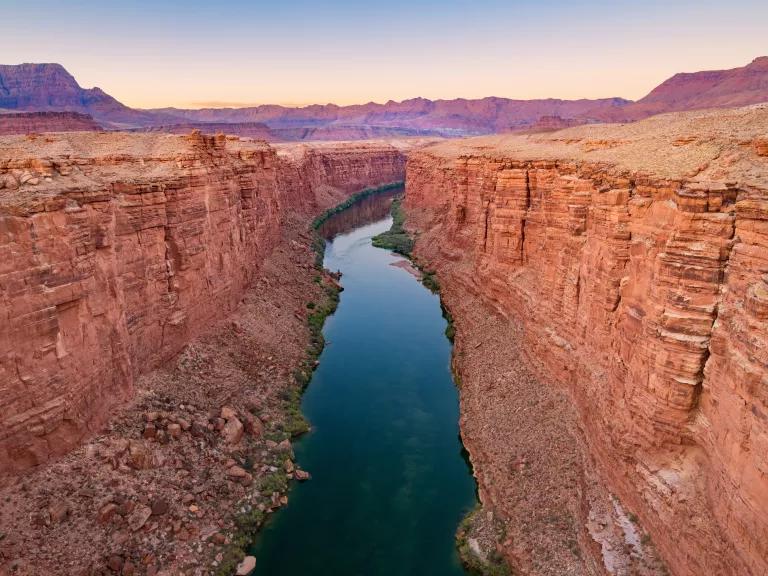
Utah and Nevada in the crosshairs
With more than 35 million acres of federal lands within its borders, Utah has long been on the forefront of public lands battles.
Advocates like Katie Umekubo, managing director for NRDC’s lands division, have observed a significant push by the BLM for land transfer in western states like this one. Another way of describing it, Umekubo notes, is land disposal. “That’s basically transferring public lands to states, private entities, or others to get rid of protections and pave the way for extraction,” Umekubo says.
The State of Utah is already seeking exactly this. It recently filed a complaint with the U.S. Supreme Court, challenging federal control over most BLM land. Though the Supreme Court denied the complaint, Utah has suggested it may try again in lower courts. And other states may follow suit: A dozen of them threw their support behind Utah’s attempt to take control of 18.5 million acres of federal public land.
“The idea of viewing federal public lands as open to extractive interests hearkens back to a much older history in the United States, when we were viewed as a continent of boundless resources that could be never exhausted,” says Michael Pappas, an environmental law professor at the University of Colorado Boulder.
For more than a century, the federal government doled out land to new states, homesteaders, and industries ranging from agriculture to mining to railroads. For the lands managed by the BLM, it wasn’t until the adoption of the Federal Land Policy and Management Act of 1976 that the government placed a priority on protecting important natural, cultural, and historical places for people.
In the 1970s, the country saw more unrest from the “sagebrush rebels” of the West, led by ranchers in Nevada who objected to new federal requirements on livestock on public lands. (The requirements came partly out of a decision in a 1974 court case argued by NRDC, which called for the BLM to begin preparing in-depth impact statements detailing the environmental effects of proposed livestock grazing permits on public lands.) Congress subsequently enacted legislation intended to guide management of public lands, including those used for grazing.
But some in the country seem to be pivoting back to this earlier ethos. During the federal budget reconciliation bill debate in 2025, Utah senator Mike Lee, chairman of the Senate Committee on Energy & Natural Resources, pushed for an initial fire sale of more than 3 million acres of public lands—an area larger than Connecticut—that would have resulted in the loss of cherished trails, parks, and recreation areas for people across the country. And specifically for Utah and Nevada, the language pushed through the bill’s markup in the House Committee on Natural Resources by Nevada representative Mark Amodei and Utah representative Celeste Maloy would have sold BLM lands in those states. After facing opposition from both sides of the political aisle, those provisions were ultimately withdrawn; nevertheless, the threat to these lands remains.
NRDC’s director of land conservation, Bobby McEnaney, talks about the cultural and environmental significance of our public lands as well as the threats they face from the Trump administration and the oil and gas industry.
Alaska on edge; Colorado on alert
About a third of all federal land sits in Alaska. Among the most majestic wild spaces is the Tongass National Forest, the world’s largest intact temperate rainforest. At nearly 17 million acres, stretching for 500 miles north to south, it comprises nearly 80 percent of southeastern Alaska. The forest’s 500-year-old cedars provide shelter for 400 animal species, from bears and rare wolves to bald eagles. Tongass waterways are home to enormous populations of salmon, a key food source for Indigenous Peoples and the driver for a $986 million annual fishing industry that supports more than 7,000 jobs across the region.
Nevertheless, the Tongass faces increasing risks from commercial logging. The first Trump administration exempted the Tongass from the Roadless Rule, a regulation that protects much of the forest (and tens of millions of additional acres across the country) from road construction and potential logging. Despite President Biden reinstating the rule, Trump began dismantling it on the very first day of his second term with an executive order directing the U.S. Department of Agriculture to once again undo those protections. This effort has since merged with the administration’s broader effort to expand logging and other development within federal forests. In August 2026, the administration proposed gutting the Roadless Rule, stripping protections from nearly 45 million acres across the National Forest System, including the Tongass.
“The Roadless Rule is incredibly important for ensuring the ongoing ecological integrity of the Tongass,” says NRDC senior attorney Garett Rose, who was part of the legal team that took the Forest Service to court when it ended protections for the forest in 2020. “This forest provides critical habitat and is key in the fight against climate change. It’s the leading carbon sink in the Forest Service system.”
Rose also points out the landscape’s cultural significance for the Haida, Tlingit, and Tsimshian Tribes of southeastern Alaska. At stake are “traditional cultural uses, hunting, gathering, foods, and medicine,” he says. “They are the leaders in conserving this place.”
Despite the clear benefits of protecting the Tongass, the state of Alaska has repeatedly sought to nix the Roadless Rule there—and repeatedly “gets knocked back on its heels” in court, Rose says. “It’s a testament to how well constructed the original rule was and the public support for the rule.”
Now, the fight continues. “We’ve been defending the rule since the beginning,” he says, “and we’re going to do everything we can to keep defending it.”

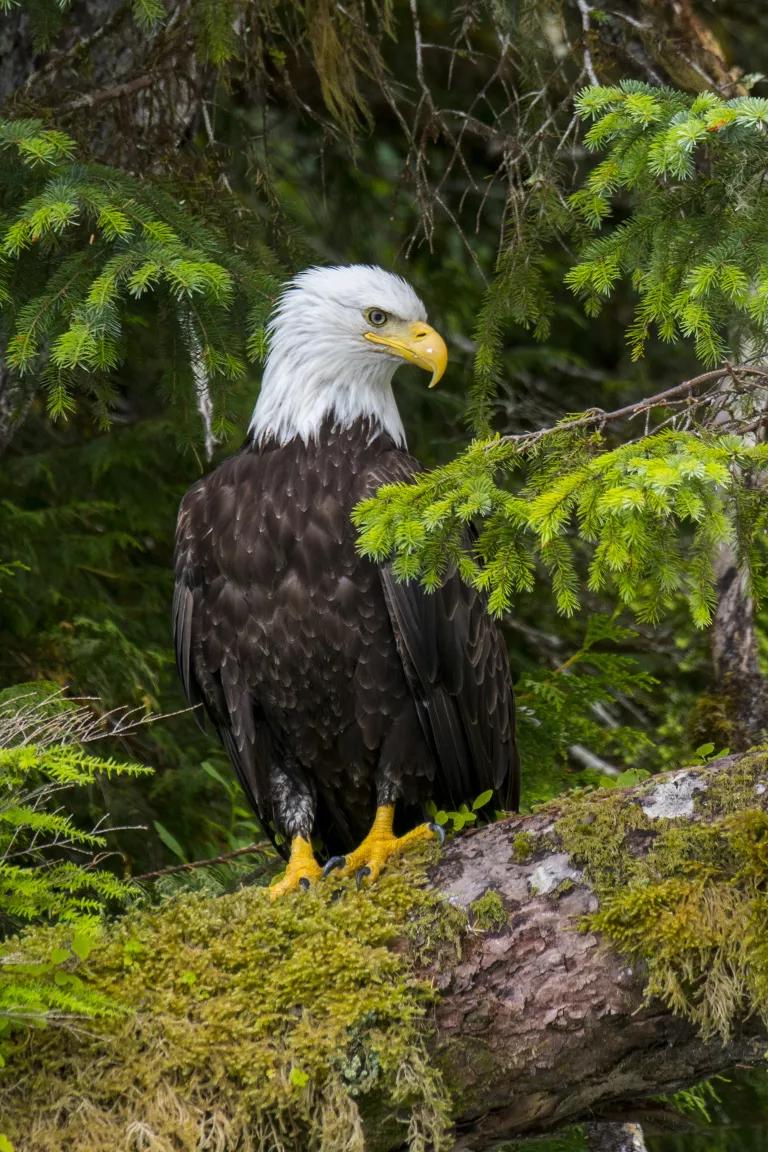
From left: Clearcut logging in Tongass National Forest's Prince of Wales Island; a bald eagle on Tongass's Baranof Island
Wolfgang Kaehler/LightRocket via Getty Images
A similar tug-of-war is taking place at the Arctic National Wildlife Refuge, a 19-million-acre preserve in northeastern Alaska that’s rich with polar bear, caribou—and oil. In 2017, Congress opened the refuge to oil and gas development. And in 2021, the Trump administration finalized plans to make some parcels available for oil and gas drilling, ending decades of protection. The outcome, however, was underwhelming, with the sale attracting limited interest. Another lease sale, in January 2025 was an even bigger failure: Not a single company submitted a bid. Yet another oil lease sale took place in the refuge this past June; it also received only a smattering of bids.
The results suggest that “drill, baby, drill” may work better as a campaign slogan than as policy. The United States is already producing record amounts of oil, and the petroleum industry doesn’t want to reduce profits by increasing production, says Melinda Taylor, a senior lecturer at the University of Texas at Austin School of Law and cofounder of the Kay Bailey Hutchison Center for Energy, Law, and Business. Industry people “will tell you, off-the-record, that they don’t intend to devote a lot of resources to trying to get permits to do additional drilling on federal lands because they’ve promised their investors and their shareholders that they will be profitable.”
Still, prompted by Trump’s One Big Beautiful Bill Act, which greatly expanded leasing mandates and incentivized fossil fuel production, some private companies have begun scooping up public lands all over the map. With the first tranche of leases announced in September 2025, the bill has already resulted in “massive encroachment issues,” says Bobby McEnaney, land conservation director for NRDC, “such as leasing in roadless areas in North Dakota that are also home to endangered black-footed ferrets.” (Only 300 of these iconic prairie predators remain.)
Tracts of wildlands in Colorado are also now under threat. In the Denver metro area, public lands surrounding the Aurora Reservoir, one of Denver’s most important drinking water reserves, is being targeted for a fracking well. Despite significant community pushback, in April state regulators approved 24 new oil and gas wells in the area.
Back in Alaska, the Trump administration has also moved to open the National Petroleum Reserve on the state’s North Slope. As McEnaney notes, the fate of Indigenous Peoples here hangs in the balance.
"There’s a way of life up there for certain villages that depends on subsistence hunting and fishing, and that way of life is fundamentally being jeopardized,” he says. “They’re already under tremendous stress from climate change, and that’s accelerated by drilling and fragmenting the landscape.”
It’s stakes like these that keep Indigenous communities and NRDC pushing back on threats to these lands that have not been set aside merely for profit, but for the people.
This story was originally published on January 23, 2025, and was updated on August 21, 2026, with new information and links.
This NRDC.org story is available for online republication by news media outlets or nonprofits under these conditions: The writer(s) must be credited with a byline; you must note prominently that the story was originally published by NRDC.org and link to the original; the story cannot be edited (beyond simple things such as grammar); you can’t resell the story in any form or grant republishing rights to other outlets; you can’t republish our material wholesale or automatically—you need to select stories individually; you can’t republish the photos or graphics on our site without specific permission; you should drop us a note to let us know when you’ve used one of our stories.
23 million acres of public lands in Alaska's Western Arctic are at risk—again
Stop the Trump administration's dangerous plan to allow drilling projects to move forward in the Western Arctic without a thorough review!
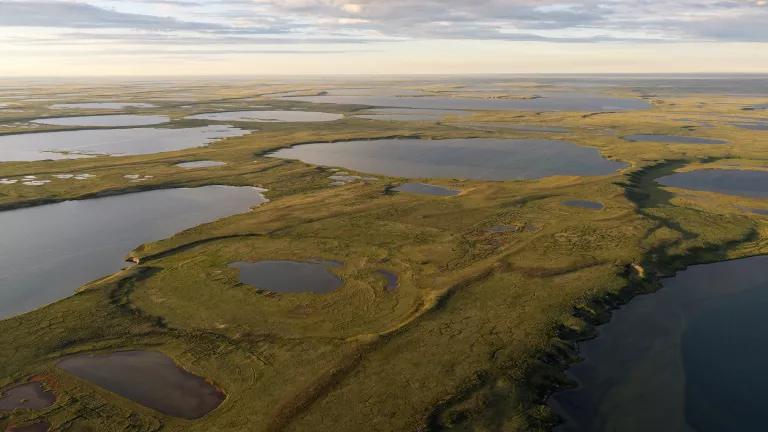
Don’t let Big Oil rewrite the rules for the Western Arctic
Following a petition from the oil and gas industry, the Trump administration has proposed allowing reckless drilling projects to move forward in Alaska's Western Arctic without a thorough review. This leaves wildlife, land, water, and local communities at higher risk while cutting the public out of the process. Submit a public comment by November 9 to stop this dangerous plan.
Alaska’s Tongass National Forest at Risk Once Again
The Endangered Species Act Under Attack
We Need NOAA Now More Than Ever