
Why Are the Feds Leasing Public Lands to Big Oil for So Cheap?
In the sunny Southwest, oil and gas companies can get an acre for as low as $10, while solar companies can barely get a scrap.
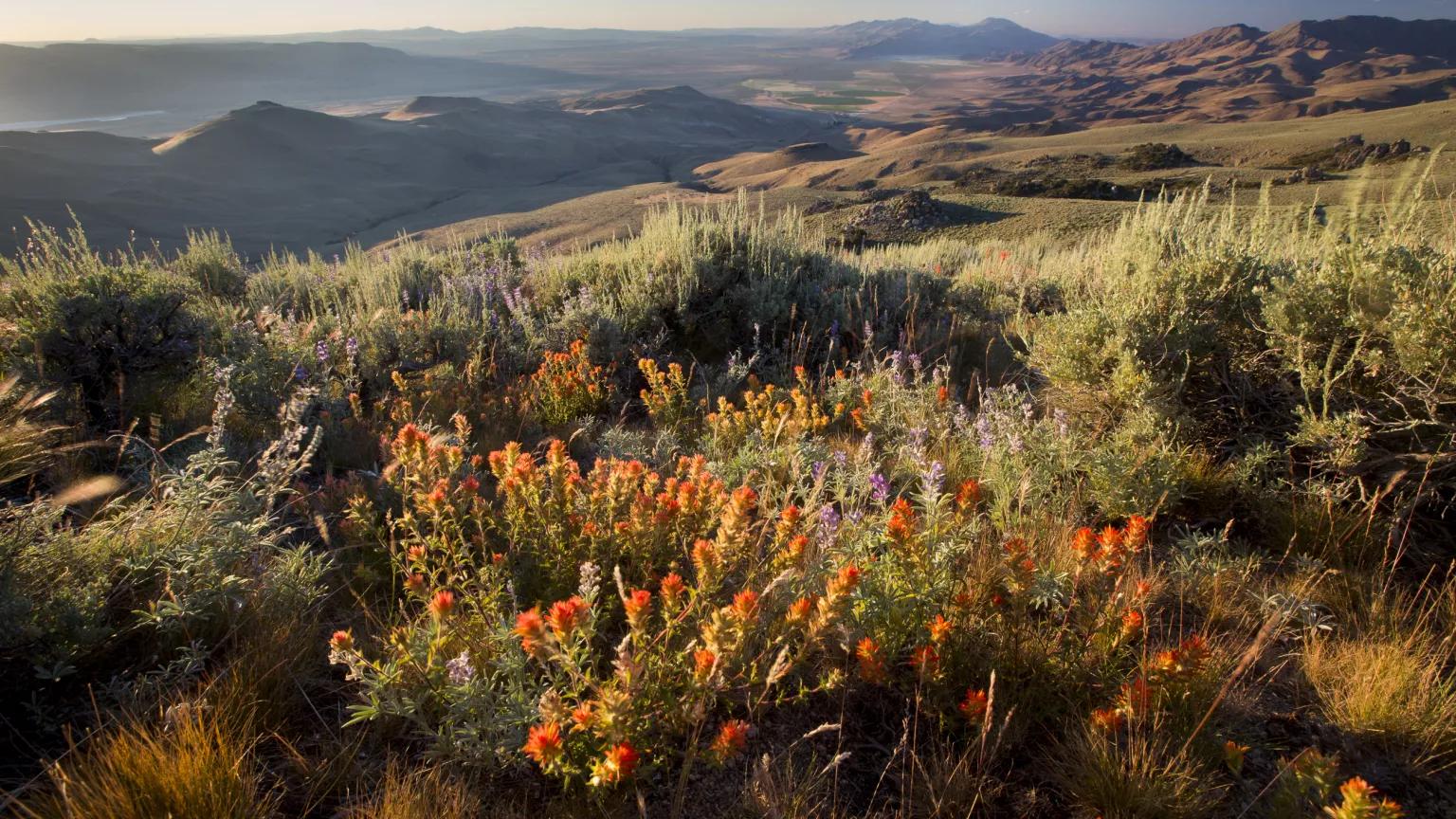
Northern Nevada's 25,000 acre Pine Forest Range Wilderness is an island in the sky rising almost 6,000 feet above the desert floor to peaks that top out at just below 10,000 feet.

About 85 percent of Nevada is federal land, which means that we, the people of the United States, own it. These millions and millions of acres are to be used for the benefit of the public. That’s the law. Two other fun facts about Nevada? It’s the nation’s second-sunniest state (behind Arizona), and it has almost no oil or gas reserves to speak of.
So, it seems odd that the Bureau of Land Management (BLM) currently leases nearly half a million acres in Nevada to oil and gas companies. In fact, this past spring, the BLM auctioned nearly 20,000 acres of this land to the fossil fuels industry for a measly $10 an acre. That’s not enough to get you three gallons of gas these days.
The low lease price in Nevada coincides with low interest from the industry. Indeed, many past lease sales in the state ended without a single bid and only 0.3 percent of all oil and gas leases in Nevada have ever produced either fuel. So why do these public lands sit idle in the hands of the fossil fuel industry—especially when solar companies are clamoring to use them? After all, the state’s abundant sunshine makes them prime territory for generating cheap electricity.
The reason for this mismatch comes down to a mix of regulatory loopholes, strict leasing practices, and the Trump administration favoring oil and gas drilling at all costs—even when those costs fall upon the American people. Let’s break down what’s going on here.
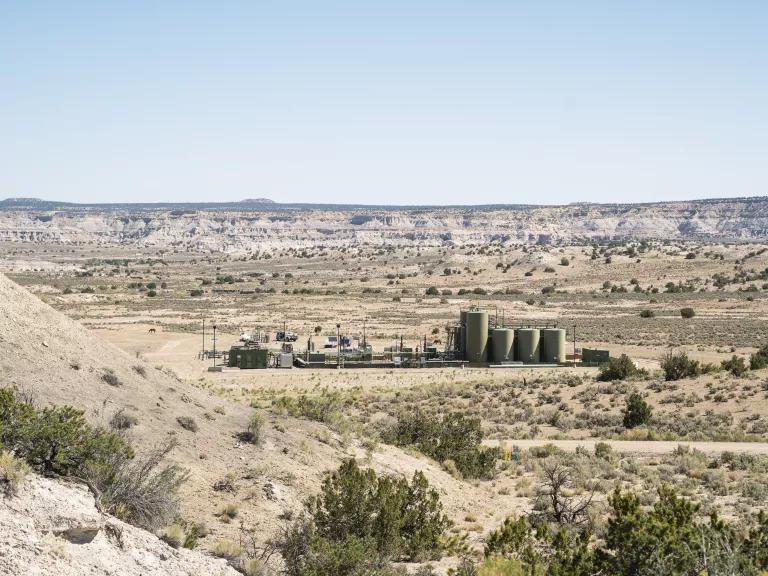
An oil and gas rig development in New Mexico.
Gaming the system
Companies can nominate which parcels they’d like to lease, and after the BLM decides which lands to put up for auction, companies bid on parcels, with the price per acre varying greatly by state. For instance, in a recent lease sale in Utah, more than 68,000 acres went for more than $56 million—a price about 82 times higher per acre than the Nevada lease earlier this year.
The winning bidder gets an initial 10-year term period and pays a onetime up-front payment called a bonus bid and an annual per-acre rental fee along with some administrative fees. For use of the people’s land, the company is also responsible for a 12.5 percent royalty fee on sales of the oil and gas produced, which the federal government and the state split.
Royalties can be an important revenue stream for states, helping to fund public services, such as infrastructure, health care, and education. But in current practice, they often put communities at the mercy of the boom-and-bust cycles of oil and gas prices.
And should the BLM hold an auction and receive no bids, the agency can relist the parcel the next business day and award it to the first applicant interested in snatching it up for future drilling. This noncompetitive process allows the lessee to skip out on paying the bonus bid, potentially shortchanging taxpayers by millions.
Many of the companies that take advantage of this loophole are engaging in speculative leasing, which is when they obtain land without proven energy development resources. Nationwide, more than half the public lands leased between 2012 and 2022 were on land with little potential for oil and gas extraction. As to why companies would do this, Bobby McEnaney, NRDC’s director of land conservation, explains that leasing an abundance of undeveloped land could be a strategic way to inflate a company’s value—having a portfolio containing thousands of acres of federal land to potentially develop could help attract investors.
In 2022, the Inflation Reduction Act eliminated the noncompetitive bid process and increased the royalty rate from 12.5 percent to 16.6 percent, with the Department of the Interior (DOI) committing to a “balanced approach to responsible energy development and management” of our public lands. Unfortunately, the One Big Beautiful Bill Act, passed last year, reversed both reforms.
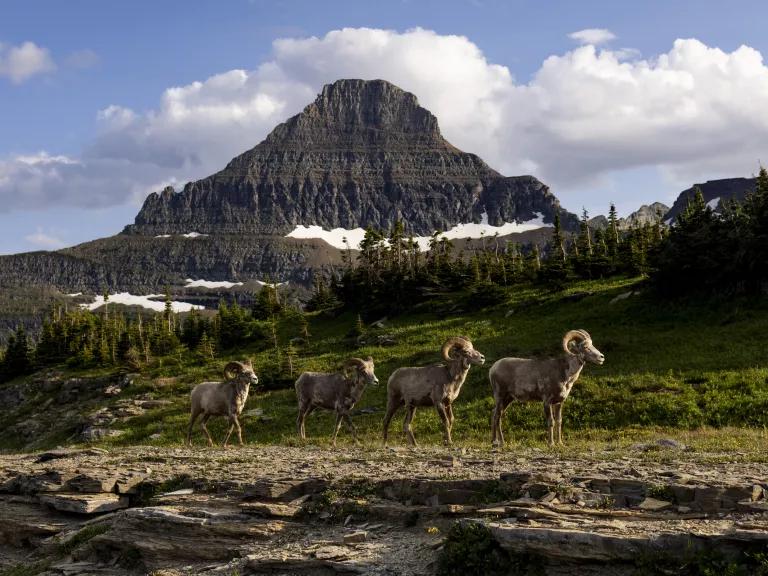
Bighorn Sheep stand along the Hidden Lake Trail at Glacier National Park in Montana.
A lose-lose scenario
A scenario where companies stockpile public land—sometimes for decades—without actually doing anything with it ends up costing Americans in the long term.
“There have been leases in suspension for over 50 years. We found some that are approaching 60 years,” says McEnaney. During such suspensions, the clock stops on the term limit and the company doesn’t have to pay rent.
McEnaney points to a case in Montana’s Badger-Two Medicine area, a critical wildlife corridor between Glacier National Park and the Bob Marshall Wilderness. This roadless expanse is home to grizzly bears, moose, elk, and bison and holds religious and spiritual importance for the Blackfeet Tribe, whose reservation borders the land. Back in 1982, the Reagan administration illegally issued oil and gas drilling permits without an environmental impact statement or Tribal consultation. Following decades of lawsuits between the BLM, the Wilderness Society, and the oil company that leased the land, the BLM finally relinquished the last remaining lease in 2023.
“It took about 40 years to unwind that lease. In the meantime, all that land was left in limbo instead of being managed as, say, wilderness,” says McEnaney.
Even if leased land is left untouched, local wildlife populations may suffer without active conservation management of their habitats, and cultural artifacts on the land could also be at risk. An analysis of BLM’s resource management plans—done by the Center for Western Priorities, the Wilderness Workshop, and the Colorado Wildlands Project—found that lands with wilderness characteristics that were under lease were three times less likely to be properly protected than those that were not.
This is partly because an active lease blocks other uses of the land, whether it’s adding conservation safeguards for nesting grounds or migratory corridors, opening recreational trails for biking or hiking, or promoting other types of development, such as wind or solar farms. And without any clean energy production, there is also no royalty revenue to benefit the public.
Nearly a third of Nevada’s power currently comes from solar, but it has the potential to generate much more. The Solar Energy Industries Association estimates that Nevada is on track to add nearly 6 gigawatts of solar capacity in the next five years. For reference, just one gigawatt is enough to power 876,000 households for a year. This growth, however, may never happen if oil and gas companies continue to needlessly hog the state’s public land.
In public comments submitted earlier this year, NRDC questioned the BLM’s methodology that would allow two Nevada lease sales to proceed, noting that the justifications that the agency has used to move forward don’t reflect the facts on the ground.
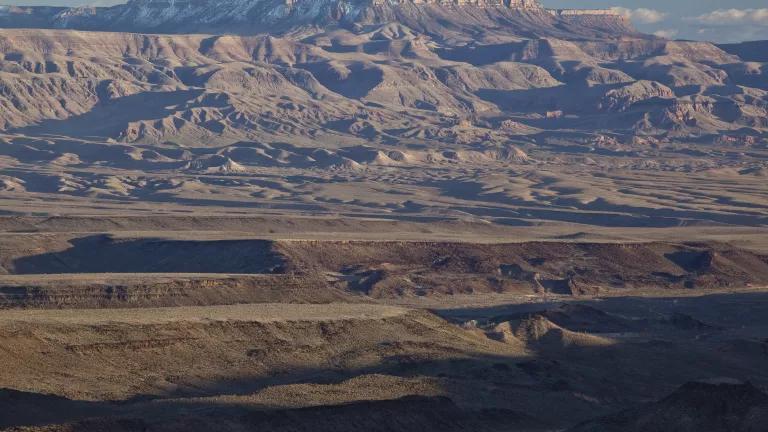
The problem is mirrored in the state’s southern neighbor. Two oil and gas lease sales of nearly 300,000 acres in northwestern Arizona are planned for later this year and early next year. Some of these areas would overlap with areas that BLM has already identified as being well suited for utility-scale solar generation. Many of the parcels nominated are also very close to popular conservation areas, including the Grand Canyon. In fact, one that’s up for bid is less than a mile from Grand Canyon–Parashant National Monument. To boot, the region in question also has no known oil or gas resources.
NRDC is also challenging these sales, which would be the first held in the state in eight years—a long stretch when it comes to oil and gas auctions and just another sign that designating this land to this particular industry is inappropriate. This summer, we submitted nearly 52,000 public comments opposing the public lands fire sale in the Grand Canyon area.
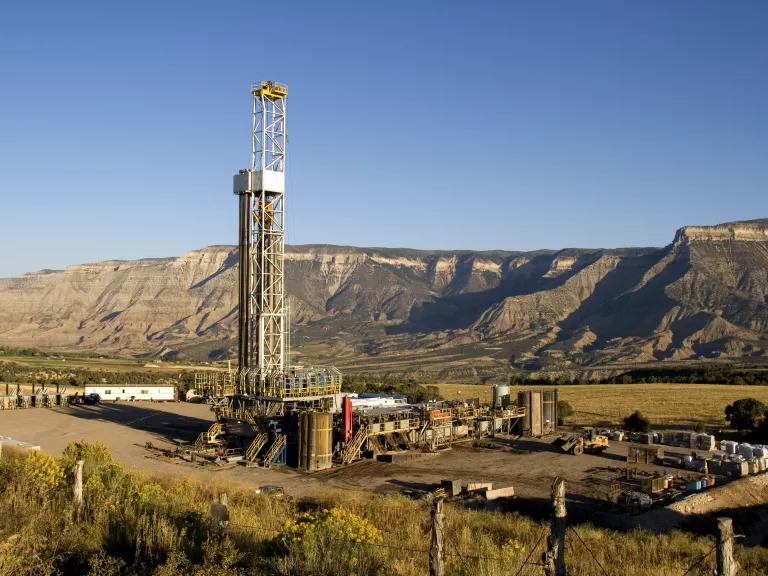
A rig drills for natural gas, framed by the cliffs of the Roan Plateau near Rifle near Rifle, CO
Trump tips the scale even more
Despite the mandate that requires the agency to strike a balance between various potential uses of public lands, the BLM earmarks more than 80 percent of its lands for drilling. On top of that, requirements for renewable energy leases and wilderness designations are much more stringent than those for oil and gas.
“If you want to develop a parcel of land for solar, you have to meet some very specific financial requirements. Whereas for oil and gas, what constitutes a qualified bidder is very vague,” notes McEnaney. “They allow almost anybody who would potentially develop land to get the lease.” In contrast, the administration has canceled dozens of solar projects, he adds—although it has faced some recent legal setbacks in its efforts to undermine renewables.
The BLM’s giveaways to fossil fuel interests—even in areas where it just doesn’t make any sense—are blatant. The Trump administration recently repealed the Public Lands Rule, a Biden-era measure that prioritized conservation, recreation, and renewable energy development on federal lands. The rule essentially spelled out how the BLM could carry out the multiple-use mandate and established new regulations for landscape restoration, land health evaluations, and designations for areas of critical environmental concern.
Making matters worse, the One Big Beautiful Bill Act also directs the BLM to expand extractive activities on public land. In 2025, the agency leased 328,000 acres for oil and gas development but has announced plans this year to offer more than twice that. Before the act, BLM district offices also had some discretion on when or how often to hold oil and gas lease sales, but now Congress has directed offices in certain states—Alaska, Colorado, Montana, Nevada, New Mexico, North Dakota, Oklahoma, Utah, and Wyoming—to hold them four times a year, every year, for the next decade. (There are no such mandatory sales for the renewable energy industry.)
In the short term, local advocacy can be pivotal. Under the Federal Land Policy and Management Act, BLM must develop resource management plans in partnership with state and local governments. And while states cannot directly block the BLM from leasing out federal land, they can create certain restrictions when it comes to oil and gas development. For example, California currently requires a 3,200-foot buffer zone between new oil and gas production facilities and homes, schools, hospitals, and community centers.
The public has 90 days to weigh in on a lease sale: a 30-day initial scoping period, a 30-day public comment period, and 30-day protest period for each phase of the sale. This is the opportunity for organizations like NRDC to provide substantive feedback on potential environmental impacts of specific lease sales.
But even this public feedback process is now at risk—the DOI recently proposed a rule that would eliminate both the scoping and public comment periods and cut the protest period down to just 10 days. To add insult to injury, the rule would also place a $1 per page filing fee for any written protests more than 50 pages long while at the same time reducing fees for industry.
For longer-term and nationwide change, reforming BLM’s practices is the way to go. First, no more land hoarding. If the land has little or no viability for oil and gas production, the BLM shouldn’t offer it to that industry. In addition, speculative leasing shouldn’t allow millions of acres to be locked up by the oil and gas industry through unlimited lease suspensions or renewals when that land would be better managed for other important uses, including renewable energy. Second, minimum bid amounts, higher rents, and increased royalty rates would help ensure public lands aren’t given away for less than they’re worth.
“Nothing short of wholesale reform is going to be adequate,” says McEnaney.
This NRDC.org story is available for online republication by news media outlets or nonprofits under these conditions: The writer(s) must be credited with a byline; you must note prominently that the story was originally published by NRDC.org and link to the original; the story cannot be edited (beyond simple things such as grammar); you can’t resell the story in any form or grant republishing rights to other outlets; you can’t republish our material wholesale or automatically—you need to select stories individually; you can’t republish the photos or graphics on our site without specific permission; you should drop us a note to let us know when you’ve used one of our stories.
Say no to the drilling onslaught near the Grand Canyon
The Trump administration wants to open 200,000+ acres of public lands for oil and gas leasing in the Grand Canyon area. Send a message of opposition.
Say no to the drilling onslaught near the Grand Canyon
The Trump administration wants to open 200,000+ acres of public lands for oil and gas leasing in the Grand Canyon area. Send a message of opposition.
9 Places to See Before They're Gone
The Best and Worst Toilet Paper, Paper Towel, and Facial Tissue Brands
Our Public Lands Are on the Chopping Block Again