Minnesota’s Water Quality Wake-Up Call
Nitrogen pollution is a statewide problem that needs a new solution.

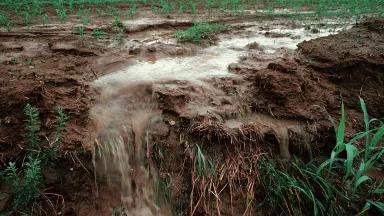
When agricultural runoff containing nitrates wash into the Mississippi River, it fuels toxic algal blooms and the hypoxic “dead zone” that suffocates marine life in the Gulf of Mexico.

Coauthored with Julia Kirkland, 2026 Stanback fellow
In July, a state audit submitted to Minnesota’s legislature confirmed what many expected: The Minnesota Agricultural Water Quality Certification Program (MAWQCP) is failing at reducing nitrogen pollution from croplands. This comes as state advocates wait to hear if the Minnesota Department of Agriculture will fix another one of the state’s ineffective nitrogen reduction tools, the Groundwater Protection Rule.
These failing programs are leaving Minnesotans frustrated. For the past 40 years, Minnesota has been dealing with a nitrogen pollution crisis fueled by the overapplication of nitrogen fertilizer. Public attention has largely focused on Minnesota’s southeastern karst region that has been at the frontline of this issue. In April 2023, the U.S. Environmental Protection Agency (EPA) mandated a state emergency response after 11 environmental and public health organizations petitioned the agency, citing nitrate pollution as an “imminent and substantial endangerment” to human health. While this aid brought needed relief to affected southeastern households in the form of well testing, filtration systems, and bottled water, the water data confirms that this problem is not isolated to a small region. Nitrate is showing up in waters across the state, in regions like the Central Sands, at levels that pose significant risks to human and environmental health.
The Central Sands sound a statewide alarm
Data collected from Minnesota’s own state agencies confirms that the Central Sands region, bordering the Twin Cities metropolitan area and extending west, is equally vulnerable to nitrogen pollution from agricultural runoff.
This region, comprised of 14 counties in the central part of the state, contains sandy soils that allow nitrates to run off farm fields into nearby streams, rivers, and lakes and leach easily into groundwater. An analysis of state water data shows that lakes, rivers, and groundwater in the Central Sands are polluted with alarmingly high levels of nitrates, regularly exceeding the EPA’s drinking water limit of 10 milligrams per liter (mg/L)—a threshold that ongoing research indicates is outdated and insufficient to protect human health.
Learn More

The Minnesota Department of Agriculture’s own ambient groundwater testing found that Central Sands had the highest median concentration of nitrates of any region in the state (14.7 mg/L). This testing also confirmed that nitrate contamination is most extreme in this part of the state, with the top 10 percent of samples containing almost three times the EPA drinking water limit (28 mg/L)—past the point where home reverse osmosis systems no longer work to filter out nitrates. One sample came in at a shockingly high concentration of 81.2 mg/L.
This is a concern because roughly 75 percent of Minnesotans get their drinking water from groundwater. Drinking nitrate-laden water increases the risk of certain cancers, thyroid disease, and blue baby syndrome (where infants are starved of oxygen when they ingest water contaminated with nitrates). Around half a million Minnesotans drink groundwater contaminated with elevated nitrates. And across 10 years of sampling, one in eight Minnesotans routinely consume tap water exceeding safe drinking water limits.
“One of Minnesota’s most beloved summer destinations had to overhaul its entire municipal water system because of the amount of nitrate contamination coming from surrounding farm irrigation. Big Ag left the 4,500 residents of Park Rapids to pick up the tab, which residents were forced to do in order to protect their families and thousands of summer visitors.”
Kent Scheer, Wadena, Minnesota
Nitrates also cause serious environmental problems when they reach surface water. Agricultural runoff containing nitrates wash into the Mississippi River, fueling toxic algal blooms and the hypoxic “dead zone” that suffocates marine life in the Gulf of Mexico. Excess nitrogen volatilizes into the air as nitrous oxide—a greenhouse gas that’s 273 times more potent than carbon dioxide. This air pollution also degrades our ozone layer and can cause respiratory diseases.
Data from the Central Sands confirms that agricultural nitrate contamination is not a regional anomaly specific to the southeastern karst region—it is a statewide crisis.
Persistent problems require new solutions
State policies surrounding nitrogen contamination have largely focused on voluntary reporting and the adoption of best management practices, most notably through the MAWQCP. The recent legislative audit on the program concluded that decades of voluntary reporting have produced no measurable evidence of water quality improvement and found that 92 percent of sampled 2019 farm certifications relied on “contingencies” or promises of future practice implementation rather than demonstrated compliance. With no ongoing enforcement, producers maintained certification benefits without actually reducing their share of nitrogen pollution.
Likewise, the state’s sole regulatory program—the Groundwater Protection Rule—is not designed to reduce the biggest sources of nitrogen pollution.
With Minnesota’s nitrate crisis growing, statewide, it is clear that current programs are insufficient. To protect public health and water quality, Minnesota must implement mandatory, outcome-focused data collection and reporting systems to meaningfully quantify nitrogen loss and target intervening efforts at the source. The state also needs a comprehensive policy that sets enforceable limits to nitrogen fertilizer application and runoff—offering farmers clear, field-level management guidance while accounting for local geological and hydrological vulnerabilities, such as those in the Central Sands region. This approach has proven to be successful in countries like Denmark and New Zealand, and California is considering a similar strategy as well.
Only through mandatory limits, site-specific guidance, and robust data measurement can Minnesota achieve real, lasting reductions in nitrogen pollution to see improved water quality.
This NRDC.org blog is available for online republication by news media outlets or nonprofits under these conditions: The writer(s) must be credited with a byline; you must note prominently that the blog was originally published by NRDC.org and link to the original; the blog cannot be edited (beyond simple things such as grammar); you can’t resell the blog in any form or grant republishing rights to other outlets; you can’t republish our material wholesale or automatically—you need to select blogs individually; you can’t republish the photos or graphics on our site without specific permission; you should drop us a note to let us know when you’ve used one of our blogs.
Related Blogs

Report: Harmful Pesticide Contamination Rampant in Minnesota Waters

Groups Call on Minnesota to Address Rampant Neonic Pollution