Colorado: A National Leader in Transportation and Climate
The state’s next governor can make Colorado’s transportation system cleaner, safer, more equitable, and more affordable.

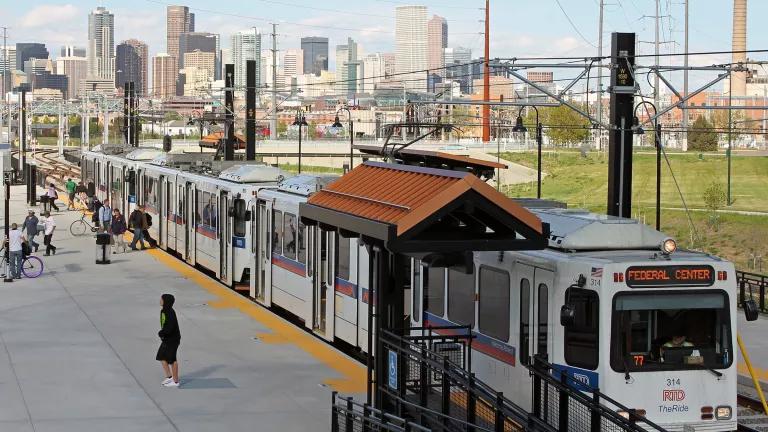
The light rail train in Denver

When it comes to the fight against climate change, the United States has a transportation problem. Transportation has become the largest source of greenhouse gas emissions in the country, with most of these emissions coming from cars and trucks. Especially in the absence of federal action on climate, it falls to states to drive the clean transportation transition.
Colorado has quietly emerged as a leader in this field, implementing a broad, creative suite of transportation policies that protect the climate while also spurring economic development and putting money back into Coloradans’ wallets.
This leadership is highlighted by the state’s progress on electric vehicle (EV) infrastructure. Colorado has announced that the state has nearly completed its fast-charging network under the National Electric Vehicle Infrastructure Program, with 83 percent of the state highway system being within 30 miles of a fast-charging station. This investment in charging has helped Colorado become one of the top states in the country for EV adoption.
Today, Colorado finds itself at a turning point. Governor Jared Polis’s eight years in office are coming to an end, and the office is about to change hands. It is imperative that the next governor continues and accelerates the state’s climate leadership.
Demonstrated leadership on clean transportation
Colorado has continually demonstrated its commitment to clean transportation in recent years. The state’s comprehensive approach to transportation reform led it to rank sixth in NRDC’s 2025 scorecard Getting Transportation Right, an improvement of one spot since the previous edition of the scorecard in 2023. Colorado’s score of 59.7 points out of 100 is a nearly three-point increase from 2023 and puts the state between Maryland and Massachusetts and 11 places ahead of New Mexico, its highest-scoring border state. Complementary analysis from the Brookings Institution ties Colorado for fourth place in state transportation planning.

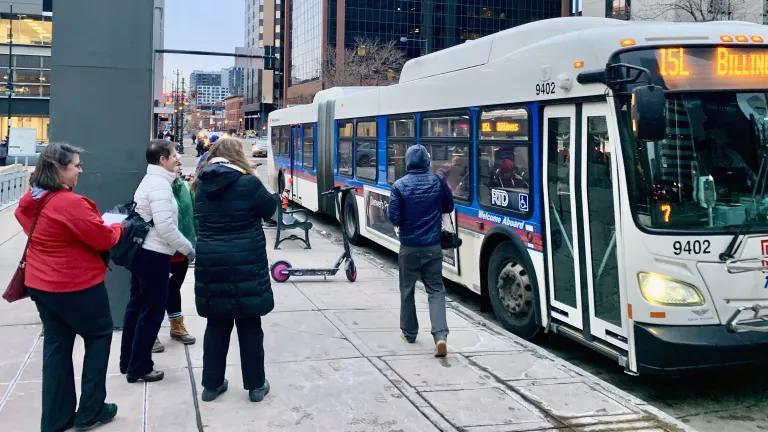
A public bus in Denver
Investing in transit
Colorado has steadily grown state investment in transit throughout the past decade. Colorado launched a statewide bus service—called Bustang—in 2015. Consistent service expansion has led to a double-digit percentage increase in ridership each year, with annual ridership growing from a pandemic low of 70,000 to more than 350,000 in 2025.
To get more people onto transit, Colorado has invested in a program that offers free youth transit passes during ozone season. To pay for increased transit, the state passed a bill levying fees on oil and gas production—a win-win measure that makes dirty energy producers help pay for clean transportation investments. A nonpartisan fiscal analysis estimated that the fees will raise $116 million annually for transit by 2027.
Colorado is also investing in long-distance rail to give residents of cities and towns across the state an alternative to crowded and polluting highways. The Front Range Passenger Rail is set to run between Denver and Fort Collins by 2029, with a southern extension to follow.
Project prioritization
In 2021, Colorado approved a landmark greenhouse gas rule for transportation planning. The rule requires that major transportation projects meet greenhouse gas targets or include measures to alleviate pollution impacts. The state has already seen results, with one wasteful and polluting highway expansion being canceled and replaced with bus rapid transit service in the Denver area.
Moving away from highway expansions doesn’t mean that Colorado is ignoring its roads. Rather, the state is focusing on maintaining the infrastructure it already has. Colorado’s interstates are now better paved than at any time in the past eight years, with the share of interstate pavement in good condition rising nearly eight percentage points in the past three years. This fix-it-first approach means smoother commutes and less car maintenance for Colorado drivers and clearly shows that ambitious climate action and routine pothole filling can and should go hand in hand.
Electric vehicles
Colorado drivers have adopted EVs en masse, with the state leading the national EV market in 2025 and ranking third nationally among peers in a state policy scorecard for electric vehicle "readiness" from the Brookings Institution. The state is using the federal National Electric Vehicle Infrastructure program to complement its own Charge Ahead Colorado and EV Home Charge programs to build a robust charging network, making EV ownership increasingly convenient—even in rural areas. To help meet growing consumer demand for electric vehicles and their charging needs, Colorado passed legislation aimed at modernizing its electricity grid. To make EVs more affordable in the wake of the termination of the federal EV tax credit, Colorado increased its own tax credit to purchase EVs.
Land use
A cleaner transportation system isn’t just about how people travel—it's also about reducing how far they must travel to meet their daily needs. Sprawling development often forces people to drive, while denser mixed-use development lets people make their own choices about how to get to work, school, and other destinations. Colorado has acknowledged the role of land use in decarbonizing our transportation system by passing bills that encourage denser housing near transit, let nonprofits and public agencies build housing on underused land, and reduce wasteful parking minimums.
A 10-year vision
A 10-year vision
In 2024, Governor Polis released Transportation Vision 2035, a long-term plan for making Colorado’s transportation system cleaner, safer, more convenient, and more affordable. The document laid out ambitious and achievable goals that will require ambitious action. The plan calls for significant increases in funding for transit and active transportation—two areas that were identified as gaps in Getting Transportation Right. The plan also highlights the importance of EVs and the need for cooperation between local, state, and federal government.
Colorado should continue its clean transportation leadership
Colorado is on the eve of a gubernatorial transition. The incoming governor will have an opportunity to build on the work of the Polis administration and maintain Colorado’s transportation climate leadership.
NRDC’s Getting Transportation Right shows a path forward: Colorado scored near the bottom of the top 10 states in the “State funding for transit capital” category and at the absolute bottom of the top 10 in “State funding for transit operations.” The new fees on oil and gas should improve this score in future report cards, but the state nonetheless has more work to do in providing robust and stable funding for transit systems—especially if Congress moves forward as proposed and slashes transit and passenger rail funding in the next federal transportation law.
Colorado has spent the last decade establishing itself as a national leader in clean transportation. The next governor can not only preserve that legacy but elevate it. By defending against attacks and continuing to grow state investments in transit, rail, active transportation, and EV infrastructure, the state’s next governor can make Colorado’s transportation system cleaner, safer, more equitable, and more affordable.
This NRDC.org blog is available for online republication by news media outlets or nonprofits under these conditions: The writer(s) must be credited with a byline; you must note prominently that the blog was originally published by NRDC.org and link to the original; the blog cannot be edited (beyond simple things such as grammar); you can’t resell the blog in any form or grant republishing rights to other outlets; you can’t republish our material wholesale or automatically—you need to select blogs individually; you can’t republish the photos or graphics on our site without specific permission; you should drop us a note to let us know when you’ve used one of our blogs.
Related Blogs
Colorado Legislative Roundup: 2024
Bill Passes to Power Up Colorado