The Next Transportation Bill Must Continue Progress on Affordable Transportation Choices for All
Congress must invest in alternatives to gas-powered cars—including electric vehicle infrastructure, transit, biking, and walking—and avoid excessive spending on new roads and highway lanes.

Skyrocketing gas prices have left individuals searching for ways to save on their transportation costs. The volatility of gas prices is yet another reminder that Americans need cleaner and cheaper options—both for the good of their wallets and the air they breathe. While the future of public transit and alternative transportation options remains unclear in the upcoming surface transportation bill, a new tax on electric vehicles (EVs) and hybrids is a real possibility. At a time when Americans should have more options, including EVs, the federal government is seeking to penalize those who choose to move away from the reliance on gas cars.
For public transit, walking, and biking infrastructure, questions remain on the level of funding support these programs will receive and whether the Trump administration will faithfully implement these programs. While Representative Rick Larsen, the Ranking Member of the House Committee on Transportation & Infrastructure, has shown his support for transit infrastructure, the president’s budget recommends slashing a quarter of public transit funds and 82 percent of passenger rail funding, which is illustrative of the administration’s disdain for public transit, EVs, and transportation alternatives. Even if these programs receive funding, we have seen with other funding authorized as part of the Bipartisan Infrastructure Law that the Trump administration will meddle in implementation: slow-rolling the distribution of funds and sowing uncertainty.
For those individuals choosing to avoid the pain of paying $4 or more for a gallon of gas by purchasing a hybrid or EV, this may become much more expensive, with Congress yet again pursuing a tax on EVs and hybrids. Current proposals would see EV owners paying an extra $250 a year while hybrid owners would pay an extra $100 a year.
Let’s be very clear: A new tax on efficient vehicles will do nothing to reduce the cost of transportation for any American household, especially not for individuals who are already struggling to make ends meet. This tax will not bring down the cost of gas; it will not make EVs more affordable; it will not benefit the air that we breathe. What this will do is put cleaner, more efficient vehicles out of reach for the very Americans who may be considering an EV purchase to weather high and volatile gas prices.
Forty-one states already have additional taxes and fees for electric vehicles, ranging from special registration fees to taxes on EV charging. EV drivers are already paying their fair share (and often more than their fair share) to maintain our roads and bridges. Continuing to levy tax after tax on these vehicles won’t solve our existing infrastructure issues or make transportation more affordable. It will just lock drivers into gas cars and the associated higher fuel costs.
With Americans struggling with increased transportation costs, taxing households that are taking action to conserve oil and gas will exacerbate affordability challenges rather than alleviating them. Congress must reject additional taxes on electric and hybrid vehicles and invest instead in clean and affordable transportation for all.
A coalition of advocates and labor allies are gearing up to defend critical programs in another landmark bill set to be introduced in 2026. The decisions that Congress makes will determine how much Americans pay for transportation expenses and whether they have access to an array of transportation choices.
The current federal transportation law, enacted in November 2021 as part of the Bipartisan Infrastructure Law (BIL), will expire on September 30, 2026, and Congress is responsible for refilling and reallocating federal coffers for the next five years. How federal infrastructure money is allocated and eventually spent by states will determine the impact these investments have on household budgets, high-quality transportation choices, and air and climate pollution. More investments in new roads and highway lanes will lead to more traffic, more money spent at the pump, more pollution, and expensive, sprawling development. Smart and effective investments—such as those that support transit, biking, and walking options; road maintenance; and fueling infrastructure for new technologies like zero-emission vehicles—will strengthen the choices people have to move around affordably, reduce harmful pollution and health costs, and save taxpayers their hard-earned money.
Learn More


The BIL made some progress on prioritizing transportation projects that advanced many of these goals. Nevertheless, Congress will need to maintain momentum on affordable and clean transportation funding with the next bill. Unfortunately, we can instead expect proposals to cut funding, rescind commonsense public review of road construction projects and their impacts to the local communities and the environment, and give states a blank check to spend federal transportation dollars on ineffective highway boondoggles that will keep people stuck in traffic. Americans and businesses are already bracing for increasing household costs due to recently implemented tariffs and cuts to federal programs that support access to medical care and food. It will be even more important to preserve programs that lower transportation costs and increase access to high-quality travel choices.
A key roadblock to advancing clean transportation in the next transportation bill is the Highway Trust Fund (HTF), the primary source of federal transportation funding, which no longer collects sufficient revenue from fuel taxes to cover spending. Federal fuel taxes have not been increased since 1993, not even to adjust for inflation over the past 32 years. The past several transportation bills have simply transferred money from the general fund into the HTF to make up the difference; $275 billion has been transferred from general funds to the HTF since 2008. The latest transfer is projected to run out by 2028, so Congress will be looking for ways to drastically cut spending or add new sources of revenue. Both scenarios could seriously penalize clean transportation investments and compromise progress on creating affordable and accessible transportation systems.
For the next surface transportation bill, NRDC recommends that Congress do the following.
Invest in transit and active transportation
The average cost of owning and operating a car in 2024 was $12,296, a heavy burden for many families, and the current surface transportation program forces people to depend on cars by prioritizing roadbuilding. Congress must fix this by a) increasing funding for transit to the same level as highway funding; b) reauthorizing critical programs for active transportation, such as Safe Streets and Roads for All, at higher funding levels; c) putting a fix-it-first policy in place to prioritize maintenance of existing roadways rather that building new roads; and d) creating new transit operations funding to support existing capital investments, as outlined in the Stronger Communities Through Better Transit Act bill.
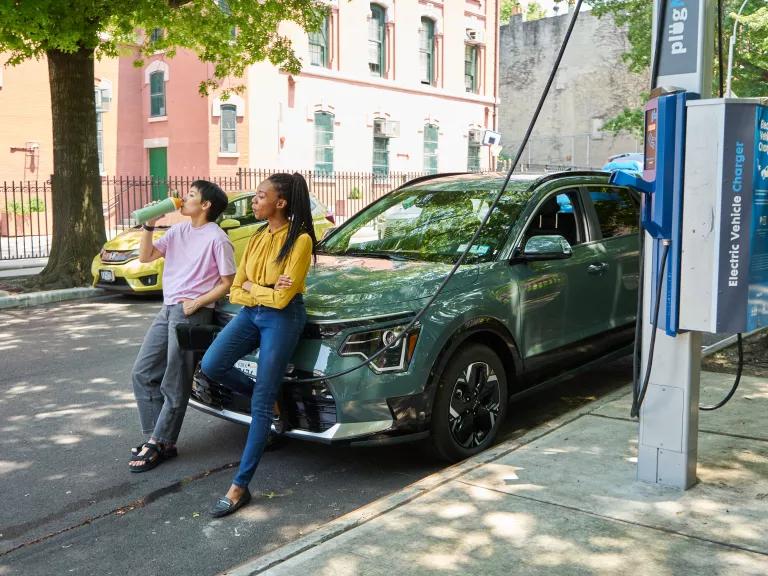
A public EV charging station in Brooklyn, New York
Support U.S. modernization and competitiveness on electrification
The next reauthorization bill should also prepare America’s transportation system for new fueling infrastructure and vehicle technologies. Both developed and emerging economies throughout the world are racing ahead technologically while the United States lags. Congress must catalyze more private investments domestically by reauthorizing and increasing funding for the National Electric Vehicle Infrastructure Program and the Charging and Fueling Infrastructure Grant Program. These programs are essential to developing a national fueling network for new electric vehicle (EV) technologies at a scale that will meaningfully modernize our transportation system and give people more affordable options to reduce their fuel bills while also reducing pollution and adverse public health impacts.
Unfortunately, as legislators deliberate on how to keep the HTF afloat, an additional threat to electrification technologies in transportation has emerged in the form of punitive federal EV fees. These proposed new federal fees are unlikely to make a significant dent on projected revenue shortfalls and will disproportionately burden EV owners, who already pay more in state fees and taxes than drivers of conventional vehicles. Congress must identify revenue generation solutions that are sustainable in the long run and do not unfairly penalize clean transportation technologies.
Protect and strengthen the Carbon Reduction Program
The Carbon Reduction Program (CRP), created under BIL, funds projects that move people and goods efficiently while reducing emissions and long-term costs. While this first-of-its-kind program played a significant role in encouraging states to make transportation decisions based on climate outcomes, many states have undermined the CRP by transferring its funds to other projects. Congress must not only maintain funding for the CRP but tighten up transferability limitations for the program. States must also be required to track greenhouse gas outcomes from their investments and set declining targets to ensure real progress is made on emissions.
Keep revenue collection aligned with clean air goals
The existing federal gas tax and vehicle registration fee framework appropriately incentivizes fuel efficiency and therefore cleaner vehicles. Congress should preserve this incentive by ensuring that any revenue-stabilizing policy avoids punitive fees on clean vehicles and maintains an incentive for energy efficiency—for example, by assessing any gas tax–replacement fees on the basis of the U.S. Environmental Protection Agency’s fuel efficiency equivalent ratings rather than as a flat fee designed to penalize clean vehicle owners.
Increase transparency and accountability
Data on how states spend federal transportation dollars are hard to come by in a consistent fashion, making it difficult to hold federal and state governments accountable for their decision-making. Americans deserve to know how their tax dollars are being spent—and whether those investments are delivering results.
NRDC recommends that the next surface transportation bill require the U.S. Department of Transportation to shine a light on how federal transportation dollars flow by regularly publishing clear, accessible, and reliable state data on the use, outcomes, and impacts of both formula and discretionary grant programs as well as the amount of funding that is transferred from one program to another.
Invest in underserved communities
Underserved urban, rural, and Tribal communities often benefit the most from investment in clean transportation options that help them fill existing gaps and respond to long-standing transportation needs. Funding from major programs that support accessible and affordable transportation systems, like BUILD and PROTECT, should be extended and directed toward these communities, using indicators such as income level, poverty rate, and local unemployment. For Tribal transportation in particular, funding levels should be equivalent to their share of the total American population. Indigenous communities see higher rates of roadway deaths relative to other racial groups yet received just $3.8 billion of the $643 billion that the infrastructure law set aside for transportation. Lastly, although they understand their own transportation needs better than anyone else, underserved urban, rural, and Tribal communities many times lack the technical capacity to navigate complex federal grant processes. Preserving and expanding federal technical assistance programs like Thriving Communities will ensure that every community can access the resources that meet their economic and community goals.
As Congress embarks on negotiations to secure transportation funding for the next five years, an ongoing focus on highway expansions and new roads will fail to defray the high cost of transportation for households and exacerbate harmful pollution and health outcomes. The next transportation bill presents an important opportunity for the federal government to invest in infrastructure that will keep transportation affordable and plentiful for every American and to pave the way for long-term change in the way that states spend their transportation dollars.
This expert blog was originally published August 6, 2025, and has since been updated with new information and links.
Related Blogs
Congress Is Cutting Off Transportation Investments that Help Families Save Money

Getting Off the Gas Price Rollercoaster