
The Plastics Industry’s Latest Deception: “Mass Balance”
Mass balance “recycled” plastic credit schemes are misleading.

This blog is coauthored by Veena Singla, a campaign fellow with Halt the Harm Network.

Example logo for material tracked by mass balancing
If you saw this logo on a plastic cup, what would you think it meant?
Looking at the text that says “30% recycled plastic” and the chasing arrows symbol, common sense would say that 30 percent of the plastic in the cup is recycled from plastic waste and that the cup itself could easily be recycled. Those assumptions would, unfortunately, be wrong.
The cup bearing this label could physically contain 0 percent recycled content and may not be readily recyclable itself.
How is this possible? It’s through the shell game of mass balance credit accounting schemes, the plastics industry’s latest attempt to mislead the public on plastic recycling (which has a long history) and promote so-called chemical recycling.
The reality is that these mass balance credit schemes not only involve creative accounting but are highly deceptive. They are promoting fake recycled content, contrary to the transparency and truth in labeling that people expect and deserve when purchasing products that are supposed to be “green” or “sustainable.”
As the world increasingly moves away from burning fossil fuels for energy, the oil and gas industry is looking to expand plastics production as the way to continue using fossil fuels and increase profits. But the public knows there is a plastic pollution problem and doesn’t want to accept more plastic. So the chemical industry has embarked on a major campaign to convince people that so-called chemical recycling will solve the plastic crisis, when it is mostly just plastic incineration. This is why industry is desperate to promote mass balance credit schemes, because they are needed to make the most common form of “chemical recycling,” pyrolysis, marketable and financially viable.
The plastics industry’s credit schemes are effectively trying to turn the decades-old practice of mass balance accounting into mass imbalance, twisting the practice in ways that were never intended and deceiving the public in the process.
If you’re not familiar with mass balance, see the section below titled “Primer on mass balance accounting: What is it and how does it work?” for an overview of this complex accounting method, terminology, and the specifics of what the plastics industry is proposing. See also Figure 1, which summarizes the concerns with mass balance credit allocation approaches, as compared to other methods used to track recycled content (or hypothetical recycled content that only exists on paper).
What are the problems with the plastics industry’s efforts to use mass balance accounting for “chemically recycled” content?
The plastic and chemical industries have called mass balance an “exciting accounting principle,” and deemed it as “critical to advance chemical recycling” and “a great way to scale up sustainability.” What they are not telling the public is how these schemes are misleading and will lead to rampant greenwashing, disadvantage real recycling (i.e., traditional mechanical recycling), promote harmful plastic incineration, and distract from real solutions to the plastic crisis, among other issues.
Mass balance accounting is complicated and confusing. Confounding matters even more is the fact that there are different kinds of mass balance–based approaches. Some (like the rolling average method, which is light green in Figure 1) are accepted by the Federal Trade Commission (FTC) to be used for recycled plastic. Others (like the “free” or nonproportional credit allocation method, which is dark red in Figure 1) are not, but the industry is pushing for this to change.
Our critiques below apply to two kinds of mass balance credit schemes that the industry is promoting (specifically proportional and/or nonproportional “free” credit allocation). Here is what’s wrong with what is being proposed:
- It’s not transparent. There is no way to know how much recycled content, if any, is in the physical product you buy. There is also no way to know what actually happened to the material claimed as “recycled,” including whether, rather than being recycled, it was burned as fuel.
- It’s misleading. Under the industry’s nonproportional “free” mass balance credit scheme, you could have a feedstock that is 90 percent virgin fossil fuel and only 10 percent plastic waste material, which is used to create products marketed as 100 percent recycled content. (If that sounds confusing, that’s because it doesn’t make much sense; see Figure 5 in the primer below for a visual on how this can be claimed.) In this scheme, plastic waste can be burned to fuel the pyrolysis process and yet be counted as being “recycled,” as can the creation of fuel products that will later be burned. (For more information on these concerns, see this report.) The plastics industry made up this highly misleading credit scheme; it isn’t being used in any other context.
- It’s greenwashing. Allowing use of these schemes will lead to rampant greenwashing and further undermine public confidence in the recycling system. The plastics industry’s proposed schemes would allow plastic that is not itself recyclable to be labeled as “circular mass balance recycled content,” which does not align with the common understanding of circularity and could mislead consumers into thinking the product is recyclable. Greenwashing—in this case, misleading the public as to what they can recycle and what is happening with the material they put into recycling bins—is problematic because people see the fake recycling as dealing with the problem and thus excuse the continued proliferation of plastic.
- It promotes plastic incineration. The plastics industry’s favored mass balance credit scheme is only needed and purposely designed to make two specific “chemical recycling” technologies economically viable: pyrolysis and gasification, which are regulated as incineration under the Clean Air Act (although the industry is trying to remove these regulations). Other “chemical recycling” technologies (which are also fraught with health, environmental, technological, and economic concerns) don’t need to use mass balance credit accounting schemes because they don't create fuels or burn plastic waste as part of the so-called recycling process.
- It disadvantages traditional mechanical recycling. Allowing mass balance credit schemes would create an uneven playing field for real recycling (i.e., mechanical recycling), which has far fewer health and environmental concerns than “chemical recycling” and is the process by which virtually all plastic is currently being recycled today. This is partly because mechanical recyclers are actually selling physical recycled material, whereas “chemical recyclers,” using certain forms of mass balance accounting, are really selling a marketing claim. (See the primer below for more details about the selling of marketing claims, as well as this report for more information regarding the uneven playing field.)
- It’s inconsistent with established policy and legal definitions of recycling. Both proportional and nonproportional credit allocation would allow the conversion of plastics into fuels to count as recycling, which is contrary to definitions established by the U.S. Environmental Protection Agency (EPA), the European Union, the state of California, and many others. Even more concerning, nonproportional credit allocation would allow the direct burning of plastic waste to count as recycling, which is also not allowed in many policy and legal definitions of recycling (and, on its face, is clearly not recycling). Additionally, many standards do not allow the transformation of plastic to other materials (such as chemicals) to count as recycling either—that is, the inputs and outputs should both be plastic, such as required in Canada.
- It distracts from real policy solutions to the plastic crisis. The fact that mass balance credit schemes can make it seem like more plastic is being recycled through a numbers game than is actually happening makes it more difficult to achieve true plastic reduction through public policies. (In fact, this is probably one of the industry’s goals in promoting these schemes.)
Key recommendations
- Government programs: Don’t allow a mass balance credit approach for recycled content, including in the FTC Green Guides and Extended Producer Responsibility (EPR) legislation, regulations, and programs. Require recycled content claims to correspond or at least be proportional to the physical quantity of recycled material contained in the product. The EPA Safer Choice program’s updated standard requires recycled content to be measured by weight.
- Companies: Don’t allow a mass balance credit approach for recycled content in products or to meet recycled content goals and sustainability commitments. Do not accept certifications that use this approach. Mass balance credit schemes have uncertain legal standing in the United States because they are inconsistent with established definitions of recycling and circularity, and companies would do well to avoid them. According to surveys and interviews with major brands, most companies did not believe that making a 100 percent recycled content claim using a mass balance approach conveyed accurate information to consumers.
- Individuals: Avoid products labeled as using mass balance “recycled plastic,” such as those that bear the International Sustainability & Carbon Certification (ISCC) label, pictured above. As explained earlier, there is no way to know what you are actually getting, and there are many concerns with the “chemical recycling” used to process this plastic. While we need policy change and systemic transformation to solve the plastic pollution crisis, individuals can take action too; see these other recommendations for reducing your own plastic use.
Primer on mass balance accounting: What is it and how does it work?
Mass balance is a chain of custody model. Chain of custody means following a material through each step of the supply chain, from sourcing to processing to the final product. Chain of custody models are often applied to trace sustainably and/or ethically produced and processed materials. The international standard for chain of custody is ISO 22095.
For example, mechanical recycling of plastic may use either a segregation or controlled blending chain of custody model (see Figure 2), both of which physically track recycled plastic content.
Figure 2. Accurate and transparent: Segregation and controlled blending chain of custody models

In a segregation model, virgin and recycled content are kept physically separated, such as in different processing areas, equipment lines, or facilities. In a controlled blending model, the amounts of virgin and recycled content inputs into the process are continuously tracked so that the product has a consistent and known quantity of recycled plastic content.
Segregation and controlled blending models are preferred because they are the most accurate and transparent. These are not forms of mass balance accounting.
A mass balance approach breaks the physical link between the inputs and outputs, and thus is more like an accounting method than the other chain of custody models.
In the mass balance rolling average percentage approach (Figure 3), there may be inconsistent amounts of recycled inputs available over time. Based on tracking the total amount of recycled inputs used in a specific time period (such as a month), an average amount of recycled content is then claimed for all products made in that time period, though the actual amount of physical recycled content in each item manufactured may be lower or higher than that average. Some certifications for mechanically recycled plastic allow this method.
Figure 3. Accurate but less transparent: The mass balance rolling average percentage chain of custody model

This mass balance rolling average percentage method is also currently part of the FTC Guides for the Use of Environmental Marketing Claims (Green Guides). This is reasonable since it corresponds to an actual physical quantity of recycled material, unlike the way that the industry wants to apply mass balance to pyrolysis and gasification. It is also practical since it reflects the real world of inconsistent feedstock availability and other constraints.
Because rolling average percent mass balance is accurate, does not allow for fuel creation, and is tied to physical recycled content, it is a reasonable and acceptable approach.
None of the above chain of custody models (segregation, controlled blending, or rolling average percentage) will work for pyrolysis, which is the main technology that is being used in currently operating and proposed “chemical recycling” facilities. (The current models also won’t work for gasification, but this is a much less common technology so we’ll focus on the implications of pyrolysis here for simplicity.) This is because plastic producers can’t use pyrolysis oil directly to make new plastic. It must first go into a fossil fuel refinery where it undergoes a second pyrolysis process (often called steam cracking or catalytic cracking) to convert it into different chemical and fuel products (see Figure 4). Then, in theory, some of the chemical products could go on to further processing into plastic. The pyrolysis oil (which is the product of plastic pyrolysis) is too contaminated to use at a level of more than about 10 percent in the refinery (it must be blended with virgin fossil fuels to dilute the contaminants), so it is not possible to have physical recycled content made from 100 percent pyrolysis oil, as shown in the segregation model example (Figure 2).
Figure 4. Semi-accurate and not transparent. The mass balance proportional credit allocation chain of custody model

Adapted from Chain of Custody Model Implications for Chemical Recycling
To account for the transformation of the pyrolysis oil input into different chemicals, the mass balance proportional credit method creates a credit for recycled input and allows allocation of that credit proportionally to the different products that come from processing the pyrolysis oil. (Note that the words allocation, assignment, and attribution are all used interchangeably for credits.) Fuel products can be counted as “recycled content” under this scheme, which is inconsistent with policy and legal definitions of recycling.
The plastics industry’s mass balance proportional credit allocation schemes are problematic because they are not transparent, allow the creation of fuel products to count as recycling, are only semi-accurate, and are misleading to the public.
While mass balance proportional credit allocation methods are problematic, the industry’s new nonproportional (“free”) allocation schemes are even worse. Notably, they were created by the plastics industry primarily to inflate the recycled content claims that could be generated by the “chemical recycling” technology of pyrolysis.
While other models (segregation/blending, rolling average, proportional) are variously allowed by existing standards and could be utilized for mechanically recycled content, or theoretically “chemically recycled” content—there’s a big problem with applying these to pyrolysis oil.
As mentioned above, the pyrolysis oil is too contaminated to use at a level of more than 10 percent, so with a proportional credit allocation, that places a ceiling of about 10 percent for any recycled content claim. (Even 10 percent is probably an optimistic estimate given that, for a variety of technical reasons, only 2 percent of the plastic waste fed into the pyrolysis process could effectively be recycled under a best-case scenario, according to one analysis.) ISO 22095 only allows proportional credit allocation. This is where the plastics industry has stepped in, inventing its own credit scheme to make the products of pyrolysis more attractive. (See this report for more on problems with pyrolysis of plastic.)
The plastics industry is promoting its own version of mass balance that it calls “free” allocation (Figure 5). In reality, this means nonproportional credit allocation, but industry prefers the term “free” because it sounds better. In this scheme, through questionable accounting methods, you can use feedstock that is only 10 percent plastic waste and 90 percent virgin material and market the products as having 100 percent recycled content. Nonproportional allocation also allows plastic waste that is burned during the pyrolysis process and any fuels that are produced to count toward recycled content credits, which can then be “allocated” to products claimed as 100 percent recycled.
Figure 5. Not accurate and not transparent: Industry scheme for mass balance non-proportional credit allocation
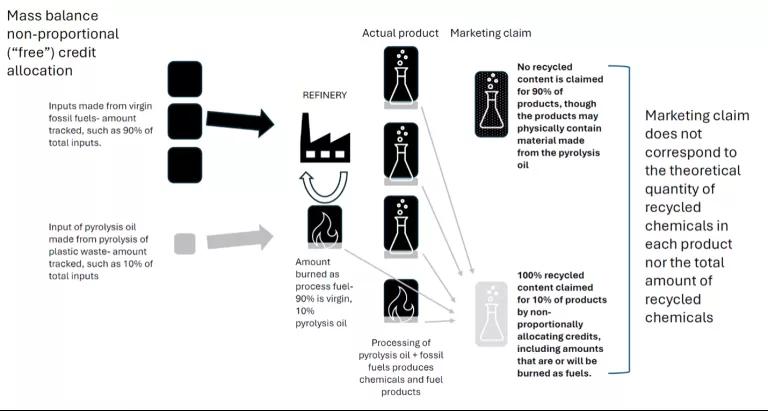
Adapted from Chain of Custody Model Implications for Chemical Recycling
This is how that hypothetical ISCC-certified plastic cup we introduced at the beginning of this blog can say “30% recycled plastic” but physically contain 0 percent recycled plastic. See the section above (What are the problems with the plastics industry’s efforts to use mass balance for “chemically recycled” content?) and an in-depth article from ProPublica for many more concerns with this approach.
The plastics industry’s nonproportional (“free”) allocation credit scheme is highly problematic, not accurate, not transparent, misleading, and should be avoided at all costs.
The plastics industry claims that mass balance is already an established practice in use and accepted in other sectors such as for certified fair-trade products, but this is not a relevant comparison. First, the international Fairtrade guidelines conform to the ISO 22095 standard, which does not allow nonproportional allocation. In fact, the guidelines do not allow credit schemes at all and use the rolling average percent method for mass balance; further, actual average percentage must be included in the claim. The Fairtrade guidelines state that the term certified may not be used for claims about ingredients: “The word certified, when used in relation to an ingredient, implies physical traceability so it must not be used.” Note that the ISCC mass balance logo includes the word certified, which Fairtrade considers misleading for mass balance ingredients. The way Fairtrade applies mass balance is entirely different from the nonproportional credit schemes the plastics industry is proposing.
Second, there is no transformation of a Fairtrade product, such as cocoa, into fuels or other materials. If a label claims that “mass balance is used to match Fairtrade sourcing, total 30 percent,” then there would physically be that amount of Fairtrade cocoa existing in the supply chain; you couldn’t have this cocoa being burned to power the factory that makes chocolate. This is not the case with the processing of pyrolysis oil—some plastic is burned as fuel, so with nonproportional allocation, you can’t be sure that the amount of recycled feedstock even exists in the world, much less in a particular product.
In addition, while it is physically possible to have 100 percent Fairtrade cocoa, it is not possible to have plastic made from 100 percent pyrolysis oil. There is no physical limit on the percentage of Fairtrade cocoa that can be in a product, up to 100 percent, but it is not possible to increase the percentage of pyrolysis oil that goes into a refinery above 10 percent because of the contamination problems.
Finally, despite plastics industry claims of mass balance credit schemes contributing to a “circular economy,” “circular feedstocks,” or other such terms, this is not actually the case. While there are different definitions for a circular economy or circularity, all generally include one fundamental principle: There must be circular material loops (see the EPA definition). A circular material loop means that materials entering the market remain in their best and highest uses as long as possible through pathways such as reuse, remanufacturing, and recycling. Both proportional and nonproportional mass balances are inconsistent with circularity because they allow burning of recovered materials as fuels, removing them from the manufacturing cycle. Further, since there is no requirement with mass balance that the nonfuel products (such as chemicals, or even other types of plastic) made from waste plastic be recyclable or even be likely to be recycled themselves, these products would also exit the manufacturing cycle.
So, to be clear: The way the plastics industry is proposing to use mass balance is very different from the way it is currently used in other sectors. As stated earlier, the plastics industry’s credit schemes are effectively trying to turn the decades-old practice of mass balance accounting into mass imbalance, twisting the practice in ways that were never intended and deceiving the public in the process.
The bottom line is, if you are buying a product and see a logo like this (or something similar), what you see is not really what you get; it is likely tied to a highly polluting form of plastic waste disposal; and this is a product to avoid.
Example logo for material tracked by mass balancing
Veena Singla is a campaign fellow with Halt the Harm Network, which is a vetted online network of experts, researchers, organizers, presenters, and people impacted by the oil and gas industry, who are connecting with each other to take decisive action to protect their communities. Singla’s research investigates how toxic chemicals and pollution related to systems of materials use, production, and disposal—including plastics—threaten the health of impacted communities, especially those experiencing environmental injustices. She focuses on advancing comprehensive solutions in collaboration with communities that center public health and racial and health equity. She is also an associate director with the Agents of Change in Environmental Justice program at Columbia University.
Related Blogs

When States Act, Markets Follow: The Ripple Effects of PFAS and Chemical Safety Policies
Communities and Workers Deserve Robust Protection from Chemical Disasters
