
What Will It Take for COP30 to Deliver a Climate-Resilient and Prosperous Future?
As extreme weather events increasingly devastate communities across the globe, COP30 must push for stronger, faster, and more creative ways to adapt to our changing climate and drive more effective, rapid emissions reductions.

The Amazon rainforest on Ilha do Combu and the skyline of Belém, Brazil, which will host the 2025 United Nations Climate Change Conference from November 10–21, 2025

It’s been 10 years since the creation of the Paris Agreement, the landmark global treaty to tackle climate change, and the world has made important progress. But as conveyed by the most recent United Nations reports, it is not nearly at the pace or scale that the moment demands. As climate impacts intensify, we must renew our resolve to accelerate action and rethink how we build resilient communities, economies, and natural systems.
How we adapt to the world we’ve created is critical. With the United Nations’ preeminent global climate talks coming up in Belém, Brazil, this year, known as COP30, it’s imperative to focus on how we build a resilient future by climate-proofing our economies, protecting people, and safeguarding the natural systems on which all life depends.
An emergency that demands rapid acceleration
However, we should first acknowledge that 10 years onward with the Paris Agreement in place, the world has made real progress—from the 36.2 million jobs generated by clean energy globally (more than oil, gas, coal, and fossil-engine manufacturing combined) to the exponential growth of solar energy (now four times what was predicted in 2015). Yet the latest reports show we are still drifting off course from limiting global temperature increase to 1.5–2 degrees Celsius, with profound consequences for people and the planet.
To change course, we need both emergency brakes and acceleration—brakes on the forces driving deforestation and forest degradation, ocean acidification, and sea level rise and acceleration in actions, such as deploying clean energy, efficient cooling, early warning systems, accessible finance, and affordable insurance, while protecting lives and livelihoods. Scaling up investment in these solutions is essential for a safer, more resilient future.
This is why COP30 matters. It must move beyond headlines and targets to focus on turning commitments into action—strengthening the cycle of planning, implementation, and accountability created in Paris to raise ambition over time. As an “implementation COP,” the international community must recalibrate this multilateral process and center those who are most affected by strengthening our ability to decarbonize supply chains, adapt to the changing climate, and address rising losses and damages, along with ensuring that vulnerable countries and communities are no longer left behind.
As leaders from over 190 nations convene in Belem, Brazil, this month for the latest climate talks, NRDC’s Yamide Dagnet discusses the critical work needed to meet our climate ambitions.
Rethinking resilience at COP30
The Brazilian COP30 presidency has signaled that this will be a COP that’s centered on climate adaptation and resilience—and rightly so. Rethinking resilience means building systems that can anticipate, absorb, and recover from shocks, in addition to sustaining progress toward a livable future. This focus could not be timelier. Amid geopolitical headwinds and more extreme climate events, COP30 must serve as a cornerstone for strengthening resilience—across economies, communities, and ecosystems alike—by:
Enhancing the ability of the U.N. Framework Convention on Climate Change and the Paris Agreement to remain beacons of light in the midst of external shocks
Let us be clear here: While global cooperation may be strained, the Paris Agreement has nevertheless held firm—preventing the world from veering toward even greater 4–5°C warming trajectories. No country has followed the United States in leaving the accord. Global investment in renewables now doubles that of fossil fuels. Climate measures have increased sevenfold, with more than 80 percent of the global economy committed to net zero targets. Still, the pace and scale of action, along with the means of implementation—finance, capacity building, and technology transfer—remain far from sufficient. New tools and ideas are emerging to close this gap, from the International Court of Justice advisory opinion to innovative investment mechanisms, bolstered by the momentum from the International Union for Conservation of Nature (IUCN) World Congress in Abu Dhabi.
Rallying the world to close the emissions and resilience gaps
COP30 must signal a truly collective response to both the emissions gap and the resilience gap—helping nations adapt to intensifying climate impacts while limiting losses to lives and livelihoods. This will require formal decisions and strong action from governments that accelerate implementation on the ground. Central to this effort is doubling down on untapped opportunities, including reducing emissions other than carbon dioxide, like methane or HFCs from refrigerants, and ensuring “just transitions”—moving away from fossil fuels in a way that protects workers, communities, and economies, in addition to reducing poverty and leaving no one behind.
Adapting, addressing loss and damage, and putting justice at the center
Adaptation efforts have long been underfunded and insufficient, leaving communities exposed to mounting climate impacts. COP30 must push for scaled-up financing for adaptation that integrates climate risk and resilience into economic planning, and the adoption of meaningful indicators. Yet even the best adaptation has limits, and unavoidable losses and damages are increasing, as seen in the recent devastation from Hurricane Melissa and other record-breaking events worldwide. Addressing both adaptation and loss and damage is not just about climate action—it is a matter of climate, economic, and social justice.
Ensuring that nature is part of the solution
Protecting and restoring forests, mangroves, and wetlands and reforming agriculture and food systems not only reduce emissions but also strengthen our resilience to climate impacts. They need to be integral to climate decision-making. In order to be on track to halt and reverse deforestation and forest degradation by 2030, the degradation in the Global North, which holds some of the most carbon-rich forests in the world, should receive the same level of scrutiny, transparency, and accountability as the tropics. This issue was elevated at the 2025 IUCN World Conservation Congress in Abu Dhabi, through the adoption of an NRDC-led motion. The COP30 presidency’s anticipated launch of the Tropical Forests Forever Facility is a potentially positive step toward delivering further progress, but it requires more robust engagement of Indigenous Peoples and local communities and standards that capture all drivers of deforestation and forest degradation.
Mobilizing financial flows to those who need it
Finance remains the elephant in the room. COP30 must accelerate both the scale and alignment of where global climate finance is currently at, ensuring that funds reach the countries and communities that need them most. At COP29, in Baku, Azerbaijan, the international community committed to mobilizing at least $1.3 trillion per year in climate finance for developing countries by 2035, with developed nations taking the lead in mobilizing at least $300 billion annually. COP30 is about engineering a major leap in both funding and delivery. Adaptation and resilience must receive a fair share while private and public flows are mobilized with transparency, accountability, and impact.
NRDC’s priorities at COP30
This is why NRDC will be with our partners in Belém this year (as well as in Rio de Janeiro and São Paulo beforehand for other preconference dialogues and forums). Together, we aim to shape a COP30 package that drives forward a durable transition to a clean, low-carbon global economy and resilient future for the planet and its people. Our focus will be on four key thematic areas:
- Catalyzing a finance step change, especially for adaptation and ensuring that the private and public sectors both work in concert to channel funds to the right kinds of efforts on the ground.
- Holding governments accountable for the ambition and delivery of their 2035 climate plans, at a time when every fraction of a degree matters.
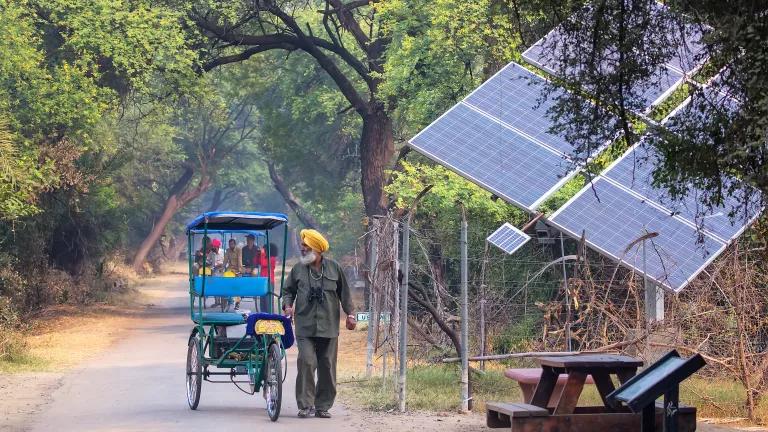
- Showcasing community-level resilience—including action on extreme heat and sustainable cooling in countries like India—that blends adaptation, resilience, and mitigation in tangible ways.
- Advancing equitable accountability for forest protection to preserve forests as critical carbon stores and sinks and tackle drivers of forest degradation and deforestation across both the Global North and Global South.
All of these efforts, in synergy with other multilateral processes—like the High Seas Treaty, the Montreal Protocol, the biodiversity and desertification conventions—are central to not only upholding multilateralism and global cooperation as a cornerstone of equitable global climate governance but also to meeting the human imperative of building a safer, healthier, and more prosperous society.
COP30 is a moment to mobilize all hands—Rio de Janeiro’s local leaders, São Paulo’s private sector, youth, women, faith-based communities, Indigenous and local communities, academics and engineers—to be, and continue to be, the changemakers turning the promise of the Paris Agreement into reality. It is also about ensuring the agreement remains a guiding beacon, providing the frameworks, space, and inspiration needed to catalyze transformative action for people and the planet.
Related Blogs
Overshoot Demands a New Era of Adaptation, Loss and Damage, and Climate Justice
Finance Beyond the COP: How India Is Rebuilding the Case for Global Climate Finance
