2025 Wins in Food Waste and What’s Next in 2026
Food waste programs and systems made significant advances around the country—and even the world. It's important to keep up the momentum in 2026.

Food waste being emptied into an anaerobic digester in Chicago


This year brought meaningful progress in slashing food waste across the country and in countless communities. But across the country, critical programs and funding are under mounting threat, even as the urgency to tackle food waste and build a more just, sustainable food system grows stronger. Here’s a look at what moved forward in 2025 and what’s coming next.
As the nation approaches its 250th anniversary, we are optimistic about the potential for renewed federal attention, funding, and amplification of the food waste work happening across the country.
Regional and municipal
Despite strains on local efforts due to limited federal support, cities continued to advance ambitious food waste reduction goals. NRDC supported communities nationwide as they launched new programs, strengthened collaborations, and tested innovative approaches. Highlights:
- Southfield, Michigan, launched a citywide blueprint to eliminate food waste.
- Greater Boston Collaborative Food Access Hub distributed more than 1.7 million pounds of food to residents and recovered 164,000 pounds from going to waste.
- Tennessee’s Clean Memphis rescued 250,000 pounds of food through the Careit donation and rescue app.
At the same time, access to composting continued to expand across our partner cities. Nashville extended its popular food scrap drop-off pilot for a second year, now reaching more than 700 households. Cincinnati launched four food scrap drop-off sites and is working with community gardens to build 40 new composting sites by mid-2026. Chicago added 13 new food scrap drop-off sites, bringing the total to 33 sites citywide.
Our Food Matters network also broadened its reach this year with programming on food waste messaging in public art, tools for calculating methane emissions, and global cooperation on food loss and waste. In partnership with Raftelis Financial Consultants, we hosted a workshop series tailored for government representatives on funding food waste reduction projects.

Model Municipal Ordinance on Advancing Community Composting, With and Without Commentaries

Tackling Food Waste in Cities: A Policy & Program Toolkit (Second Edition)
Advancing Food Rescue Guide
State
State action on food waste diversion policies—policies that prevent food from entering landfills or incinerators—continued to accelerate. Maine became the latest state to take a bold step forward, and NRDC is helping to drive progress in many others. These policies not only reduce waste and climate pollution but also spur composting, support surplus food donation, and reduce pollution in environmental justice communities.
In 2025, NRDC deepened partnerships with a wide range of stakeholders committed to advancing food waste diversion policies. We joined the Feed and Conserve IL coalition and developed a fact sheet making the economic and environmental case for action in Illinois, which we will circulate widely in 2026.
Economic considerations of food waste management are becoming increasingly central in Michigan. As part of a coalition of environmental organizations, NRDC continues to push for an increase to the state’s strikingly low waste surcharge fee—just $0.36 per ton, compared to $13 per ton in Wisconsin. A higher waste surcharge fee can generate revenue to support recycling infrastructure and waste prevention efforts while also discouraging excessive waste.
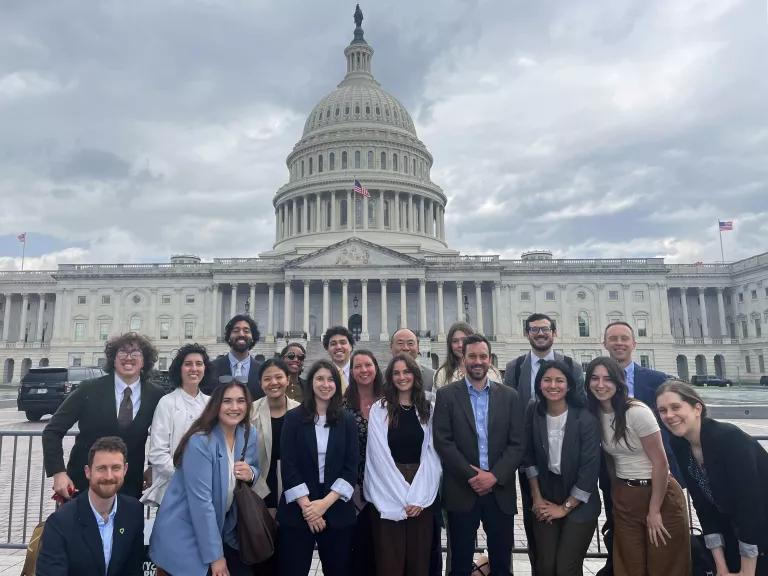
Coalition members in front of the Capitol Building on Zero Food Waste Coalition Hill Day, May 2025
National
Even with the significant disruption that our food system faced in 2025—the longest government shutdown in history, the dismantling of the traditional Farm Bill process, the cutting or freezing of an array of other major programs—food waste solutions remained a rare point of broad agreement.
This year:
- The U.S. Environmental Protection Agency reported that a family of four throws out nearly $3,000 of food annually and launched the Feed It Onward initiative that highlights national food waste reduction and recovery efforts.
- Momentum for standardizing food date labels continued to grow. A new national survey from ReFED, Harvard Law School Food Law and Policy Clinic, and Johns Hopkins Bloomberg School of Public Health found rising confusion over date labels, reinforcing this issue as a key focus for NRDC and the Zero Food Waste Coalition (ZFWC).
- In May, ZFWC brought 25 members to Capitol Hill, helping to secure the first-ever bipartisan Senate support for the federal Food Date Labeling Act.
Throughout the year, NRDC and ZFWC advocated to protect funding for the U.S. Department of Agriculture’s Food Loss and Waste Liaison and the Office of Urban Agriculture and Innovative Production, which runs the Composting and Food Waste Reduction grant program. We will continue pushing for strong federal engagement in 2026.

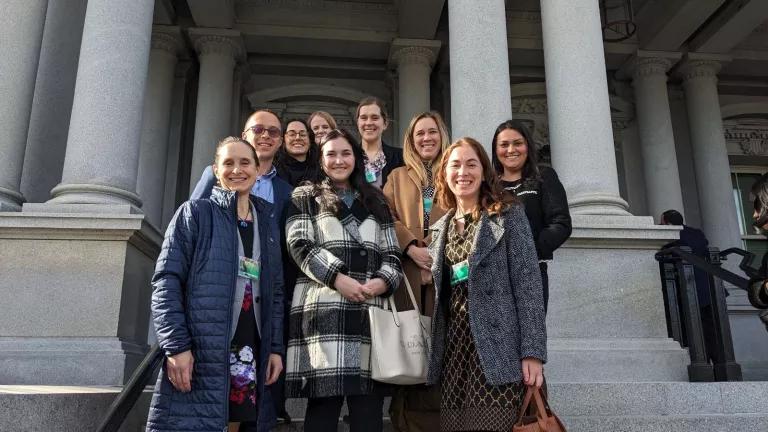
NRDC staff and city partners at Global Forum Milano 2025 held in Milan, Italy, October 13-17, 2025
Global
International momentum continued to build. The Champions 12.3 network released Maximizing Food: A Messaging Toolkit for Motivating Business & Policy Leaders to Address Food Waste, which was designed to help actors reframe food waste within broader policy and economic priorities.
At the Milan Urban Food Policy Pact (MUFPP) Global Forum, cities shared insights on food system innovation, including food waste efforts. Several American cities were recognized for leadership, including Austin, Baltimore, and Columbus.
International collaboration strengthened as well. Ahead of this year’s United Nations Framework Convention on Climate Change conference (COP30), ZFWC participated in the roundtable on agriculture and food systems in Bonn to accelerate global food waste action. At COP30 in Brazil, the U.N. Environment Programme launched the Food Waste Breakthrough initiative, introducing a $3 million effort funded by the Global Environment Facility to accelerate national and subnational food waste reduction and methane mitigation.
Looking ahead
With major events and new partnerships forming, 2026 promises to be a big year for food waste action.
Next summer, the FIFA World Cup comes to North America. Together with C40 Cities, a global network of mayors dedicated to climate action, NRDC has begun coordinating with host cities to elevate food waste strategies during the games—an opportunity to show the world that North American stadiums and cities take food waste seriously.
In March, Austin will host the first-ever MUFPP North & Central American Regional Forum, bringing international collaboration on food system transformation stateside. Cities across North America are invited to attend.
ZFWC and NRDC are also gearing up for meaningful state-level progress. In partnership with local organizations, we will work to strengthen New Jersey’s food waste diversion policy and increase Pennsylvania’s waste surcharge. We hope that successful models in these states will encourage replication nationwide.
As the nation approaches its 250th anniversary, we are optimistic about the potential for renewed federal attention, funding, and amplification of the work happening across the country.
You will find our team representing at the Food Waste Summit 2026, COMPOST 2026, Pasa Sustainable Agriculture Conference, the ReFED Food Waste Solutions Summit, SXSW, Climate Week NYC, and many more gatherings that shape the future of our food system.
NRDC is humbled to partner with such a dedicated network of food system leaders across the United States and around the world. This work brings us closer to a food system we can all be proud of, every single day. Thank you for all you do, and onward to a strong 2026.
Related Blogs

Global Climate Action Summit: More Feast, Less Food Waste
Columbus Signs Milan Urban Food Policy Pact