
Tackling Food Waste in Cities: A Policy & Program Toolkit (Second Edition)
Strategies for U.S. cities to prevent food from being wasted, to increase food donation, and to recycle food scraps.

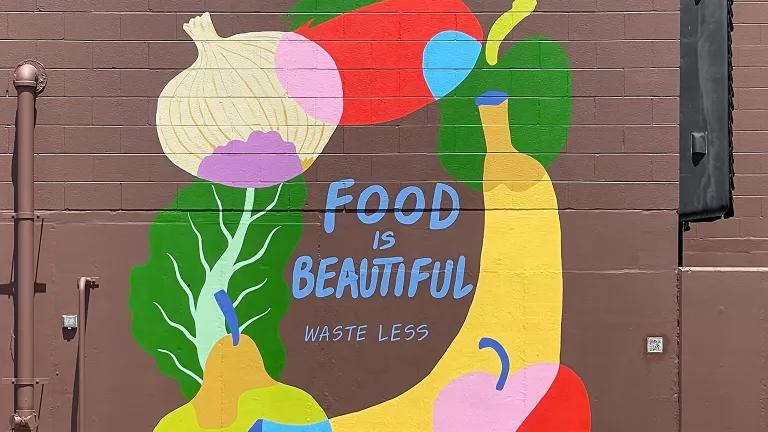
LeAndra Crystal's Food is Community. Waste Less mural at the Turnip Truck Natural Market in Nashville. Urban Green Lab, in partnership with NRDC, commissioned a series of murals across Nashville to continue public education on reducing food waste through the Nashville Food Waste Initiative.
Stephanie Swart for Urban Green Lab 2025 and Beyond, All Rights Reserved


DOWNLOAD THE FULL TOOLKIT
Introduction
Since the first publication of this toolkit, in 2019, awareness of the problem of food waste has grown and numerous policies and programs have been adopted at every level, yet about a third of our food supply still goes to waste. Producing food that we don’t consume is valued at $382 billion, swallows up 16 percent of cropland and agricultural water in the United States, and generates 4 percent of our global warming emissions (e.g., carbon dioxide from energy required to grow, transport, refrigerate, and cook food that goes to waste; and methane produced from food decaying in landfills and in sewers). At the same time, 13.5 percent of American households experienced food insecurity at some point during 2023.
In 2020 approximately 80 percent of the U.S. population resided in urban areas. Given that, tackling urban food waste is crucial to achieving the federal government’s national goal of reducing food loss and waste by 50 percent by 2030. Since 2015 NRDC’s Food Matters project has provided technical support and networking opportunities to cities developing food waste reduction policies and programs. In this updated toolkit, we have added and refreshed strategies to incorporate new content and resources, including the many reports, tools, and other resources for municipal practitioners developed by NRDC and available on our website. The strategies and structure selected for this update reflect our many years of close engagement with dozens of cities and what we have learned in this time about the most effective, practical, and sought-after solutions to reduce food waste.
Municipalities are uniquely poised to address food waste reduction and stand to realize significant benefits from doing so:
- Preventing food from going to waste, and therefore from entering the municipal waste stream, reduces waste management costs.
- Food donation programs can help cities address food insecurity and bolster the emergency food assistance system.
- Managing food scraps through strategies such as composting creates jobs and helps keep resources in the community.
- Addressing food waste helps cities improve resilience and further their climate, zero waste, and other sustainability goals.
What is this toolkit?
This toolkit includes 13 strategies (what a city can do to reduce food waste) divided into three sections: foundational, ambitious, and transformative. For each strategy we offer one or more recommended actions (how a city can accomplish the strategy).
Foundational strategies
Cities should undertake all foundational strategies because they focus on actions already within the city’s purview and offer opportunities for early wins.
- Estimate local baseline food waste generation and surplus food rescue potential.
- Set food waste reduction targets, develop a plan for ongoing measurement, and communicate goals.
- Identify opportunities for food waste reduction policy improvements.
- Develop mandatory food waste reduction protocols for municipal buildings and properties.
Ambitious strategies
While more challenging, ambitious strategies offer the opportunity for significant reduction, including through community-wide policies and programs.
- Educate the public about food waste reduction, emphasizing prevention.
- Update municipal waste collection services to boost food waste reduction.
- Adopt procurement policies and procedures that reduce food waste.
- Help businesses and institutions adopt food waste reduction measures.
- Assess and expand food rescue system capacity and address barriers to safe food donation.
- Create and expand infrastructure for organics recycling at every scale.
Transformative strategies
Transformative strategies build on the success of foundational and ambitious strategies to accelerate food waste reduction to the next level.
- Update municipal waste financing policy to fund and incentivize food waste reduction.
- Transition to pay-as-you-throw or other unit-based pricing for waste collection services.
- Adopt a mandatory organics recycling policy.
Although this ranking represents a rough ordering of least to most challenging to adopt, each city’s unique circumstances (e.g., what policies and programs are already in place at the local and state levels) will point to an individual path for adopting these strategies. This ranking is not intended to represent a linear sequence, but rather to help cities identify their own situation and select strategies that make the most sense for them. For example, a particular city may have the resources or momentum to adopt an organics recycling program before many of the foundational strategies are in place.
How to ensure longevity: Allocating resources to food waste reduction
For any of the listed food waste reduction strategies to succeed over the long term, cities must have a plan to secure needed funding and staffing resources for ongoing work. Designing a work plan and creating a working group help ensure that all relevant city departments, staff, and community stakeholders are included in policy and program development as well as implementation. For all strategies, incorporating equitable approaches and outcomes1 into development and implementation will help ensure lasting success.
Addressing food waste requires sustained public and private funding (see NRDC’s Guide to Funding Food Scrap Recycling and Food Rescue for more guidance). To build out a robust financial strategy:
- Understand the scope of the problem. Assess where and how food waste is generated, and evaluate existing food rescue and food scrap recycling infrastructure. (See strategies 1, 9, and 10.)
- Prioritize prevention and food rescue. While many cities focus on financing food scrap recycling infrastructure, funding activities higher on the wasted food scale—such as preventing food from being wasted in the first place and rescuing and redistributing surplus food—should be prioritized. (See strategies 5 and 9.)
- Adopt a holistic and strategic budget approach. Use savings from waste reduction programs to fund other food waste initiatives. Identify strategies and resources (such as new or existing full-time equivalent staff) that may require additional funding, and assess the likelihood of that funding coming from municipal budgets, an existing or new fund, or another source. For example, some cities have created new revenue streams, such as by adding a trash disposal surcharge, to increase funding for waste prevention efforts. (See strategies 11 and 12.)
- Explore funding and financing mechanisms. Cities can look to both internal and external mechanisms for funding, including city funds, taxes, and fees; municipal bonds; public–private partnership models; federal, state, or local grants or loans; community foundations; and philanthropic organizations. It may be helpful to use a grant writer for pursuing grants and other funding.
We recommend creating a detailed food waste work plan that guides the city’s short-, medium-, and long-term food waste reduction goals and targets and lays out corresponding strategies and key actions needed to achieve those goals over the next several years. For more on creating a work plan, see NRDC’s Quick Guide to Creating a City Food Waste Work Plan.
A designated staffer (whether dedicated full-time or part-time to food waste reduction) can oversee the work plan’s implementation and coordinate and interface with working group members. This person might work out of a public health, environmental health, or public works department, for example. Regardless of where the dedicated person sits, they should be empowered to work across departments, both facilitating connections and supporting active and dynamic ties. For more, see NRDC’s Guide for Hiring a City Food Waste Coordinator.
To the extent possible, every city interested in developing food waste reduction strategies should form a cross-agency or -department team that meets regularly to drive strategy development and implementation and increase buy-in across city departments. This team should include representatives from all relevant departments and agencies, such as public works, solid waste, sustainability, and public health. It may be separate from or combined with a community group focused on food waste reduction. Engaging local partners who represent communities affected by food waste reduction strategies; involved parties such as food rescue organizations, organics recycling haulers, and composters; and potential champions of the work is critical to sustained success, community buy-in, and equitable solutions that benefit everyone.
Like the work plan, the working group membership and duties should never be considered set in stone, as participation should be responsive, collaborative, and built over time to correspond with the evolution of a city’s strategy development and implementation.
Consider identifying the most affected constituencies who are concerned with or have experience related to the policy or project at issue. For instance, we recommend ensuring that the following groups or communities are included in planning and invited to co-develop and implement strategies:
- Populations or sectors served by each strategy, with proportional representation (e.g., by socioeconomic status, race, gender, age, neighborhood)
- Health, environmental, or racial justice groups
- Any groups or communities in the city that might be disproportionately burdened by the implementation of any strategies
- Vulnerable groups that should be considered in strategy implementation such as elderly people, disabled people, people of color, immigrant and refugee populations, and nonnative English speakers.
Early on, groups should agree on equitable and inclusive operating procedures along with other ground rules. For example, an evolving best practice to ensure that everyone’s time and expertise are equitably compensated and appreciated is to compensate people for sharing their lived experiences or for volunteering to participate in a working group, just as one would a technical expert. Further, groups should evaluate their strategy outcomes and identify who benefits and who is burdened, with the goal of ensuring policy outcomes improve the quality of life for vulnerable and historically marginalized communities.
1 We use “equity” to mean the guarantee of fair treatment, access, opportunity, and advancement for all in matters that affect their lives by striving to acknowledge, identify and break down barriers that have prevented the full participation of those oppressed due to their race, creed, age, gender, color, national origin, income, etc. When we use the term, we are thinking about equity as one part of justice and must include the work to address root causes of inequity while moving closer to the guarantee of fair treatment and access. This could mean changing policies, practices, attitudes, and cultural messages that limit our understanding of how we understand the social, political, and cultural forces that perpetuate food waste and the inequitable distribution of food.
Foundational strategies
Estimating a local baseline level of food waste involves developing an approximation of the total amount of food wasted by sector. This information helps cities appropriately tailor future interventions and raise awareness of the scale of the problem. Assessing the potential to increase food rescue involves quantifying how much surplus food may be available. This information helps cities identify untapped opportunities to bolster rescue efforts so that more food becomes available for redistribution.
Recommended action
Estimate the city’s residential and industrial, commercial, and institutional (ICI) baseline food waste generation as well as the scale of under-tapped sources of surplus food that could potentially be donated; supplement with more specific and localized information where available.
Download the PDF for more details
Setting food waste targets involves defining key metrics, including goals on comprehensive waste reduction as well as specific targets for wasted food prevention, surplus food rescue, and food scrap recycling. Cities should plan for ongoing measurement to guide actions and assess progress over time and should effectively communicate their goals internally and externally to build support and secure investments.
Recommended actions
- Set short-term and long-term targets that focus on reducing the amount of wasted food generated, increasing the amount of surplus food donated, increasing food scrap recycling, and reducing the amount of disposed food waste.
- Develop a plan for ongoing assessment of progress toward goals.
- Develop a communications plan that includes messaging to target audiences, leveraging relationships, and earning media coverage that can help influence outcomes.
Download the PDF for more details
To identify opportunities to change existing policies or add new policies to support food waste reduction, conduct a clear assessment of the state and city regulations related to waste collection, waste financing, organics collection and processing infrastructure, food rescue, and other areas related to food waste reduction.
Recommended actions
- Assess state, county, and city regulations related to waste collection, waste financing, organics collection and processing infrastructure, food rescue, and other areas related to food waste reduction.
- Analyze the city’s authority to pass laws and regulations in a given issue area.
- Identify how and by whom relevant laws and regulations are enforced.
Download the PDF for more details
Cities can lead by example, demonstrating their commitment to food waste reduction by instituting policies and programs within and across city government. These actions can be undertaken relatively quickly since in many circumstances they do not require legislative action.
Recommended actions
- For both city-run facilities and government food service operations, institute food waste prevention programs for pre- and postconsumer food waste, expand food donation, and measure and report on food waste generation.
- Conduct a food waste audit at government food service operations.
- Implement organic waste collection at city offices and city-leased properties, as well as front-of-house and back-of-house of government food service operations.
- Implement training, education, and incentives at the agency level and for individual staff.
- Provide training and require food waste reduction measures for events held at public facilities and as part of the special event permit application process.
Download the PDF for more details
Ambitious strategies
Few people want to waste food, and yet many do not know how to waste less. Cities can help raise public awareness and share strategies that individuals can implement in their homes to reduce the amount of food that goes to waste.
Recommended action
- Build a multiyear, citywide educational campaign to prevent household food waste, incorporating multiple platforms and voices that reach different audiences.
Download the PDF for more details
Cities can influence waste generation and recycling rates through targeted changes to waste system policies and infrastructure. Key actions should reflect existing waste and recycling collection infrastructure and aim to expand capacity where needed.
Recommended actions
- Require that organics recycling collection (including food waste) be offered to all trash subscribers.
- Alter collection frequency so organics are collected as frequently as trash.
- Ensure that the city code authorizes organics collection (even where service is not currently available) for both new and existing organics haulers.
- Require new commercial and multifamily buildings to have adequate space for on-site organics recycling collection.
Download the PDF for more details
Cities can demonstrate their commitment to reducing wasted food and closing the organics recycling loop (i.e., returning carbon and nutrients to soil) by implementing procurement policies and standards for compost products and vendor food waste reduction actions across city government, consistent with state law.
Recommended actions
- Require the use of compost on city properties for earth-disturbing activities such as landscaping and new construction.
- Alter city procurement policies to prioritize contracting with vendors that reduce food waste through prevention strategies, food donation, and other measures.
Download the PDF for more details
Food businesses and institutions can lower costs and improve customer relations by wasting less food. Cities can facilitate these operational changes by providing technical and financial support. Food waste reduction initiatives can help engage the food service sector in prevention, donation, and organics recycling. Businesses can also be required to report on their waste generation.
Recommended actions
- Provide ongoing technical assistance to help food businesses and institutions conduct food waste audits, monitor and report on food waste generation, and share best practices for food waste reduction.
- Develop a grant program for local businesses and institutions to implement prevention, donation, and upcycling strategies.
- Sponsor a food waste challenge to engage local restaurants or other food service businesses.
- Require businesses and other large organizations to report the amounts of food waste and surplus food they generate (see strategy 2).
Download the PDF for more details
Food rescue systems in most cities are under-resourced and operate without sufficient coordination, resulting in inefficiencies and missed opportunities. Cities can play a pivotal role in strengthening food rescue systems by assessing system gaps, investing in infrastructure, clarifying regulations, and facilitating partnerships. Health departments can ensure clear and consistent guidance on food donation safety, while city leadership can foster collaboration among stakeholders to build a robust and equitable rescue network.
Recommended actions
- Conduct a comprehensive food rescue assessment.
- Streamline and clarify food safety regulations for food donation.
- Strengthen infrastructure and support for rescue organizations.
- Promote innovative and mobile solutions.
- Engage the philanthropic community.
Download the PDF for more details
Even when prevention and rescue are maximized, there will always be food scraps that have to be managed. Recycling food scraps through composting and, in some cases, anaerobic digestion allows food scraps to be captured as a resource. Cities should assess gaps in existing physical and policy infrastructure and plan for investment to develop needed capacity to recycle at every scale, including large-scale centralized composting, community composting, and home composting.
Recommended actions
- Conduct a food scrap recycling landscape assessment to identify and map current local food scrap recycling collection and processing capacity and gauge opportunities and barriers related to expansion.
- Invest in centralized composting (and, potentially, responsible anaerobic digestion) infrastructure.
- Provide funding and technical assistance for community and home composting.
Download the PDF for more details
Transformative strategies
How municipal waste management services are financed can be influential in encouraging or impeding food waste reduction. In most cases, policy, financial incentives, and procedures are not coordinated to encourage preferable wasted food management. Determining what policy changes are suitable and feasible depends largely on the current municipal waste financing system.
Recommended actions
- Alter landfill or incinerator tipping fees so that they are higher than the tipping fee at organics management facilities.
- Enact a trash disposal surcharge or other fee to fund food waste reduction.
- Include waste collection service as a line item on property tax bills, or bill separately.
Download the PDF for more details
Transitioning to a pay-as-you-throw (PAYT, system also known as unit-based pricing, save-as-you-throw, variable rate pricing, etc.) for residential waste collection services can spur waste reduction and recycling. Under unit-based pricing waste systems, generators pay according to the amount of trash they discard, measured through the size of the container, frequency of collection, or use of prepaid bags. Typically, recycling and composting are low-cost or no-cost compared with the cost of garbage pricing.
Recommended action
- Transition to pay-as-you-throw or other unit-based pricing for residential waste service.
Download the PDF for more details
Cities may require food scrap generators to recycle food scraps instead of disposing of organic materials in landfills and incinerators; this type of policy often interacts with state policy and is usually most effectively employed after many of the other policies in this toolkit have been put into place. Additional components, like requirements for businesses to submit plans and reports on their organics recycling, could be implemented separately.
Recommended actions
- Enact mandatory organics recycling requirements in a phased approach, beginning with large generators and adding residential and small commercial generators later.
- Require businesses and multifamily buildings to submit organics recycling collection plans and report waste data to the city.
Download the PDF for more details
Join the NRDC Food Matters Network
Cities, counties, and organizations can learn from experts, communicate with one another, and share advice and lessons learned.
Join the NRDC Food Matters Network
For advice and collaboration on all these strategies, consider joining NRDC’s Food Matters network. The network provides ongoing opportunities for cities, counties, and organizations involved in food waste reduction at the municipal level to learn from experts, communicate with one another, and share advice and lessons learned. NRDC also offers a suite of tools, reports, and other resources for cities on food waste reduction.
Related Resources
Comparative Cost Analysis for Residential Curbside Organics Collection Programs
