
A Weakened USDA Will Hurt Small Farmers (and Everyone Else)
Meager budgets for farm grants and food safety and assistance programs will leave the country’s land—and people—undernourished.

A farm manager at the Northwest Michigan Horticulture Research Center—a test field of more than 100 acres run by Michigan State University and funded by USDA grants and grower donations—harvests cherries in Traverse City, Michigan.
“The People’s Department”— that’s what President Abraham Lincoln called the U.S. Department of Agriculture (USDA) after he created it back in 1862. There’s little wonder why. Established to help farming communities, the USDA has gone on to serve all U.S. residents in some way, whether in the form of farm grants, rural development, wildfire control, or simply what appears on their dinner plates.
Since President Trump took office, however, his administration and Congress have taken major steps to shrink and weaken the agency. At the beginning of the year, the USDA had around 100,000 employees at 4,500 sites across the country, but more than 15,000 employees have taken the resignation offers issued by Elon Musk’s so-called Department of Government Efficiency.
That’s likely just the beginning of the department’s staff losses. The administration is currently targeting the USDA for a full reorganization, a move that’s facing bipartisan criticism.
“The USDA has announced that it is closing many of its offices in Washington, D.C., and moving staff to field offices in new cities,” says Rebecca Riley, the managing director of NRDC’s Food & Agriculture program. “This is designed to further shrink the workforce and push out career experts who’ve served honorably across administrations, replacing institutional knowledge with a smaller circle of loyalists.”
LEARN MORE

Among the agency’s offices slated for closure is the Beltsville Agricultural Research Center in Maryland. Since its founding in 1910, the center’s scientists have sought to protect and improve the country’s (and the world’s) food supply through their wide-ranging studies. They’ve determined nutritional requirements, researched diseases harming bee colonies, investigated safer pesticides, and even devised ways to extend the shelf life of butter.
Amid the flurry of office closures and staff cuts, the People’s Department has also been contending with a funding freeze, in which the administration refused to distribute funds already allocated by Congress. Additional budget cuts, included within President Trump’s massive reconciliation bill (the One Big Beautiful Bill Act), also seek to slash billions for programs that would make Americans healthier and safer.
Here are just a few examples of the public services at stake with the current USDA overhaul.
Making farm grants and other assistance tougher to find
Many of the USDA’s recent actions prioritize large agribusinesses over the family-owned small and medium-size farms that have historically played a critical role in rural economies and the U.S. food supply. But those farms are vanishing fast: The United States lost more than 140,000 farms between 2017 and 2022, and more than 2,000 acres of farmland are paved over or otherwise developed every single day. This crisis is especially acute for farmers of color. Black farmers alone have lost more than 90 percent of their farmland over the last century, a staggering decline caused by discriminatory USDA lending practices, state-sanctioned violence, and government inaction.
“You’re seeing this insane amount of land transfer,” says Jeffrey McManus, a federal legislative advocate for NRDC. “Small and midsize farms are disappearing, either bought up by Big Ag or sold off to developers when the economics no longer pencil out.”
While President Trump promised to help farmers, his tariffs and domestic policies have driven up costs, gutted export markets, and sent crop prices tumbling, McManus explains. “This has left producers squeezed from every direction.”
And it’s one of many reasons why grants are so vital to smaller farms. Yet suddenly, they’ve been cut off from these resources: The Trump administration has already terminated around 600 USDA grants.
For decades, USDA experts based in rural communities have provided hands-on assistance to farmers seeking help for everything from training workers and buying more efficient equipment to learning how to deal with the challenges of climate change, such as shifting growing seasons and droughts. For instance, among the defunded programs is the Working Lands Conservation Corps, which trained young farmers in regenerative agriculture techniques.
This support didn’t just improve farming practices and keep smaller farms afloat. McManus says it also built trust, because it “helped bridge that nexus between these rural communities and the federal government.”
The consequences of the USDA staff cuts could even harm initiatives that didn’t see big cuts to their budgets, such as the Conservation Stewardship Program and the Environmental Quality Incentives Program. Both of these programs protect working lands by preventing erosion, improving soil health, and promoting sustainable farming.
While terrible overall for the environment, the reconciliation bill did maintain conservation program funding for farmers. “That’s terrific, but these programs are only as good as the people behind them,” says Riley. “If there aren’t enough grant and loan officers to process applications or local staff to help farmers carry out conservation practices, then the money could just sit there, helping nobody.”

Manti-La Sal National Forest firefighters conduct an edge burn on the Babylon Fire near Steamboat Point west of Blanding, Utah.
Fighting fire with fewer funds
The USDA oversees the Forest Service, which is responsible for managing timber production, conservation, and recreation on 193 million acres of national forests and grasslands. Since February, Trump has slashed between 10 to 20 percent of the Forest Service’s workforce, cut its budget to nearly a third of its previous size, and moved to rescind the Roadless Rule, which has long protected remote forests from logging, road construction, drilling, and mining.
“With fewer staff and resources, the Forest Service will struggle to maintain trails, manage recreational areas, and uphold protections for clean water and wildlife habitat,” says Garett Rose, a senior attorney in NRDC’s Nature program. “Communities that rely on national forests for jobs, tourism, and public health will particularly suffer as conservation, recreation, and sensible management are sidelined in favor of supercharging commercial logging.”
Fire-prone communities could feel these cuts even more dramatically. According to the National Interagency Fire Center located outside of Boise, Idaho, wildfires are burning, on average, twice the amount of land each year than they did in the 1990s. Forest Service scientists have also found that parts of the West are now experiencing fire seasons that are more than a month longer than they were 35 years ago. Unfortunately, in some areas, wildfires are now a year-round risk. And removing large, fire-resistant trees through increased logging (while leaving behind flammable debris) will only worsen these risks, points out Rose.
While the Trump administration insists that recent cuts won’t impact fire management, the Forest Service trains about 75 percent of its staff in wildland firefighting, so a smaller staff overall would mean fewer qualified workers to deploy when such skills are needed most. Many firefighters also report being assigned to other duties, such as mowing lawns or answering phones.
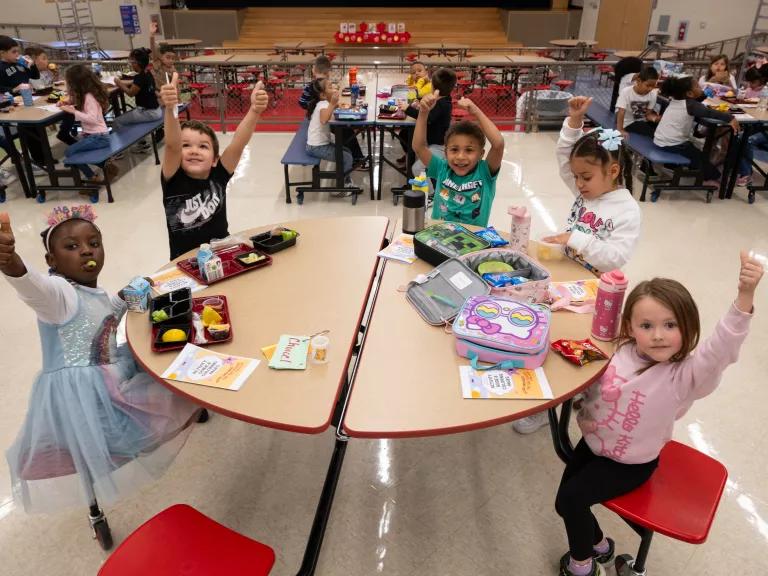
In early 2025, the Trump administration canceled funding for a popular initiative that helped public schools buy produce from local farms and educate kids on healthy eating.
More food insecurity—and fewer safety checks
On its website, the USDA boasts that it feeds one in four Americans over the course of a year, but that number will soon shrink due to cuts to its food assistance programs.
With nearly 50 million people already facing food insecurity, the severely constricted budgets of these programs (combined with rising prices due to President Trump’s tariffs and other supply chain issues) will make it even harder to put food on the table in households across the country.
Earning the nickname “Robin Hood in Reverse,” Trump’s Big Beautiful Bill served tax breaks to wealthy Americans, made cuts to the Supplemental Nutrition Assistance Program (SNAP), which helps supplement grocery budgets for low-income families. This could result in 2.4 million fewer people receiving assistance.
The country’s children are feeling these measures in their bellies as well. Earlier this year, the Trump administration abruptly canceled funding for the Patrick Leahy Farm to School Grant Program, a popular initiative that helped public schools buy produce from local farms and educate kids on healthy eating. By freezing funds, the administration also effectively halved the budget for the Emergency Food Assistance Program that purchases food for food banks and other providers that serve low-income individuals.
Food safety has also been on the chopping block. While the Food and Drug Administration regulates about 80 percent of the country’s food supply, the USDA handles the rest, mostly focusing on domestic and imported animal products. So far, the Trump administration has eliminated two longtime food safety advisory committees, moved to cancel contracts with thousands of unionized food safety employees, and scrapped a proposed rule that had aimed to reduce salmonella in raw poultry products.
To boot, the USDA rescinded a decades-old rule requiring farmers to record details about their applications of “restricted use” pesticides, such as paraquat and chlorpyrifos, putting farm workers and nearby communities at risk of higher levels of exposure to toxic chemicals.
In short, fewer food safety inspectors to go around along with less oversight into the use of dangerous pesticides on farms is a recipe for disaster.

Community members can buy or lease shares from this 200 kW community solar garden in Ignacio, Colorado, which are then attributed to the electric meter in their home or business through virtual net metering.
USDA’s budget cuts do not spare rural communities
The adage “you reap what you sow” doesn’t only apply to farming. Take away programs aimed at growing rural economies and you risk making farming communities less financially secure.
The USDA announced in 2023 an influx of $145 million for its Rural Energy for America Program (REAP). The initiative helps farmers and rural businesses save money on electric bills by investing in clean energy and more energy-efficient equipment. Although REAP has enjoyed bipartisan support since its creation in 2008, back in February, the Trump administration froze payments to thousands of farmers. More recently, the USDA stopped loan guarantees for larger solar projects on farmland made through REAP, as well as for solar and wind farms via the Rural Development Business and Industry Guaranteed Loan Program.
“As farmers turn to solar and wind to stay afloat and cut costs, the Trump administration is blocking them—telling farmers what they can and can’t do with their own land,” says McManus.
Eliminating opportunities to make farms and rural communities more economically and climate resilient is likely to only make the U.S. food supply more volatile—all while more and more small farmers are saddled with new debts that could cause them to lose their farms altogether.
Still, hope remains. Many of these changes to the USDA are not yet final.
Advocacy groups continue to file lawsuits against the Trump administration that could potentially stop these kinds of drastic cuts from occurring, or at the very least, slow them down. In May, the USDA reversed course on a decision to remove climate data from its websites, thanks to a lawsuit filed by NRDC, the Environmental Working Group, and the Northeast Organic Farming Association of New York. Now, farmers can once again access important information, such as how to lower agricultural pollution, apply for conservation grants, and better withstand extreme weather.
Change can also come from home. “Call your legislator and tell them you care about these issues,” Riley suggests. “The more folks in Congress who hear from their constituents that these issues matter to them—that they don't want to see cuts to SNAP, that they care about farm conservation programs, etc.—the more they will hesitate before signing on to legislation that will devastate farmers and folks who need food programs.” You can even tell them that the USDA was once called the People’s Department—and that we’re taking it back.
This NRDC.org story is available for online republication by news media outlets or nonprofits under these conditions: The writer(s) must be credited with a byline; you must note prominently that the story was originally published by NRDC.org and link to the original; the story cannot be edited (beyond simple things such as grammar); you can’t resell the story in any form or grant republishing rights to other outlets; you can’t republish our material wholesale or automatically—you need to select stories individually; you can’t republish the photos or graphics on our site without specific permission; you should drop us a note to let us know when you’ve used one of our stories.
We Need NOAA Now More Than Ever
What Are the Causes of Climate Change?
Yes, Climate Wins Are Still Happening! Let’s Keep It Up in 2026.