
Three Clean Energy Milestones to Note on Earth Day
This Earth Day, 15 months into the Trump administration’s attacks on the environment, it can feel like Scorched Earth Day.

Media Contact
Today is Earth Day, and 15 months into the Trump administration’s attacks on the environment and clean energy (460 harmful actions and counting), it can feel like Scorched Earth Day instead.
But there is still much to be thankful for on this Earth Day.
Over the previous decades, the United States has slashed the air pollution from smokestacks and car exhausts, reducing the harm to our lungs and our children, and addressed global crises like the hole in the ozone layer. We cleaned up many miles of waterways and wetlands, making them safe for swimming, boating, and fishing.
Even recently, there were some targeted successes: Flint, Michigan, finished the legal battle to replace all of its lead pipes, and even the Trump Environmental Protection Agency (EPA) couldn’t bring itself to drop lead standards that stemmed from the crisis there. Sempra canceled plans to build a destructive liquefied natural gas terminal along the Gulf of California in Mexico.
Just this week, three clean energy milestones prove the point often made by NRDC President Manish Bapna: “The U.S. is much bigger than Washington, and the world is much bigger than the United States.”
- A federal court in Massachusetts put a preliminary halt to actions by the U.S. Department of the Interior and other agencies that block wind and solar projects. Among other things, these actions had included a requirement that any “decisions, actions, consultations, and other undertakings” by the department could only proceed after a sign-off from Interior Secretary Doug Burgum. That was a massive hurdle that had effectively blocked progress on many solar and wind projects on federal lands or waters. This is now the eighth time the Trump administration has lost in court over its unhinged attempts to block renewable energy projects.
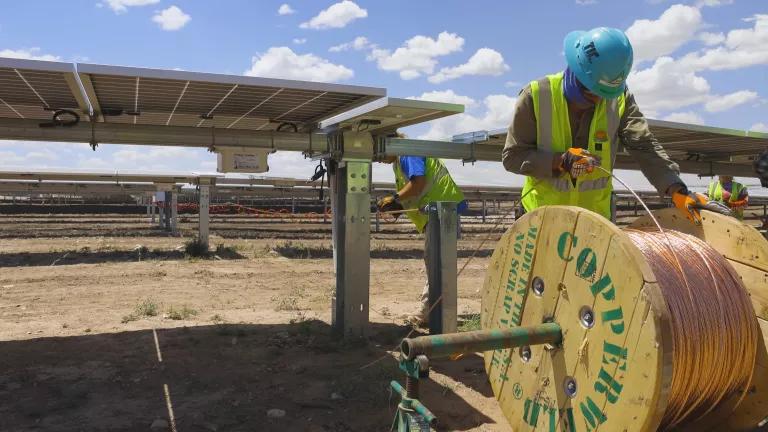
- Renewable energy accounted for the most power generation in the United States in March, surpassing natural gas for the first time in history, according to data from Ember Energy. While solar and wind power surpassed coal as far back as April 2019, natural gas has been the primary power source for years—but at least for one month, it lost that top spot.
“Emissions-free sources, a category that includes both renewables and nuclear, produced more than half of the nation’s electricity. It’s just the third time that’s happened across an entire month; the first instance being last March,” Canary Media reported. - Internationally, the renewable energy revolution is even more dramatic. A record 600 terawatt-hours of solar photovoltaic generation was installed globally last year—“the largest structural increase ever recorded in a single year for any electricity generation technology,” according to the International Energy Agency. Yes, that’s right: More new solar was installed last year than any other new electricity source in any previous year, according to the IEA. At the same time (and relatedly), it noted that emissions from China fell, India's carbon emissions were flat for the first time since the 1970s excluding the pandemic years, and global coal use declined.
So, there you have it. The Trump administration may try clamping its eyes shut and shoving its fingers in its ears, but it cannot stop the clean energy transition. The economics of clean energy are now on our side. Yes, we got here because of a combination of government-backed research and private entrepreneurs, federal incentives, and EPA standards. But now we are here—and clean energy is by far the cheapest and quickest way to meet our growing energy demand.
NRDC is going to keep fighting the rollbacks of pollution rules and the bailouts of coal plants. But on this Earth Day, we will do so with the knowledge that the future shines bright—with clean energy.
P.S. One more thing to be excited about: Microplastics re Micromonsters, NRDC’s new campaign, is featured in New York City’s Times Square today.
Related Content
NRDC Assessment of BAAJA, the 2026 Permitting and Transmission Bill

Trump’s Dirty Energy Double Whammy: Pay More for Fuel and Power—and Use More of It
