Trump's Attack on Affordable Energy and Our Health
The administration’s actions are set to raise average energy costs by hundreds of dollars per household a year—in addition to the current spike in prices at the pump.
Author


Media Contact
Three weeks on, the Iran war has driven home, yet again, the price that every American pays for the nation’s over-reliance on oil—a ruinous dependency that holds our families, workers, and businesses hostage to global price shocks beyond our control.
Prices at the pump have spiked 30 percent in a month, with even higher prices in store.
And Americans are being reminded, yet again, that the Trump administration is failing at its own self-proclaimed goal: to cut electricity prices in half and lower costs at the pump. In fact, the administration’s actions are set to raise average energy costs up to $430 per household a year—apart from the current spike in prices at the pump.
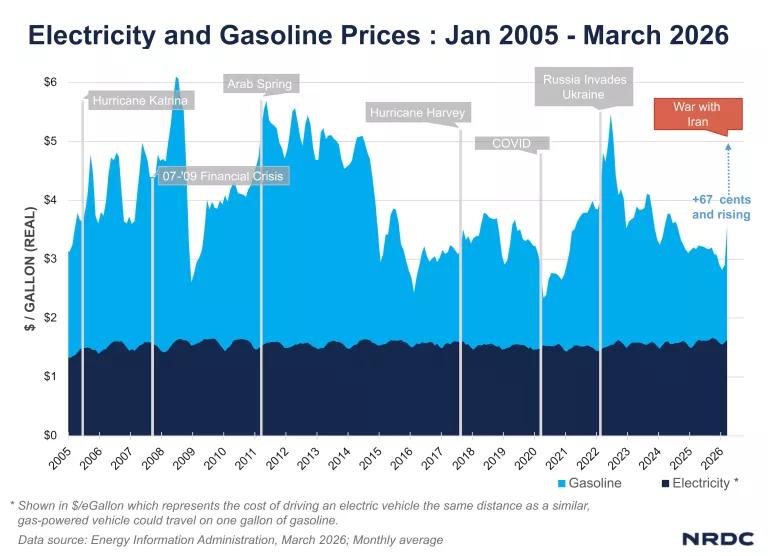
Since President Trump returned to the White House, we have seen a relentless pattern of policies that benefit fossil fuel executives at the expense of regular people. It’s a pattern that is deepening our dependence on dirty and expensive energy. As the chart below shows, these actions leave us exposed to the vagaries of an international oil market.
To add insult to injury, the Trump administration is tearing down the clean energy that can lower costs for people nationwide—just as we need that power now more than ever.
Just this past Tuesday, the New York Times reported that the administration wants to pay a French energy company some $928 million to halt plans to build a pair of wind farms off the coasts of New York and North Carolina.
At a time when energy-guzzling data centers are sending electricity demand through the roof, the administration’s answer is to hand over nearly a billion dollars of taxpayer money to a company so that it won’t produce clean energy to power 1.3 million homes and businesses.
Fueling an American affordability crisis
This pattern is raising the price tag of a growing number of things that represent a significant part of most people’s daily, weekly, monthly expenses. In a press conference this week, NRDC’s experts laid out four specific ways that the Trump administration is making life less affordable for Americans:
- Gasoline: The U.S. Environmental Protection Agency (EPA) repealed tailpipe emissions standards, costing drivers a net $180 billion over the next three decades in higher fuel, maintenance, and insurance costs, according to the Trump EPA’s own projections. With gasoline prices on the rise, the impact of selling more gas guzzlers could be even more pronounced.
- Electricity: And, with electricity rates already up 8 percent since Trump took office, the administration and Republican-led Congress repealed key federal clean energy incentives. That self-defeating move wiped out $35 billion in planned investment and nearly 40,000 manufacturing jobs. It’s projected to add $28 billion to our energy bills by 2030.
- Home insurance: Between 2021 and 2024, insurance premiums for a typical homeowner rose by 24 percent nationwide—far outpacing inflation. And now Trump administration policies could exacerbate the problem: FEMA is dismantling core recovery programs and retreating from federal investment in building resilience, leaving homeowners on their own to face stronger storms and worse flooding.
- Health: The Trump EPA has taken a chainsaw to the standards protecting us from smog, soot, mercury, and other hazardous air pollution that causes cancer, brain damage, miscarriages, and infertility. After giving power plants a free pass to pollute, coal plants saw the biggest increase in sulfur dioxide emissions in 30 years—with the sole exception of the year the economy roared back to life after the COVID-19 pandemic. The result? More heart attacks, more cases of asthma in our kids, and worsening diabetes. The costs of this pollution to our economy could be billions of dollars in lost workdays, missed school days, and more illness or ER visits.
NRDC’s director of policy analysis, Amanda Levin, explains how coal plant pollution surged across the country last year, thanks to Trump’s presidential exemptions, and how that has subsequently created billions of dollars in public health costs for local communities.
The new oil crisis
These Trump administration actions are now colliding head-on with a military action that has caused the worst disruption in history to global oil markets and underscored our nation’s vulnerability to such shocks.
Five decades after the first Arab oil embargo, an over-reliance on this destructive fuel remains the nation’s strategic Achilles heel. In response to the 1970s embargo, Congress moved to implement fuel efficiency standards for vehicles and appliances while boosting American-made energy.
This time around, the White House is undermining American energy security with wild schemes to prop up old, inefficient coal plants and blockades on new, domestic wind and solar projects.
This is an administration that falsely declared an “energy emergency” on day one. It has since set out to do everything possible to create one. Unfortunately, it may well be succeeding.
And these immediate costs don’t touch on the far wider costs of the climate crisis that’s being made worse by the Trump administration’s policies.
Between 2020 and 2024, raging wildfires, floods, drought, and other disasters caused by extreme weather and climate change left 2,520 Americans dead and did $747 billion worth of damage.
The Trump administration doesn’t want us to know about the rising toll and mounting dangers that the widening climate crisis is inflicting on every community in the nation, so it ended the annual tally.
Climate Central, however, reported that, last year alone, weather and climate disasters resulted in 276 deaths and $115 billion in damage nationwide.
At its core, the climate problem is a human health emergency.
It’s far harder to maintain human health as heat waves become more frequent and intense, driving a rise in dangerous heat strokes; as wildfires spread toxic smoke far and wide; as stronger hurricanes, supercharged by warm ocean water, bear down on our coastal communities; as more intense storms and flooding inundate heartland communities; and as drought bakes out our croplands.
So, there you have it: The oil billionaires get record profits, while the rest of us face higher costs at the pump and worse health for our children and grandparents.
There is another path
While Americans across the country continue to watch gas prices and electricity bills soar, clean and renewable power is holding steady.
Wind, solar, and battery storage are the most affordable and quickest energy sources to deploy. They lower costs and create jobs—and they are not vulnerable to foreign military conflict.
If our leaders really care about lowering costs and making our country energy secure, these are the technologies it should be working to spur ahead for today, tomorrow, and years to come.
Related Content

Trump’s Executive Orders Mean Real Damage to U.S. Economy, Communities, and Clean Energy Gains

How EPA Rollbacks Will Cost Us—in Dollars and Lives