
Comparative Cost Analysis for Residential Curbside Organics Collection Programs
This analysis of eight residential programs shows that, if properly implemented, cities can use a new organics collection program to build a more efficient, resilient, and sustainable solid waste system.


Coauthored with Raftelis
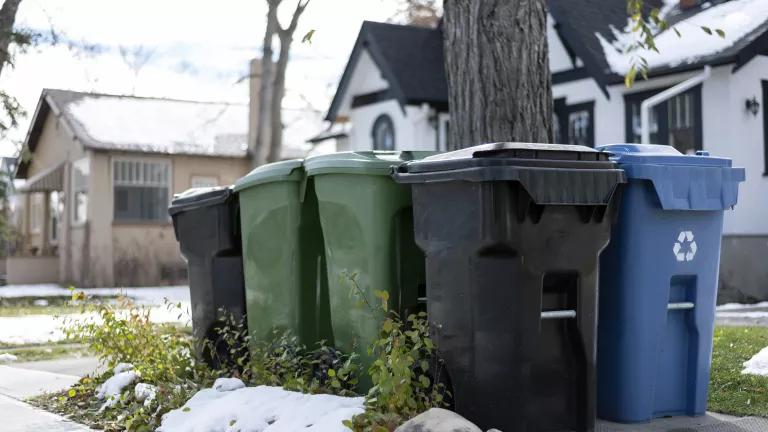
Residential curbside organics collection is expanding across the United States as states and local governments seek to reduce food waste sent to landfills and incinerators, meet waste diversion and climate goals, and respond to landfill capacity constraints. Yet for many communities, the perceived cost of adding organics recycling collection atop existing trash and recycling collection remains a significant barrier to implementation.
NRDC’s Comparative Cost Analysis for Residential Curbside Organics Collection Programs report finds that there is no single predetermined cost of implementing and operating an organics collection program. The cost to communities depends substantially on how organics collection is designed and, critically, how it is integrated into the broader solid waste system. A municipality that simply adds weekly organics collection to an otherwise unchanged garbage and recycling program is likely to see an increase in cost. However, a municipality that uses the introduction of organics to evaluate and optimize collection frequency, routes, contracts, processing arrangements, participation, and funding can offset a significant portion of the new service cost. In fact, with deliberate planning and system-wide optimization, curbside organics can serve not simply as an added service but as a catalyst for a more efficient, resilient, and sustainable solid waste system.
Learn More
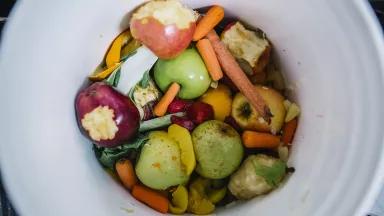
This analysis draws on eight established residential curbside organics programs and two active pilot programs representing communities of different sizes, densities, regions, service models, and participation structures. Across these communities, several findings emerge:
- Whole-system integration can substantially reduce the incremental cost of organics collection.
- Higher participation is associated with lower per-household program costs.
- Existing collection contracts and infrastructure can materially reduce start-up and operating costs.
- Funding and billing structures shape both financial sustainability and the cost visible to residents.
The community comparisons demonstrate the practical significance of these choices. In several communities that were studied, residents receive garbage, recycling, and organics collection at rates that are comparable to what residents in peer communities pay for garbage and recycling alone. For example, in Austin, Texas, residents pay approximately $29 per month for three-stream curbside service, compared with approximately $22 per month for garbage and recycling service in Raleigh, North Carolina. The comparison is not intended to suggest that every community can replicate a particular rate; rather, it demonstrates that the addition of organics does not necessarily translate into a proportionate increase in the total cost of residential solid waste service.
The Comparative Cost Analysis for Residential Curbside Organics Collection Programs report aims to support states and local communities in implementing effective strategies to fund residential curbside organic waste collection programs as a critical tool to improving resilience, reducing greenhouse gas emissions, and diverting material from landfills and incinerators. The central implication for local governments is therefore straightforward: The affordability of curbside organics is largely a program design question. Communities considering organics collection can begin by evaluating the economics and performance of their existing solid waste system; identifying efficiencies that can help offset the new service; testing critical assumptions through a pilot, where appropriate; and finally, designing a full-scale program around the participation, collection, processing, and funding structures that best fit local conditions. To support this process, the report translates these findings into a three-phase implementation framework for evaluating the existing system, designing and testing an organics program, and moving toward financially sustainable full-scale implementation.
Related Resources
