Broadway’s "Redwood" Shows Us How to Stand Strong—Together
The new Broadway musical and its superstar Idina Menzel offer lessons on coping in times of grief and darkness by going back to nature.

Idina Menzel stars as the character of Jesse in Redwood at the Nederlander Theatre in New York

Who doesn’t need an escape into nature just about now? Jesse, the lead character in the new musical Redwood, certainly does. Played by Broadway diva Idina Menzel, Jesse flees her life in New York City—one beset by addiction, loss, grief, and marital strife—to find solace in northern California’s epic woods. Once there, she hurls her smartphone, with all its reminders and interruptions from that life, across the forest floor. She looks longingly at it for a beat, then moves on.
But what Redwood makes clear, in this tidy story told in just under two hours, is that nature isn’t only a refuge—it’s also a healer. Indeed, scientists have studied the ways in which spending time in nature is vital for our mental health, particularly for city dwellers like Jesse.
Conceived by Menzel and Tina Landau, the show’s director and writer, Redwood chronicles its heroine’s recovery process and transports the audience along with her, off of 41st Street and into lush groves of ancient sequoias. This being Broadway, we are also treated to Menzel’s stunning talents, including an aerial solo she belts out while spinning 20 feet above the stage, upside down. It’s a masterfully athletic performance that leaves the audience’s mouths agape.
But it’s what’s happening belowground, described best in the song “Roots,” that truly hooks us. It begins:
“They’re spreading out.
They’re going in every direction…
And when they come to the roots of another tree,
they intertwine with that.
They lock together.
And now, not one tree,
But hundreds of trees, or thousands,
Are linked together.
And under our feet, lies a vast system of interconnected roots.
And that is how the redwood’s able to stand tall.
It’s being held up,
and supported,
by others.”
Learn More: Forests


Found only in California and southern Oregon within the United States, redwoods can reach more than 300 feet high and live for thousands of years—but they don’t do it alone. These trees are a dynamic community of beings that send vital nutrients back and forth to one another through their root system, enabling them to withstand intense cycles of trauma like drought and wildfire.
As for the human healing process, it often begins with an inner withdrawal, but it rarely ends well there. Cutting ourselves off from our own kind can be freeing for a time but dangerous in the long run. And it’s here, in the presence of these tremendous trees, where Jesse learns to reach out again.
First, she meets Finn and Becca, a pair of Berkeley-based climate scientists. After some reluctance, they allow Jesse to shadow them as they study the trees’ abilities to sequester massive amounts of carbon. She quickly becomes determined to do as they do: strap herself into a harness and climb.
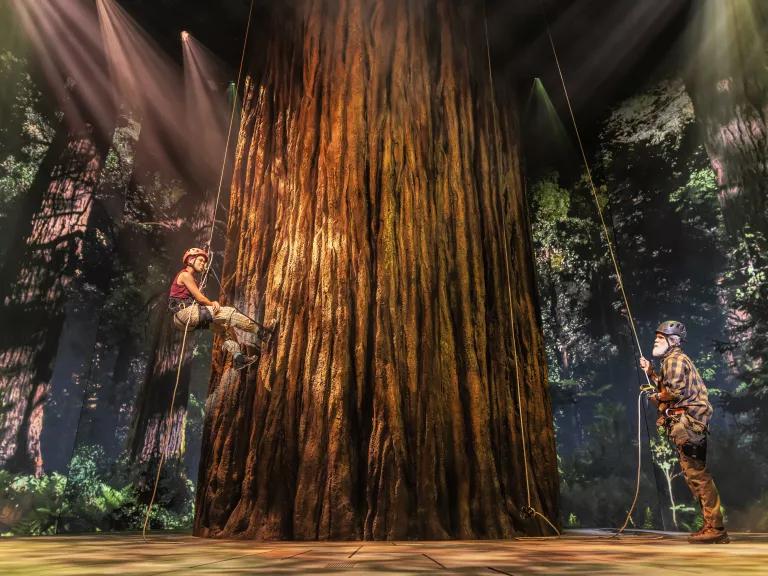
Khaila Wilcoxon (left, as Becca) and Michael Park (as Finn) in Redwood
On her journey, Jesse also finds connection with a community of activists. The show underscores that redwoods are increasingly rare: The timber industry cut down 95 percent of California’s old-growth forests “so generations of white cis male corporations could make their billions off Indigenous land,” says Becca.
Through a Google search scroll projected onto the stage (after Jesse recoups her phone), we learn about the real-life activist Julia Butterfly Hill, who courageously protested such irresponsible logging practices.
Beginning in 1997, the twentysomething Hill occupied a 1,500-year-old redwood nicknamed “Luna.” For two years, she camped out on a six-by-eight-foot platform near the tree’s crown, enduring sickness, storms, and aggressive attempts by the Pacific Lumber Company to force her down. Hill ultimately succeeded in her mission: By keeping vigil in the tree, she helped achieve a settlement that kept Luna and a 200-foot surrounding buffer zone safe from destruction.

Julia Butterfly Hill standing at the top of a redwood tree in the Headwaters Forest Reserve near Stafford, California, during her protest to protect it from being cut down by the Pacific Lumber Company, December 12, 1998
Hill’s David versus Goliath feat feels all the more brave in 2025, as industrial lobbies wield increasing power over a government that is currently shredding environmental protections and preparing to sell off our federal lands. In charge of overseeing nearly 500 million acres of public lands is Doug Burgum, a close ally of the fossil fuel industry. In charge of the Forest Service is Tom Schultz, a former timber executive seeking to overturn the federal Roadless Rule that protects unperturbed forests and other lands. We need heroes like Hill more than ever.
In Redwood, Jesse is finally able to rejoin her community back home. The solo warrior who had been running from her family’s ordeal could not ultimately move forward until she came to grips with what she had lost. As Jesse is experiencing painful flashbacks of her struggles with her wife and their son, she is also learning about how the trees face their own struggles. “How did all these tree trunks become this…deep, deep black?” she asks Finn. He explains that they’ve been burned. The redwood’s bark—over a foot thick for some trees—contains water that protects the inner heartwood.
“Redwoods don’t die because of fire—no, they need it,” Finn says. “See, their cones are glued shut by resin and when the fires come, the cones open up and drop their seeds to the ground. And that’s part of how new growth begins, because of the fire.”
The trees—but also the flames—become Jesse’s way back to herself. She spends a terrifying night trapped high in a redwood surrounded by wildfire, the stage’s digital forest panorama lit up in orange. As Jesse touches down the next morning, she looks serenely out at the audience. Silently, we are made to understand her message: Life happens down here, on the cold, knobby ground. Not up in the canopy, not where we retreat to.
This NRDC.org story is available for online republication by news media outlets or nonprofits under these conditions: The writer(s) must be credited with a byline; you must note prominently that the story was originally published by NRDC.org and link to the original; the story cannot be edited (beyond simple things such as grammar); you can’t resell the story in any form or grant republishing rights to other outlets; you can’t republish our material wholesale or automatically—you need to select stories individually; you can’t republish the photos or graphics on our site without specific permission; you should drop us a note to let us know when you’ve used one of our stories.
The Best and Worst Toilet Paper, Paper Towel, and Facial Tissue Brands
Our Public Lands Are on the Chopping Block Again
Why Are the Feds Leasing Public Lands to Big Oil for So Cheap?