
Deep-Sea Mining: What’s at Stake
Highly sought-after mineral resources lie in the ocean depths. But so does a world we could destroy before ever understanding it.
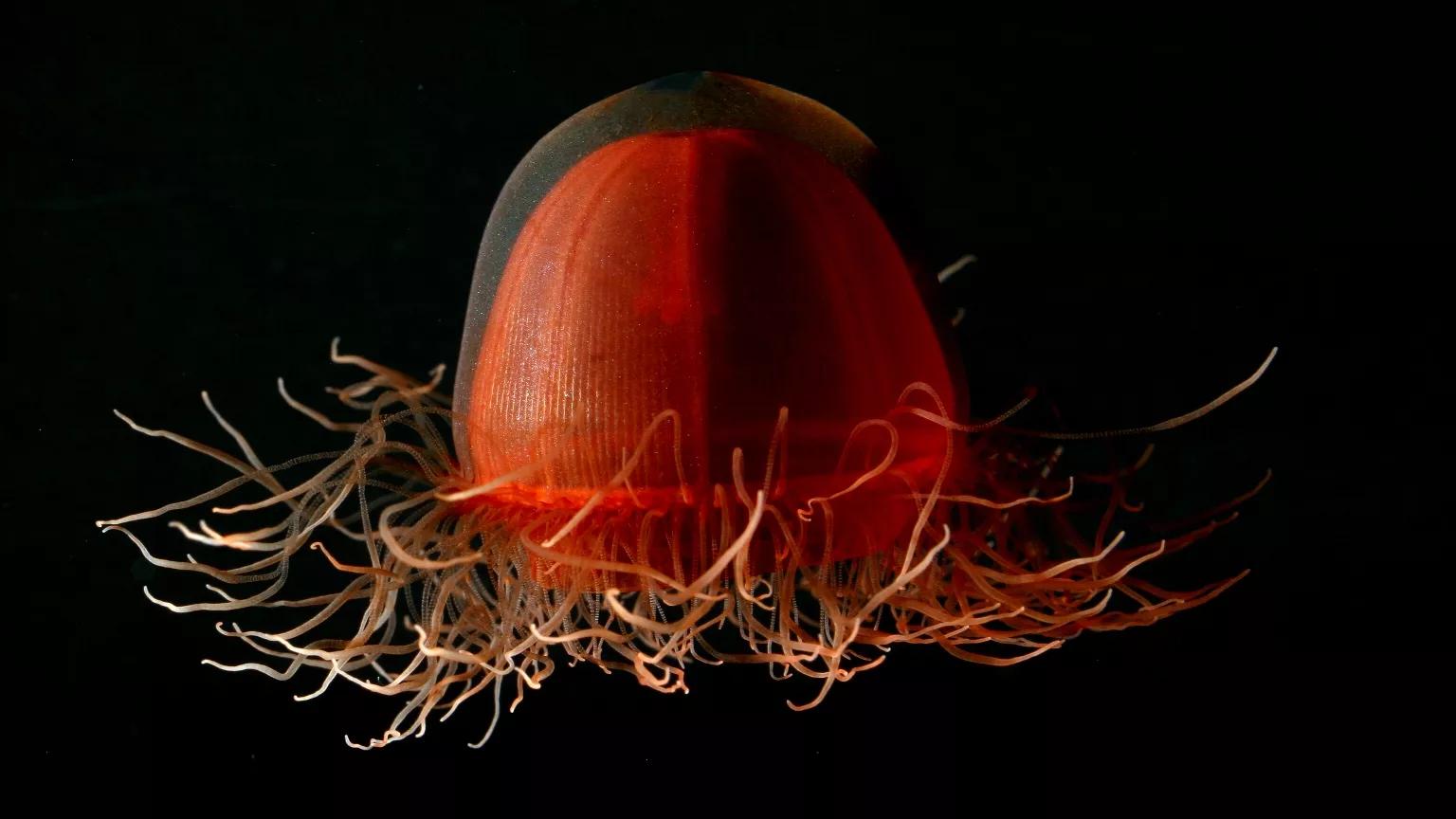

Most people don’t think of the deep sea—defined as 600 feet or more below the surface—as a thriving ecosystem. But it’s actually the world’s largest, covering more than 60 percent of the earth’s surface. Mysterious life forms, from fearsome fanged fish to 12-foot crabs, inhabit these secluded stretches, swimming through deep, dark trenches, over seamounts, and every so often, passing by a shipwreck.
Despite its seeming isolation, the deep sea needs protection. Advances in technology are bringing the mining industry to new depths in the search for precious minerals. Ocean scientists worry that we’ll make a mess of the place before we even truly understand what’s going on down there—or how this unique environment interacts with the rest of the planet.
What’s down there?
Jelly mushrooms, spiny killer sponges, colossal squid, and yeti crabs are just some of the awe-inspiring creatures that dwell in the depths of our oceans. Many more are yet unknown to science. Because this environment is so extreme—freezing cold temperatures, immense levels of pressure, and total darkness—humans have barely scratched the surface of deep-sea exploration.
Of course, naturalists are not the only group interested in investigating the seafloor. Various industries have eyes on its troves of valuable minerals, which tech companies use to create a wide array of products, like cell phones and other electronics. Given the increased demand for these goods, businesses around the world are planning to mine the deep.
The seabed, between 13,000 and 19,000 feet below the sea surface, contains minerals that are hidden in potato-size lumps called polymetallic nodules. Copper, cobalt, zinc, and nickel are some of the nodules’ most valuable contents, tucked into hot spots around the planet. The United States Geological Survey estimates (conservatively) that there are 21.1 billion dry tons of nodules in just one of the known areas, the Clarion-Clipperton Zone in the Pacific Ocean between Mexico and Hawaii.
Mineral deposits also lie within the crusts of seamounts (underwater mountains) and along hydrothermal vents, which are openings on the seafloor that spew fluids and gases from within the earth.
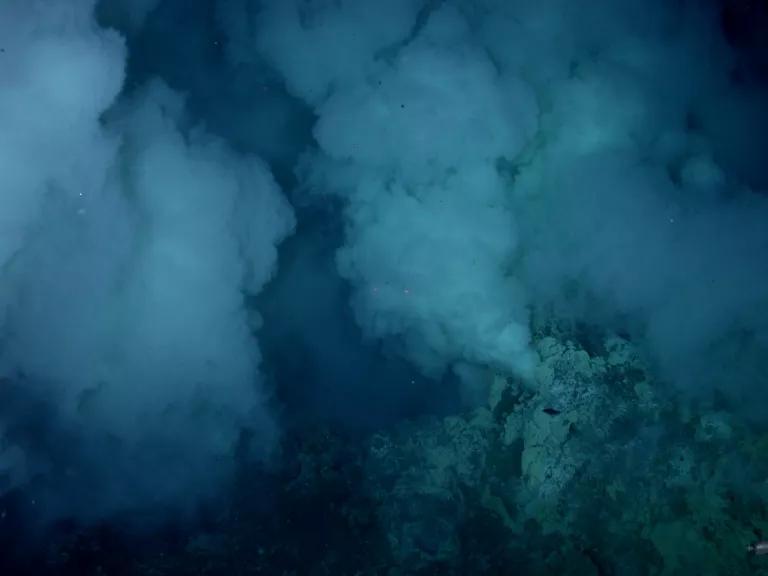
Hydrothermal vents spewing white clouds of hydrothermal fluids in a sulfur-encrusted area in the Marina Trench, Pacific Ocean, May 8, 2026
Risky business
Launching new extractive endeavors into pretty much unknown territory can cause irreparable harm to habitats, wildlife, and entire ecosystems. A 2025 study in the journal Nature Ecology and Evolution found that after a large-scale seabed mining test, the number of small marine species in the area decreased by 37 percent and the variety of species dropped by 32 percent. Other studies have found links between deep-sea mining activities and disruptions in the food web, as well as longer-term impacts on seabed ecosystems. (Interestingly, many of these studies were funded by a prospective commercial miner itself—the Metals Company.)
"Deep-sea mining is a lot like strip mining or clearcutting a forest,” says Becca Loomis, a staff attorney in NRDC’s Nature program. “It destroys sea life anchored to the ocean floor and spreads suffocating sediments far and wide.” The industry’s by-products also cause environmental damage, she adds. “There are serious concerns with toxic mine waste that is dumped back in the water. It can contaminate our seafood supply.”
And the risks compound when you consider how directly we rely on the health of the ocean. It helps regulate global temperatures and absorbs massive amounts of heat from climate pollution. It supplies half of the earth’s oxygen. It’s a critical food source for people (with 15 percent of global protein consumption coming from seafood), and an economic engine for billions of dollars’ worth of industries, from tourism to medicine.
Not surprisingly, the mining industry seems ready to put all these benefits aside. “Deep-sea mining has been a topic of interest since around the 1970s,” Loomis says. “And it’s starting to gain serious momentum now.” Although no company in the world has yet to successfully carry out deep-sea mining on a commercial scale, many firms are racing to acquire leases and permits, regardless of what’s viable.
Because polymetallic nodules are the easiest to collect, they are the primary focus of mining companies for now. Dredges and vacuums that suck nodules up from the seabed are some of the more traditional technologies being tested. But Loomis says more advanced technology is also in the works, including one from a company called Impossible Metals that is looking to use artificial intelligence to drive robotic cranes around the ocean floor, picking up nodules like a toy crane at an arcade. What could go wrong?
If the environmental costs and the technical complexity of these ventures aren’t enough to sow skepticism, the high operation costs ought to make investors think twice. “The punishing conditions of the deep sea make operations vastly more complicated and expensive,” adds Loomis. “It undermines the potential profitability. Not to mention, metal prices are volatile, making it hard to build a solid business case for deep-sea mining.”
The powers to exploit—and protect
In April 2025, the Trump administration issued an executive order to fast-track approvals for deep-sea mining projects. The move added to a slew of other initiatives that open the door to mining and drilling on public lands. Soon after, for the first time ever, the Bureau of Ocean Energy Management started the leasing process for deep-sea mining in waters surrounding American Samoa and the Northern Mariana Islands. Companies jumped at the chance to lock in 20-year, renewable leases in U.S. waters.
“Once you issue these leases, it’s really hard to claw them back,” says Loomis. The long contract period gives the companies the leeway to grab the leases now and fine-tune the technology later.
Extraction becomes more complicated on an international scale. Although the ability to protect deep-sea areas outside of a country’s jurisdiction is, according to Loomis, “limited at best,” there is at least one check: the United Nations’ International Seabed Authority (ISA). That group, which was established under the Convention on the Law of the Sea (UNCLOS), oversees who can mine and where it’s acceptable to help ensure that our drive to harvest the deep sea’s resources doesn’t end in ruin. For example, if a company or country wants to explore or mine, it must submit a proposal for two sites. The ISA then chooses one and sets the other aside to be protected or to be used later by a country that doesn’t currently have the resources to mine.
Since its inception, the ISA has yet to issue a mining permit and actually has not even finished developing the mining code, i.e., the regulations for commercial mining practices. So at this point, no party is allowed to mine in the deep seas under the U.N. framework. At the same time, there is growing support for a moratorium on deep-sea mining, with 40 countries pledging their support to safeguard deep-sea ecosystems.
The United States, however, is moving forward with approving deep-sea mining permits in international waters because it never ratified the UNCLOS. Even so, we have largely followed and relied on the treaty’s standards up until now. The approvals are yet another example of the federal government deciding to work directly against an international treaty (the Paris Agreement among them).
“Not only is this bad diplomacy, but we are going to alienate allies, and we are going to encourage other countries to just go ahead and do whatever they want,” says Loomis.
The good news for the oceans is that on top of potential legal disputes, the United States faces major hurdles in its pursuit of deep-sea mining. One provision of the U.N. treaty ensures that no party states are allowed to supply vessels or process minerals mined in violation of the framework. Loomis explains that many U.S. companies lack the equipment necessary to do this work, so they would need to find partners to fill in gaps. If a company from a country that has signed the treaty were to get involved, it would be in direct violation of international law, which greatly limits the company’s options.
The guardrails don’t just protect the oceans but global economies too. After all, “deep-sea mining is not only geopolitically risky but also financially risky,” says Loomis. She points to Papua New Guinea, which currently faces $120 million of debt, thanks to a controversial deep-sea mining project that failed to get off the ground in 2020.
A core principle of UNCLOS is that the deep sea and its resources are “the common heritage of mankind,” and that any activities there must benefit humankind as a whole. That’s something businesses and lawmakers should also consider before they dive in.
This NRDC.org story is available for online republication by news media outlets or nonprofits under these conditions: The writer(s) must be credited with a byline; you must note prominently that the story was originally published by NRDC.org and link to the original; the story cannot be edited (beyond simple things such as grammar); you can’t resell the story in any form or grant republishing rights to other outlets; you can’t republish our material wholesale or automatically—you need to select stories individually; you can’t republish the photos or graphics on our site without specific permission; you should drop us a note to let us know when you’ve used one of our stories.
From Whales to Walruses, Sea Mammals Are Under Attack—and So Is the Law That Protects Them
Blue Whales Ply the Northeast Canyons and Seamounts; Industry Could Soon Too
Single-Use Plastics 101