In the Play “KYOTO,” a Reminder that We Don’t All Need to Agree on Climate to Make Progress
Sometimes, two steps forward, one step back gets the job done.
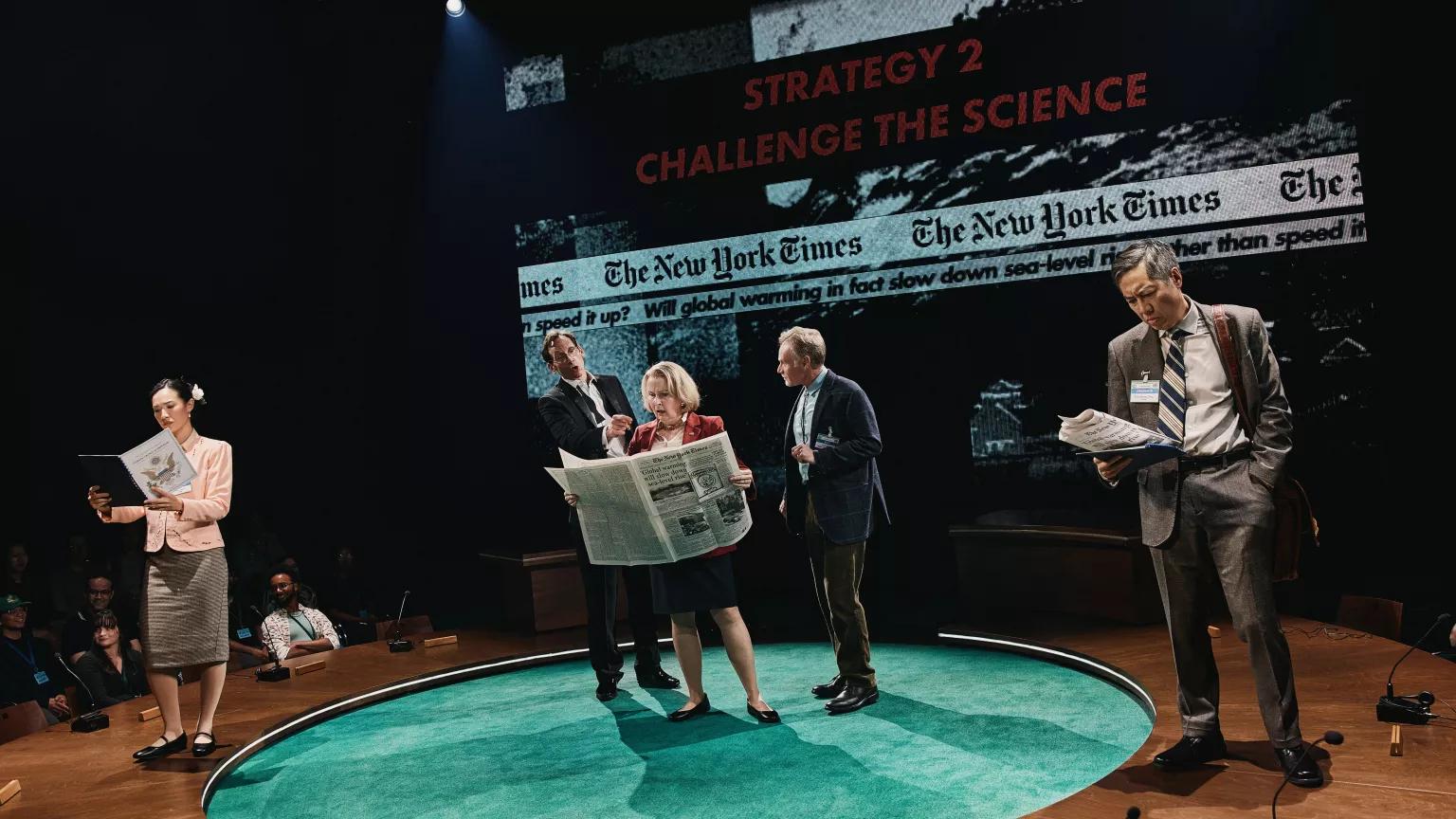
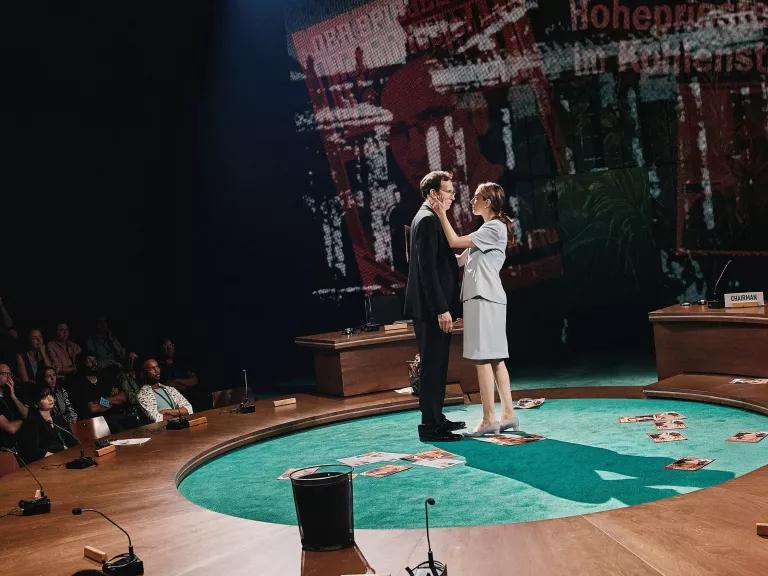
Taiana Tully, Stephen Kunken, Kate Burton, Peter Bradbury, and Feodor Chin in the Royal Shakespeare Company and Good Chance production of KYOTO at Lincoln Center Theater in New York City

If you think we’re living through dark times now, well…so does the Royal Shakespeare Company.
“I think we can all agree on one thing—the times you live in are f—ing awful,” opens the prologue of KYOTO, a play coproduced by Good Chance that’s currently making its U.S. premiere at New York’s Lincoln Center Theater through November. Scenes of recent civil strife on American city streets flash on the stage’s backdrop.
And it’s all happening on “a planet in literal meltdown,” adds the omniscient narrator, who is also the play’s antihero: the oil lobbyist and lawyer Don Pearlman, played by Stephen Kunken. In real life, Pearlman infamously undermined climate negotiations in the years leading up to the 1997 Kyoto Protocol, which, despite Pearlman’s efforts, became a seminal event that kicked off international cooperation around this global existential threat. The prologue wraps up, noting that, by comparison to today’s political chaos, the 1990s were “freaking glorious.”
And that’s when act 1 begins, on a stage that immerses the audience in the early international meetings on climate action. And the outcomes continue to be ours to inherit and pass down.
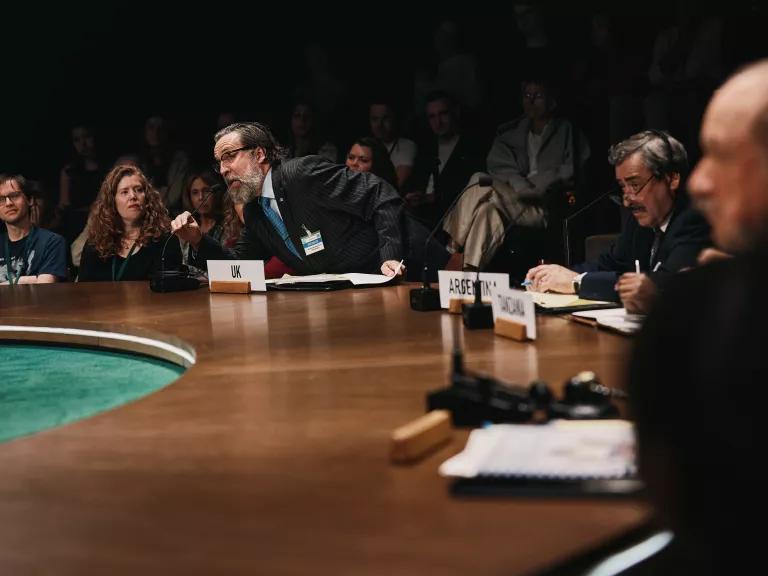
Ferdy Roberts in the role of British deputy prime minister John Prescott in KYOTO
An audience of stakeholders
Given the straits the world is in (and the climate anxiety most ticket holders are no doubt carrying), KYOTO—directed by Stephen Daldry and Justin Martin—recognizes the need to activate its audience. Step into the lobby, and you’re given a delegate badge to wear for the duration of the show. Once inside, the stage set creatively allows space for about 10 to take actual seats at the proverbial table, right beside the actors as they furiously negotiate. (Occasionally, these “extras” are nudged to raise placards or stand up with the cast during certain keynote speeches.)
But the dialogue quickly dispels any semblance of unity at the table or shared appetite for action. Playwrights Joe Murphy and Joe Robertson have developed a cast of characters that reflect the convention’s range of clashing voices: the ruthless capitalists, the developing nations paying the steepest prices for climate inaction, the diplomats tasked with compromise, and the cohorts of lobbyists, scientists, and journalists around the edges. We encounter real and symbolic figures, from Germany’s Angela Merkel (played as a stiff, humorless arbiter) and Argentina’s Raúl Estrada-Oyuela (the meeting’s chair) to characters listed in the Playbill simply as USA, Saudi Arabia, China, etc. All fall into roughly two camps: those who would act on climate and those who view any action as anathema to their country’s sovereignty and wealth.
Learn More

The rhetoric smacks familiar, in a country where the current president spent zero days of his second term contemplating the withdrawal of the United States—yet again—from the 2015 Paris Agreement.
But with the help of Pearlman’s character, KYOTO puts the climate denialism of today’s administration in historical context. Once dubbed “the high priest of the Carbon Club” by Der Spiegel magazine, Pearlman worked for the so-called Climate Council, which pushed the interests of the fossil fuel industry. Council members (including BP, Chevron, ExxonMobil, Shell, and others, portrayed in the show as a shadowy septet of black-cloaked Big Brother–like influencers) spent millions of dollars to support think tanks that tried to refute climate science and waged campaigns to paint climate activists as the problem. “Enviros,” scoffs Pearlman, “our nickname for the watermelons—green on the outside and red in the middle.”
Stephen Kunken as Don Pearlman and Natalie Gold as his wife, Shirley Pearlman
“Are we on the wrong side, Don?”
Throughout the depictions of many negotiations (or as Pearlman calls it, the “hand-to-hand combat”) around the world—Rio, Geneva, and finally, Kyoto—the USA delegate decries any effort to make her country rein in its climate emissions with lines like “this is a plan to destroy America.” But the loudest voices in the room don’t always make the most impact.
The alliance of low-lying island states, led by the central Pacific islands of Kiribati, asserts itself with a powerful speech, commanding attention for the perilously rising sea levels threatening to consume their homelands as the developed world looks the other way. Other outspoken delegates include China, who insists there must be no targets or timetables for emissions reductions—“China will not remain poor so the world can breathe”—and Saudi Arabia, intent on defending his country’s vast oil wealth. Delegates make and break alliances and shout back and forth in various languages.
We can see where this is going. Or more likely, where it’s not. The world is heating up and Kiribati is slipping beneath the sea, but the delegates are debating semantics. Like a game of high-stakes Mad Libs, they fight over a string of 28 adjectives to fill sentences such as: “The balance of evidence suggests a ___ human influence on global climate.” Ultimately, they land on “discernible.”
The word represents a watered-down compromise—but still a feat, according to atmospheric scientist Ben Santer. (Having attended KYOTO’s premiere in Stratford-upon-Avon, the real-life Santer reflected on that line in a review for Scientific American, calling it “a momentous statement from cautious scientists and a rather conservative organization.”)
Around this time, public opinion also starts coming around. For instance, a copy of the January 2, 1989, issue of TIME is waved around the stage. The magazine names “Endangered Earth” as the most important story of the year, subbing in an image of our planet, wrapped in rope and plastic, for its annual “Person of the Year.”
At one point, even Pearlman’s wife, Shirley, questions her husband: “Are we on the wrong side, Don?” He shuts her down. “What if you’re wrong, and everything they’re saying is right?” she ventures.
Yet what a painstakingly slow awakening, upon the part of the privileged, to understand how deep we’ve dug ourselves in through our stubborn reliance on fossil fuels. And however urgent the crisis, the solutions, of course, are never the speeding bullets we hope for. The play gives us a peek at the convention’s numbers game—the factors by which countries decide to reduce their emissions relative to the levels measured in 1990—and deftly dramatizes the backroom deals, concessions, and through-the-night negotiations.

Kyoto governor Teiichi Aramaki speaking during the opening session of COP3 on December 1, 1997, in Kyoto, Japan
Agreeing to agree
If KYOTO at times feels like a play about diplomatic baby steps, the audience can, at least, take comfort that the steps do lead somewhere. As COP3 nears its finish line, a narrator announces it’s been 10 days with no agreement, and 20 of the delegates, so drained from the marathon sessions, have even been sent to the local emergency room.
“Disagreement is what we are,” exclaims Pearlman. “It’s human nature.” And given that truth, the fact that in the end, the delegates do put aside such serious differences and agree on legally mandated, country-specific emissions reduction targets seems remarkable.
Of course, disagreement continues to this day, even as average global temperature rise surpasses the 1.5 degree Celsius threshold and the consequences of the climate crisis become painfully obvious to communities around the world. This particular hindsight may leave the audience wondering: Is it still relevant that nations did ratify the protocol (albeit without the United States’ signature, thanks to Pearlman himself)—and then later, the Paris Agreement?
The answer is a resounding yes. While the scope of the clean energy revolution and current climate adaptations still have far to go, climate progress is real. And with or without U.S. leadership, the world continues to move forward, with delegates once again coming together this month in Belém, Brazil, to hash out solutions at COP30. This year, climate resilience will be foremost on the agenda.
Exactly what the Kyoto participants agreed on, the play conveys, should not be the main takeaway. “No one will remember what the compromise of Kyoto was,” says Estrada-Oyuela during the 11th hour. “They will only remember that we did…or that we did not.” He urges the weary, polarized delegates to keep going, “to just keep talking.”
KYOTO is playing at the Mitzi E. Newhouse Theater at the Lincoln Center Theater in New York City through November 2025.
Venezuela’s Oil Resources Are Vast (and Should Stay Underground)
Global Warming 101
How to Spot—and Help Stop—Climate Misinformation