
How the Trump Administration Bakes Climate Denial into U.S. Policy
Denying science no longer works, so the federal government is pretending the climate crisis doesn’t exist at all.
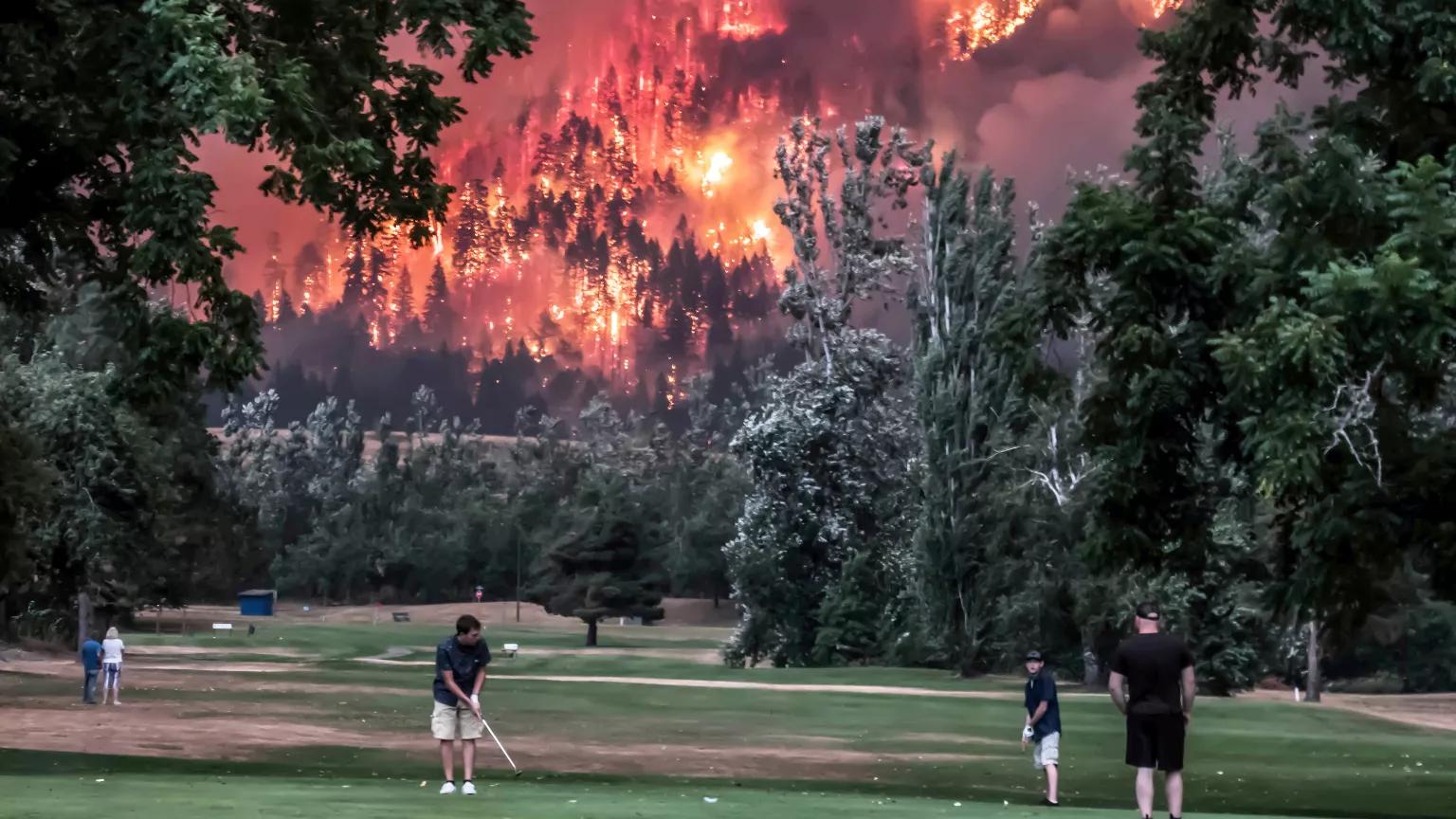
The Eagle Creek wildfire burning as golfers play at the Beacon Rock Golf Course in North Bonneville, Washington, September 4, 2017
The science explaining how fossil fuels contribute to climate change has been clear for decades. Now that communities around the country (and the globe) are experiencing more frequent and severe weather events, the realities of climate change are impossible to deny. And few do: 72 percent of American voters surveyed in 2024 acknowledged that the earth’s climate is warming—sending climate deniers scrambling to come up with a new schtick.
Enter President Trump’s second term.
President Donald Trump spent a lot of time denying science in his first term. And while the president continues to contradict settled science, this time around, his administration is taking a more backhanded approach: baking climate denial into how federal agencies conduct their basic duties. From attacking the U.S. Environmental Protection Agency (EPA) endangerment finding on climate emissions to thwarting the growing renewable energy industry and brazenly gutting federal institutions and grant programs that have played critical roles in advancing climate action, the Trump administration is trying to stop progress in its tracks.
“Over the past 15 years or so, more than 99 percent of U.S. congressional districts had at least one federally declared major disaster due to extreme weather,” says Dr. Laurie Geller, a climate scientist in NRDC’s science office. “This administration seems to think that if they just pretend these climate change risks aren’t happening, then they have no responsibility to do their job and help protect the American people.”

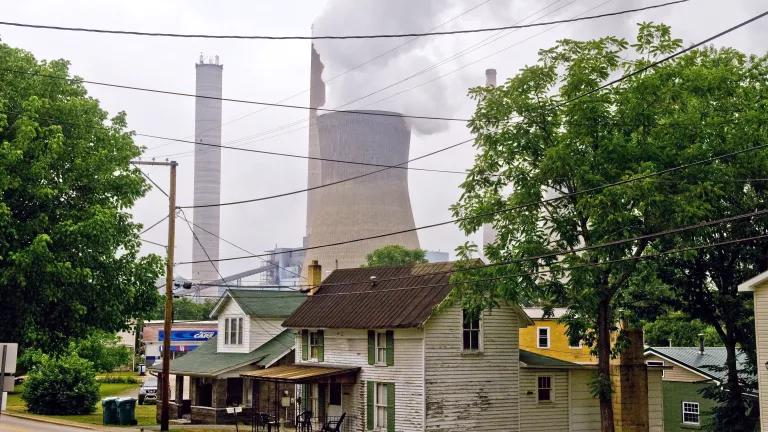
American Electric Power's John Amos coal-fired plant in Winfield, West Virginia
On the very first day of his second term, President Trump asked the EPA to recommend whether to reconsider its 2009 endangerment finding that the greenhouse gases that cause climate change also threaten public health and welfare. The finding, which is based on decades of peer-reviewed research, lists risks to the public such as increases in air pollution, temperatures, extreme weather events, and food- and waterborne illnesses.
Due to these proven dangers, the EPA must take action, under the Clean Air Act, to curb emissions of carbon dioxide, methane, and four other climate pollutants. So, following the finding, the agency set emissions caps on everything from coal-fired power plants and methane leaks from oil and gas wells to tailpipe emissions from cars and other vehicles.
In February 2026, however, the EPA fully repealed the endangerment finding. Of the decisions the agency could have taken, Meredith Hankins, NRDC’s federal climate legal director, says, “This is the worst-case scenario—to just take a sledgehammer to all EPA climate regulations from the last two decades.”
The agency is already eliminating its greenhouse gas emissions standards for vehicles and has proposed to do the same for power plants. The motive is clear, says Hankins. “They want to make corporations money, and they don't care about the impacts on people.”
NRDC federal climate legal director Meredith Hankins explains why the endangerment finding is so critical to our fight against climate change and how the EPA’s repeal of it not only goes against overwhelming scientific evidence but also has no legal standing.
The new language of climate denial
The Trump administration is also policing the language used on government websites, grant proposals, and other communications. Climate science and pollution are on the administration’s list of words to limit or avoid in research and public-facing communications. This act of censorship tries to curb any activities that may promote climate action and, subsequently, ding fossil fuel industry profits.
“They want to make corporations money, and they don't care about the impacts on people.”
Meredith Hankins, federal climate legal director, NRDC
Meanwhile, the administration has deleted climate data on agency websites, including the U.S. Department of Agriculture, the EPA, NASA, and the State and Defense departments. Not only do these sites provide historical climate records, but they also serve as crucial tools for people all across the map who are charged with planning for extreme weather, sea level rise, and other climate consequences.
For this reason, NRDC, as part of a group of farmers and other environmental organizations, successfully sued the USDA last year on the grounds that removing public access to climate data makes it harder for farmers to make informed decisions concerning their livelihoods. By hiding this information, the USDA impeded access to funding streams that could help boost a farm’s resilience against extreme weather.

Fire-affected residents meeting with FEMA officials in Pasadena, California, after the devastating fires in the Los Angeles area killed at last 24 people, January 2025
Trying to cancel science
In the months since taking office, this administration has hamstrung the federal agencies and grant recipients responsible for (among other things) addressing the climate crisis. Countless programs and agencies, such as the National Park Service, have seen their budgets slashed unlawfully and their workforces illegally shrunk to a skeleton crew, hobbling the remaining staff’s ability to do their jobs.
“The dedicated professionals around the country being fired due to this administration’s reckless cuts provide services and information that are critical to all Americans,” Geller says.
Major cuts to FEMA’s disaster-response programs and NOAA’s weather monitoring, forecasting systems, and tracking of the economic impacts of extreme weather leave people across the country less able to prepare for and recover from escalating severe weather events. Meanwhile, defunding climate research at the National Institutes of Health impedes the development of more effective ways to protect people from heat waves, wildfire smoke, and climate-fueled pathogens.
Other slashed initiatives include programs that safeguard workers from extreme heat conditions and that help low-income households afford life-saving heat and air-conditioning. Together, along with discontinued environmental justice programs that helped support communities on the frontlines of climate change, these cuts essentially pave the way for more unnecessary casualties as climate change continues to ramp up.
“The Trump administration’s attack on science might be seen as an effort to damage or destroy the credibility of an institution that is hard for them to control; that doesn't tell them what they want to hear,” says Dr. Timmons Roberts, Ittleson professor of Environmental Studies and Sociology at Brown University and the executive director of the Climate Social Science Network. “It’s heartbreaking, really, because science is what made America great, and it will lie shattered on the ground after just a few more months of this gutting of our scientific infrastructure.”
These attacks could fragment the research landscape in this country for decades to come. And with the ousting of career staff at scientific institutions like NOAA and the EPA, “we’re not just losing that individual employee. We’re also losing the 10 people they may have mentored over the next four years, who would learn the system before someone retired,” says Hankins. “It's just this generational loss of institutional knowledge and expertise.”
Another, perhaps intended, consequence of these seismic shifts within federal agencies would be people losing faith in the government built to work for them. “Who is the government serving? Is it serving the people, or is it serving Big Oil and corporations?” asks Hankins. “The government’s role is not supposed to be enriching corporate America. It’s supposed to save lives.”

Elin Energy's solar panel manufacturing facility in Brookshire, Texas
Halting the momentum of the Inflation Reduction Act
The Trump administration is also attempting to stall clean energy development by gutting the Inflation Reduction Act (IRA). Enacted by the Biden administration in 2022, the IRA has already generated more than $634 billion in investments and created more than 200,000 clean energy construction jobs, predominantly in rural districts in states like Georgia, Oklahoma, and North and South Carolina.
Canceling the largest climate change legislation in U.S. history will affect households across the country. In 2023, Americans claimed more than $8 billion in clean energy tax credits under the IRA, which helped people install rooftop solar, improve their homes’ energy efficiency, and complete other climate-friendly actions that also benefit their household budgets. Now, with the gutting of the IRA’s economic incentives for consumers, this momentum has slowed. A 2025 report by the Brattle Group estimated that repealing the clean energy tax credits would raise electricity bills for U.S. households by $51 billion over the next decade. Many businesses may suffer, too, including the auto industry, which has been using IRA funding to invest in EV infrastructure and production.
On the flip side, there's a huge opportunity for other countries to jump into the renewable energy vacuum that the United States is creating and ramp up EV production and clean energy development for international markets. Instead, the Trump administration is putting our country’s domestic manufacturing and auto industries at a huge competitive disadvantage from which they may be unable to recover.

Protesters on San Francisco's Ocean Beach, part of the Hands Off rallies held nationwide, April 2025
Fighting back against climate denial
In a country where the vast majority of people want climate action, the Trump administration’s environmental rollbacks have not gone unnoticed. Climate change was one of several themes present at the “Hands Off!” demonstrations in the spring of 2025 that brought millions of people—in cities and towns across all 50 states—to the streets to speak out against the administration’s actions.
Companies and local governments are taking a stand too. Many are mobilizing through the America Is All In coalition, which includes 10 states, 14 Tribal Nations, and more than 3,000 businesses and collectively represents two-thirds of the U.S. population. Despite President Trump pulling the United States out of the Paris Agreement, the U.N. Framework Convention on Climate Change, the Intergovernmental Panel on Climate Change, and many other international efforts to address the global crisis, the coalition is working to uphold the country’s former pledge to curb its climate emissions by 50 percent by 2030.
Meanwhile, governors of some states, such as New York, Vermont, and New Mexico, are pushing back against a Trump executive order that targets state climate laws, such as those that would make big polluters pay into funds that help communities prepare for climate disasters.
But most battles in the name of climate action are currently taking place in court. Dozens of climate-related lawsuits are already in the works, including those filed by NRDC, and many more are likely to follow.
While even a temporary pause to climate work slows the momentum that we need to avoid the most dangerous effects of a warming world, the fight against Trump’s rollbacks parallels the fight against climate change itself. Every tenth of a degree of warming we can prevent makes us safer and more resilient to the changes to come. In the same vein, every battle won against Trump’s pro-pollution agenda could bring less harm to the planet and its people.
This story was originally published May 14, 2025, and was updated on February 13, 2026 with new information and links.
This NRDC.org story is available for online republication by news media outlets or nonprofits under these conditions: The writer(s) must be credited with a byline; you must note prominently that the story was originally published by NRDC.org and link to the original; the story cannot be edited (beyond simple things such as grammar); you can’t resell the story in any form or grant republishing rights to other outlets; you can’t republish our material wholesale or automatically—you need to select stories individually; you can’t republish the photos or graphics on our site without specific permission; you should drop us a note to let us know when you’ve used one of our stories.
Tell the EPA to protect us from power plant pollution
Power plants are responsible for a quarter of U.S. carbon emissions. And yet, the Trump administration proposed to abandon its legal authority to regulate climate pollution from power plants, which would bring more unnatural disasters, dirtier air, and higher costs for families. Help us stop this illegal attempt to hand polluters a free pass while the rest of us pay the price.
How EPA Rollbacks Will Cost Us—in Dollars and Lives
Testimonies from a Warming World
The Particulars of PM 2.5