
When Energy Security Is a Casualty of War
The U.S. war with Iran makes one thing perfectly clear: Depending on fossil fuels is neither safe nor smart.

Markets have been roiled as the conflict between the United States and Iran effectively closed shipping through the Strait of Hormuz, where a fifth of the world's crude oil, as well as considerable liquefied natural gas supplies, travels through.
Within just two weeks of the United States’ and Israel’s first strikes on Iran in late February, energy insecurity careened to an all-time high. And as long as there’s uncertainty over which ships get to travel through the Strait of Hormuz, the narrow waterway through which about a quarter of the world’s oil and gas supply passes, countries that depend on these fossil fuels (which, unfortunately, is nearly all of them) will be paying more for them on the global market.
The consequences are dire and far-reaching. While prices at the pump in the United States now average more than $4 per gallon and the cost of fertilizer surges worldwide, the International Monetary Fund warns of heightened inflation and a possible global recession.
Even an end to the conflict—whenever that may come and whatever it may look like—wouldn’t spell an immediate return to prewar prices. Experts warn that it may take many months for the market to normalize while damaged infrastructure undergoes repair and safety concerns fully subside.
Amid this uncertainty, one thing is indisputable: The war has exposed a fundamental weakness of current U.S. energy policy, which has spent more than a year now aggressively blocking wind and solar projects (including some that were nearly completed) in favor of maintaining the fossil fuel status quo. Setting aside whatever other miscalculations the Trump administration made in launching the war, it clearly didn’t anticipate how doubling down on fossil fuels at the expense of the country’s renewable energy industry would hurt U.S. energy independence overall (despite it being an entirely foreseeable outcome). As a result, the United States has since grown more, not less, vulnerable to disruptions in the global energy supply chain.
As the world comes to terms with what the International Energy Agency’s executive director Fatih Birol has deemed “the greatest energy security threat in history,” it’s time for the Trump administration to re-evaluate its approach. American energy independence is a worthy goal, but oil and gas alone cannot provide it, even as we continue to be the world’s largest producer of both. Beyond the immense harm to the climate, consumers saddled with soaring costs of living are experiencing firsthand the limitations of such a fossil fuels–first strategy.

Smoke rises from Shahran oil depot after U.S. and Israeli attacks, leaving numerous fuel tankers and vehicles in the area unusable in Tehran, Iran, March 8, 2026
How armed conflict warps supply and demand
Before the war broke out, crude oil was trading at about $70 per barrel; almost immediately afterwards, the price shot up to nearly $120 before settling down around $100, where it continues to hover. In the first few weeks of the conflict, President Trump didn’t just downplay the impact of this dramatic rise. Perversely, he celebrated it.
“The United States is the largest Oil Producer in the World, by far, so when oil prices go up, we make a lot of money,” he wrote on his Truth Social media site. His post makes an (apparent) assumption that the U.S. population is composed primarily of oil company executives who stand to benefit financially from the spike, as opposed to the hundreds of millions of ordinary civilians who must now struggle to meet higher energy costs.
Additionally, the oil and gas produced in the United States enters a vast and interconnected global market that has been likened to a giant bathtub with multiple spigots. A complex matrix of supply and demand dynamics is what drives global energy prices, and these prices are extremely sensitive to political and technical factors. Among them are wars in oil-rich regions and the thorny logistical issues that come with them. The president implicitly acknowledges this fact whenever he claims that a major breakthrough has occurred and that the conflict is nearing an end—something he’s done repeatedly over recent weeks. By publicly raising hopes of a ceasefire, or even achieving a short-lived one, Trump gains a temporary reprieve as investors relax a bit and prices come down. But recent signs from the market suggest that this tactic may have finally run its course.
“This is an unstable, expensive, and unsustainable situation—and not a cycle we want to repeat again."
Amanda Maxwell, managing director of NRDC’s Global division
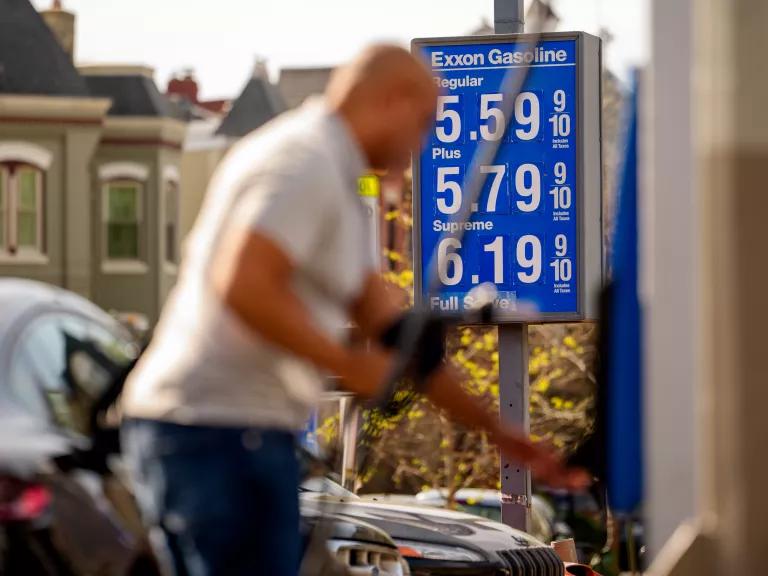
Gas prices over $5/gallon displayed at an Exxon gas station near the U.S. Capitol Building in Washington, D.C., March 31, 2026
Any energy policy that prioritizes the combustion of fossil fuels purchased on the global market is almost by definition at odds with the goal of domestic energy security. And it’s a lesson already learned. The world just saw this play out in 2022 when Russia invaded Ukraine and sent energy prices skyrocketing. “So this is the second time in four years that we’ve seen how one country’s actions can send shock waves around the world and threaten fossil fuel supplies and prices,” says Amanda Maxwell, managing director of NRDC’s Global division. “This is an unstable, expensive, and unsustainable situation—and not a cycle we want to repeat again.”
Nations that invest in clean energy are now finding themselves, unsurprisingly, with a wider range of options for powering their economies. For example, India has now installed more fossil-free power capacity than the total grid capacities of Brazil and South Africa put together. The result is that the country is projected to save nearly $100 billion on fossil fuel imports by 2070.
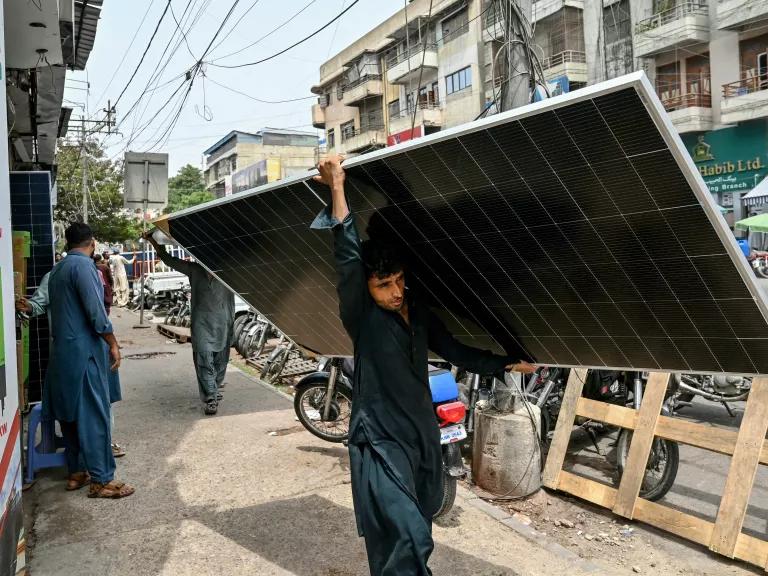
A solar panel being carried along a road in Karachi, Pakistan, a country that is increasingly using solar power, prompting a boom in rooftop panels
Pakistan has also dramatically ramped up its investment in solar energy. After the invasion of Ukraine, the country could no longer afford to import as much oil and gas and decided instead to import cheap solar panels. The decision, notes journalist Jonathan Mingle in a New York Times op-ed, “transformed Pakistan’s energy system and helped insulate it from the current scarcity of liquefied natural gas.” In just five years, solar’s portion of Pakistan’s electricity generation rose from 3 to 30 percent—an investment that is expected to save the country $7 billion in fossil fuel imports in this year alone.
While Trump administration policies slow the progress of U.S. renewable energy manufacturing, other countries are charging ahead in the production of the key components that are driving the clean energy transition. But for this transition to succeed,every single nation must work to ensure that supply chains remain open, safe, and free from political manipulation or exploitation. We know what happens when they’re not.
The clean energy economy must avoid this fate by forging partnerships that are “built on mutual respect for other countries, for communities, and for the environment,” says Maxwell. “No country has the resources, know-how, and capacity to do it all on its own.”

Wind turbines in Vega, Texas, August 16, 2025
Setting the stage for postwar energy security
Even as the Trump administration tries to deepen the country’s dependency on fossil fuels, U.S. consumers and many state governments are signaling their willingness to hasten the transition to clean energy.
Despite the White House’s 2025 removal of tax credits for electric vehicle purchases, American consumers’ interest appears to be rising, not falling, since the outbreak of the war with Iran. Higher gas prices are clearly part of that picture. And states—including many rural ones like Texas and Iowa—aren’t letting the administration’s rhetoric stifle their wind and solar industries, which have created tens of thousands of jobs while also lowering electric bills. Indeed, there’s ample evidence to suggest that U.S. states have actually intensified their efforts to transition to renewables in direct response to the president’s actions.
Maxwell is optimistic that these trends will continue, especially as costs for renewable energy keep falling. In a just-published report, the International Renewable Energy Agency notes that more than 85 percent of renewables are less expensive than their fossil fuel alternatives. Meanwhile, so-called firm renewables, which combine wind or solar with battery storage, can now provide continuous power at a lower cost than most fossil fuels can.
But alongside these economic imperatives, “we also need a cultural shift,” Maxwell says. “Hopefully, by the end of the war, Americans—and all major consuming countries—will understand deeply that fossil fuels are not the answer, and the fossil fuel zeitgeist will change.” Just imagine a world where these dirty sources of power have lost their power over us.
This NRDC.org story is available for online republication by news media outlets or nonprofits under these conditions: The writer(s) must be credited with a byline; you must note prominently that the story was originally published by NRDC.org and link to the original; the story cannot be edited (beyond simple things such as grammar); you can’t resell the story in any form or grant republishing rights to other outlets; you can’t republish our material wholesale or automatically—you need to select stories individually; you can’t republish the photos or graphics on our site without specific permission; you should drop us a note to let us know when you’ve used one of our stories.

Read next: How to Ditch the Biggest Fossil Fuel Offenders in Your Life
Here are some high-impact ways to reduce your personal use of oil and gas and gain a little energy independence.
Venezuela’s Oil Resources Are Vast (and Should Stay Underground)
What Are the Solutions to Climate Change?
A Consumer Guide to the Inflation Reduction Act