
Stratos Data Center Will Emit Air Pollution that’s Linked to Premature Deaths and Health Economic Damages for Utah and States Downwind
A new report models emissions from different on-site methane generation power scenarios to show potential impacts on the people of Utah and residents of multiple downwind states.

Stratos's plan to build a massive data center near the Great Salt Lake faces intense environmental and community scrutiny regarding water rights, pollution, power consumption, and local ecological impacts.

Canadian businessman and television personality “Mr. Wonderful” (aka Kevin O’Leary) and his businesses have proposed the Stratos data center in Box Elder County, Utah, near Salt Lake City, that will be one of the largest data centers in the world, requiring as much as 9 gigawatts (GW) of on-site power from burning methane gas. The Box Elder County Commission approved the project in May—under highly contentious circumstances and under a highly unusual arrangement within a project area created by Utah’s Military Installation Development Authority.
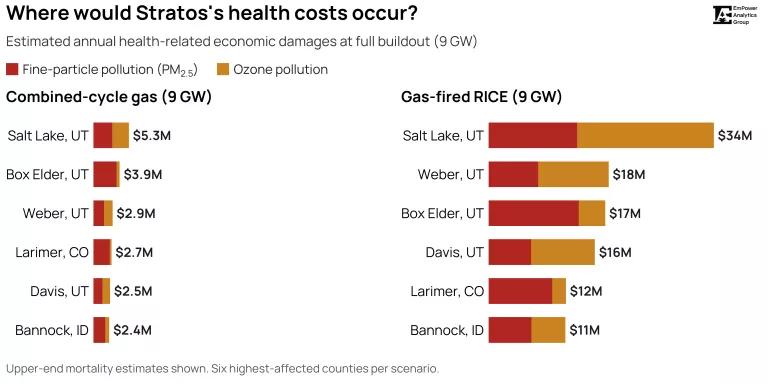
A new report prepared by EmPower Analytics Group for NRDC estimates that the air pollution, health harms, and economic damages from the proposed Stratos data center would be substantial: “[a]t the potential 9 GW full build-out, air pollution from Stratos’s methane-gas power generation is estimated to cause approximately 5–45 additional premature deaths and $75–$690 million in health-related economic damages every year.” The report also discusses additional health harms that extend beyond premature deaths and include new asthma cases, nonfatal heart attacks, hospital visits, and lost work and school days.
These ranges reflect scenarios that model the health harms and economic damage caused by air pollution from two possible methane-gas primary power generating technologies: modern combined-cycle combustion turbines and methane gas–fired reciprocating internal combustion engines (RICE). The primary harmful air pollution consists of tiny soot particles—particulate matter of 2.5 microns or less (PM2.5)—about 30 times smaller than the width of an average human hair.
The report further finds that over a 30-year period, at the potential 9 GW full build-out, the health and economic harms from this PM2.5 air pollution “could accumulate to approximately 856–1,350 premature deaths and $13.5–$20.7 billion under gas-fired RICE, compared with 145–253 premature deaths and $2.3–$3.8 billion under combined-cycle gas.”
Learn more


Of the two methane-gas primary power generation technologies evaluated in the report, one uses a smaller number of large gas combustion turbines, while the RICE scenario reflected electricity generated by many individual engines operating in parallel. Indeed, the RICE scenario is patterned on a methane gas–powered data center with 69 RICE generators that the Utah Division of Air Quality permitted in Millard County in early 2026. RICE generators produce higher emissions than combined-cycle gas at the same generation capacity. Accordingly, the report finds that “[t]he technology used to power Stratos could make a five- to sixfold difference in its estimated health harms.”
Importantly, the modeled combined-cycle gas scenario does not estimate the emissions from the use of on-site diesel generators for backup power because those plans by Stratos remain unknown. (The report modeled diesel backup generators for the RICE scenario, scaled from the Millard County permit example.) Diesel generators are significantly dirtier than comparably sized methane gas generators, emitting 95 percent more smog-forming nitrogen oxides than an equivalent gas generator as well as 98 percent more non-methane hydrocarbons and 59 percent more carbon monoxide. Harmful PM2.5 emissions will be even higher from any data center employing diesel generators (the scale of that additional pollution would depend on whether they were truly used for “emergency conditions” versus being run more frequently; state permitting parameters for backup diesels is a critical issue for all data center developments).
The highest concentrations of harmful air pollution from the Stratos data center will occur near the facility in Box Elder County, neighboring areas of northern Utah (including Salt Lake City), and southern Idaho. But the health harms and economic damage from Stratos would extend well beyond these areas: The report finds that more than 80 percent of health harms and health-related economic damages occur outside the state, reaching downwind populations in Colorado, Wyoming, and as far away as Illinois. The report appendix identifies the full list of potentially impacted states.
The Stratos developers have maintained from the start that the massive data center will be powered by methane gas. “That’s never going to happen,” Utah Governor Spencer Cox told the Salt Lake Tribune in May. “The very first phase will be natural gas, but the other phases should not be. They should be nuclear, and they should be geothermal, and solar and other technology.” But the most recent filing by the Stratos developers with the state still show plans for the full build-out of the data center to be powered by methane gas. This filing shows that the developers now say that they plan a 7.5 GW data center using the dirtier and more harmful RICE generators that burn methane gas. None of these filings commit the developers to doing or not doing something different from what they are saying now, a reality that has characterized this data center project—and many other proposed data center projects nationally.
Data centers in Utah or anywhere else, of course, need not be powered by highly polluting, harmful fossil fuels like methane gas. Other data center developers have been doing better jobs showing how, in stark contrast to the Stratos proposal, it is possible to power these facilities with cleaner energy—such as a robust portfolio of wind, solar, geothermal, and batteries—and maxing out demand side resources.
NRDC commissioned this important EmPower Analytics report to raise awareness and concerns about the harmful health impacts and associated economic damages from dangerous air pollution caused by data centers like the proposed Stratos Project in Utah and by the proliferation of data centers across the United States. These harms arise especially from hyperscaler data centers powered by fossil fuels, like Stratos. While the dangers and costs of excessive water use by data centers are more well known, the deadly toll of air pollution—a silent killer—deserves greater attention and concern.
Harmful air pollution should be met with the best air pollution control technologies available. Data centers should be powered by new, additional, deliverable clean energy that does not release air pollution, along with batteries, storage, and other smart solutions. If someone nicknamed Mr. Wonderful wants to earn that name, he should live up to it, starting with the Stratos data center.
This NRDC.org blog is available for online republication by news media outlets or nonprofits under these conditions: The writer(s) must be credited with a byline; you must note prominently that the blog was originally published by NRDC.org and link to the original; the blog cannot be edited (beyond simple things such as grammar); you can’t resell the blog in any form or grant republishing rights to other outlets; you can’t republish our material wholesale or automatically—you need to select blogs individually; you can’t republish the photos or graphics on our site without specific permission; you should drop us a note to let us know when you’ve used one of our blogs.
Related Blogs
The Carbon Removal Market Can Work—If We Build It Right

The Global AI Buildout Needs Energy Transition Guardrails
