
Cracks in the Foundation: Oil and Gas Demand Projections Don’t Add Up
As COP30 unfolds in Brazil, shifting energy markets are exposing the limits of fossil fuel optimism and the urgency of implementing Paris Agreement–aligned action.
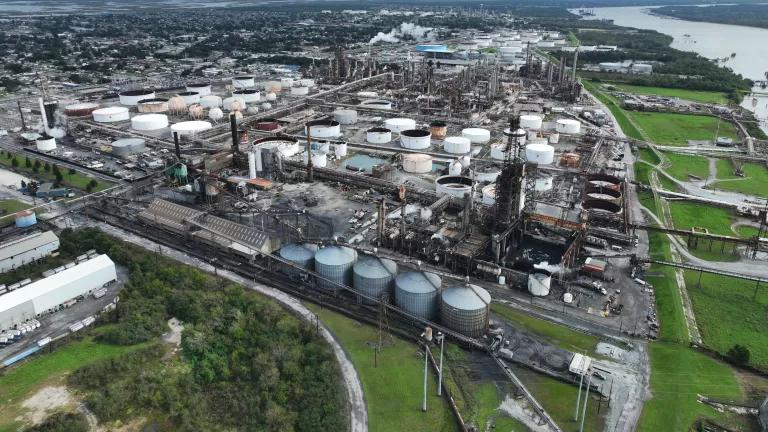
An oil refinery beside the Mississippi River in Chalmette, Louisiana, November 2024

Oil and gas companies continue to forecast decades of rising demand—from power generation and petrochemicals to heavy industry. Yet these projections increasingly reflect hubris, not reality.
Across every major sector, technologies, policies, and markets are converging toward electrification, efficiency, and circularity. Clean energy and low-carbon materials now dominate investment trends once ruled by fossil fuels.
The International Energy Agency’s (IEA) World Energy Investment 2025 report shows energy sector capital investment rising to $3.3 trillion this year—two-thirds of it flowing to renewables, grids, and low-emission technologies compared with one-third to oil, gas, and coal. Fossil fuel growth assumptions are eroding faster than industry models admit.
Global investment in clean energy and fossil fuels, 2015–2025

NOTE: 2025 values are estimated.
A record rise in clean energy investment signals a turning point for the Paris Agreement: Progress is now being measured not by targets on paper but by projects delivered on the ground. Clinging to outdated fossil fuel assumptions is no longer prudent risk management—it’s a liability.
On power: The age of renewables has arrived
Renewables paired with storage have overtaken new gas projects on cost in most major markets—from India to South Africa to Brazil. The IEA’s Renewables 2025 report concludes that nearly all new capacity this decade will be renewable.
The “age of renewables” has begun, with renewable generation surpassing coal generation for the first time, in the first half of 2025. This significant milestone is highlighted in Ember’s Global Electricity Mid-Year Insights 2025. Investment in the electricity sector is set to reach $1.5 trillion in 2025, some 50 percent higher than the total amount being spent on bringing oil, natural gas, and coal to market. Grids worldwide are being rebuilt around clean power, with approximately $400 billion now invested annually in grid infrastructure. Fossil generation, by contrast, is steadily losing market share.
Year-on-year global change in electricity generation by source, 2019–2027

NOTE: Other non-renewables include oil, waste, and other non-renewable sources. Data for 2025–2027 are forecast values.
Electricity 2025, IEA
Clean power generated closer to where it’s used, together with modernized transmission lines and advanced battery storage, is proving more reliable and affordable than volatile gas markets. The next challenge is scaling these solutions fairly—streamlining approvals, partnering with local communities, and ensuring that clean energy investments deliver shared benefits for the households and regions that need them most. But unlocking this transition also depends on lowering the cost of capital, expanding access to finance and technology, and building local capacity to deploy and maintain new energy systems.
This transition is already reshaping global labor markets. According to the IEA, clean power was the single-largest source of new energy employment in 2023, accounting for 40 percent of total job growth across the clean energy sector. Roughly 21 million people now work in power generation, including 4.5 million in solar photovoltaics alone after another record year of job growth. Employment in grids and storage rose by 230,000 to reach eight million in 2023. Ensuring that fossil fuel workers and other vulnerable communities share in these expanding opportunities will be essential to delivering a just and inclusive transition.
On industry: From competitive transformation to pollutant control
Heavy industry—sectors like steel, cement, and chemicals, long viewed as being hard to abate—is beginning to see the rising use of electrification, clean hydrogen, and circular production models, guided by frameworks like the European Union Industrial Emissions Directive and the United Arab Emirates Just Transition Work Programme. Globally, the drivers of energy transition are transforming how these sectors compete and innovate in a clean energy economy.
An equally important frontier is tackling non-CO2 greenhouse gases from methane, nitrous oxide, and fluorinated gases. The Global Methane Pledge—now endorsed by 159 countries and the European Commission—has catalyzed momentum for methane abatement across energy and industry. Progress is visible from the local to the global levels:
- In the United States, New Mexico’s methane regulations have driven down oil and gas emissions, cutting the state’s methane intensity to less than half that of Texas.
- The Global Methane Hub’s $10 million initiative to help cities in Latin America and the Caribbean curb methane emissions is accelerating regional action.
- And at the same time, leaders like Prime Minister Mia Mottley of Barbados continue to push for a legally binding global methane pact, highlighting the growing political will despite implementation challenges.
China's decision to include methane, nitrous oxide, and fluorinated gases in its latest national commitment adds further momentum, broadening the base for industrial emissions reductions worldwide. At the same time, significant progress on hydrofluorocarbon (HFC) phasedowns under the Montreal Protocol and Kigali Amendment reinforces how cooperative global action on short-lived climate pollutants can deliver fast results—a theme underscored as the Montreal Protocol meetings coincide with the first week of COP30.
Reducing methane leaks, eliminating industrial nitrous oxide, and improving process efficiency are now core performance metrics for manufacturing companies competing in a global market that values transparency and compliance. By cutting these emissions early, countries and companies are lowering costs, building more resilient supply chains, and positioning themselves ahead of tightening global production standards.
On petrochemicals: The “last growth market” is cracking
The petrochemicals sector—once touted as oil’s “last growth market”—is now facing a structural overbuild. Derived from oil and gas, petrochemicals are used to make plastics, fertilizers, and countless manufactured goods that were once seen as the oil and gas industry’s next frontier. But new data show that global petrochemical supply capacity is expanding faster than demand, driving down margins and utilization rates. Global petrochemical hubs are contending with oversupply and shrinking margins, pressures that are eroding plant utilization and investor confidence.
Policy reforms are beginning to shift the petrochemical sector toward greater efficiency and circularity, but progress remains uneven and too slow. In many countries, energy efficiency standards for petrochemical plants are being updated, yet most remain voluntary or lack enforcement—limiting their impact on fuel use and emissions. At the same time, subsidies and tax breaks for new fossil-based facilities continue to drive excess capacity, locking in high emissions and financial risk. Industrial policies are starting to incorporate recycling and resource-efficiency targets, but they still largely prioritize export growth and cheap feedstocks over deep decarbonization, leaving circular-economy and climate goals only partially aligned.
Governments should strengthen efficiency standards, quickly end subsidies and tax breaks that encourage excessive petrochemical production, and align industrial policy with circular-economy and climate goals. Policies that reward recycled feedstocks and verified emissions reductions can stabilize markets while cutting harmful pollution and waste.
For investors, the message is clear: The petrochemical build-out has overshot realistic demand for these products. The next decade will reward optimization of existing facilities—through efficiency gains, lower emissions, and smarter resource use—rather than new capacity built mainly to prop up continued oil and gas extraction.

A solar panel array at Fazenda Solar Bemol in Manaus, Amazonas, Brazil, which is capable of serving 570 households in the region
COP30 and beyond: Closing the cracks in fossil optimism
At the 2025 U.N. Climate Change Conference (COP30), countries have a unique opportunity to challenge fossil-fueled optimism—and the outsize influence of industry lobbyists within the U.N. climate talks—and to confront the realities of climate implementation. The credibility of global oil and gas demand will be tested not by models but by how decisively countries deliver on their Paris Agreement commitments in this decade.
Leaders can help turn ambition into measurable progress—by scaling up renewable power, protecting and restoring nature-based carbon sinks, and accelerating cuts in methane, fluorinated refrigerants, and other non-CO2 pollutants. COP30 must demonstrate that implementation delivers tangible results: cleaner energy, stronger economies, and fairer outcomes for communities, including the final ending of harmful subsidies that keep fossil fuels artificially competitive.
The oil and gas industry’s growth story rests on assumptions already undermined by technology, markets, and policy. Key economies shaping the COP30 agenda, from Brazil and major Asian economies to the European Union, are turning from fossil fuel expansion toward real delivery on clean energy and climate goals. The most resilient economies will be those building the next energy era—one that’s defined by efficiency, electrification, and innovation that delivers opportunity for people and communities.
Related Blogs
Accounting for AI: Environmental Transparency for a Responsible Digital Future

The Global AI Buildout Needs Energy Transition Guardrails
