
The Transition Fuel Illusion: How 2025 Exposed the Limits of Global Natural Gas Expansion
COP30 outcomes, methane regulation, and market shifts show why natural gas cannot anchor the next phase of the energy transition.
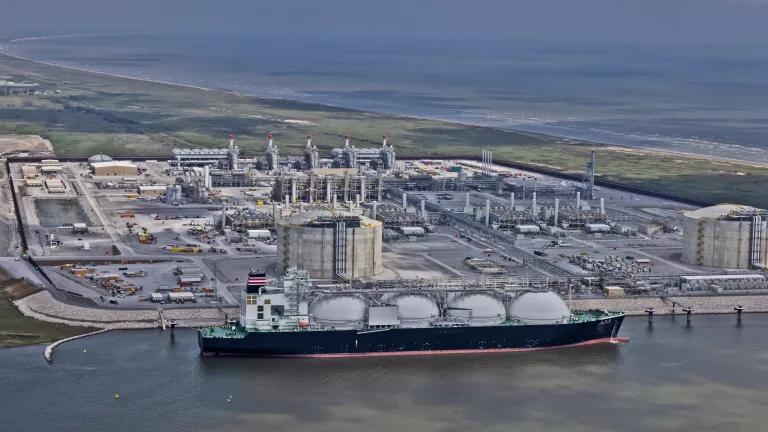
A liquefied natural gas tanker ship docked at Venture Global’s Calcasieu Pass export facility in Cameron Parish, Louisiana

As countries emerged from the United Nation’s COP30 climate conference in Brazil, one reality stood out beyond the headlines: The global clean energy transition has outpaced the fossil fuel narratives. Across markets, technology, and policy, the assumptions that once justified continued fossil fuel expansion no longer hold.
Learn More
Natural gas is perhaps the clearest example. For decades, gas has been promoted as a safe bet for investment—anchored in expectations of steady long-term demand, price stability, and a reputation as a lower-carbon “bridge fuel.” Those assumptions no longer reflect reality.
The political landscape is now catching up to a trend that 2025 made impossible to ignore: Natural gas is not a transition fuel. It cannot serve as the default solution for new power generation in a Paris Agreement–aligned transition—given its emissions profile, cost volatility, and growing competition from cleaner, lower-risk alternatives.
Markets exposed the limits of natural gas
Evidence across markets, investment trends, and power-sector economics has been building for years, but 2025 made the trend unmistakable. The latest data from the International Energy Agency (IEA) show that clean energy now captures roughly two-thirds of global energy investment, compared with one-third for oil, gas, and coal. This shift is not aspirational; it is measurable. Utilities, industries, and investors are pouring capital into renewables, grids, and storage because they are now cheaper, faster to deploy, and more dependable—reducing fuel price risk and strengthening grid resilience—than new fossil infrastructure.
Natural gas was long presented to investors and policymakers as a lower-risk “bridge fuel,” on the assumption that it would face limited regulatory scrutiny and enjoy stable demand during the transition, but this is now being reassessed by investors, lenders, and regulators because of the fuel’s exposure to tightening climate and methane emissions rules, long development timelines, and vulnerability to future policy shifts. These concerns are especially pronounced for large, capital-intensive infrastructure with long payback periods.
This is particularly evident in regions where natural gas expansion intersects with high biodiversity value and community impacts, such as Mexico’s Pacific coast. NRDC has engaged various financial institutions over the past year and determined that there is a broader reassessment underway across the market: Credible climate and investment strategies are increasingly focused on avoiding new higher-risk natural gas build-out rather than extending it.
The latest year-to-date data show that many major markets saw flat or declining demand. The steep drops in Asia underscore how even a record heat season there failed to produce the expected surge in demand. In OECD Europe, natural gas demand is expected to contract by 8–10 percent from 2024 to 2030. We are seeing a structural shift: Gas demand growth in this decade is no longer broad-based or reliable but fragmented and constrained.
Clean energy is more cost-competitive
The picture is especially clear in power generation, where clean energy is no longer just competitive—it is systematically undercutting fossil fuels. In 2024, 91 percent of all new renewable power projects worldwide were cheaper than any new fossil fuel alternative. And the shift is not limited to stand-alone renewables. Hybrid systems that combine battery storage with solar or wind power are now reaching cost parity with, and often beating, gas-fired generation. In the United States, solar-plus-storage projects are proving highly competitive with fossil fuels. According to data from the International Renewable Energy Agency (IRENA), 17 operational solar-plus-storage projects achieved a weighted average cost of $0.079 per kilowatt-hour. This cost is comparable to the midpoint for combined-cycle gas turbines ($0.077/kWh) and significantly cheaper than coal-fired power, which averaged $0.119/kWh. In Australia, hybrid systems are even more competitive, with a weighted average cost of just $0.051/kWh, well under any fossil option.
These realities are consistent with what we see across Brazil, Europe, India, South Africa, and the United States. Renewables paired with storage now routinely outcompete new gas and coal plants on cost, reliability, and build time. The IEA’s Renewables 2025 report reinforces the trajectory: Almost all new capacity added this decade will be clean. Solar photovoltaic alone is expected to account for almost 80 percent of this increase. The economics that once justified gas as a “bridge” have weakened; they have collapsed under the weight of faster, cheaper, and more scalable alternatives.
International methane rules are turning natural gas into a financial liability
Countries around the world are taking a closer look at the full life cycle emissions of their energy systems—and natural gas increasingly falls short. Because natural gas is primarily methane—a potent greenhouse gas—emissions across production, processing, and transport are central to assessing its climate impact. At COP30, the Global Methane Status Report confirmed that while new policies and market shifts are improving the outlook, current action still falls far short of the Global Methane Pledge’s goal to cut emissions 30 percent by 2030. Ministers emphasized that proven, low-cost solutions, especially in the energy sector, are available now but require rapid scale-up and far greater transparency.
These signals are already reshaping natural gas markets. Earlier this year, a joint U.S.-Qatar letter to the European Union warned that emerging methane rules could disrupt gas trade. In December, the E.U. responded by offering limited simplifications to its methane regulation—but crucially did not roll back the law itself, reinforcing that methane measurement, reporting, and mitigation are now durable requirements for accessing key markets. An Oxford Institute for Energy Studies analysis underscores that such regulatory friction is likely to intensify as importing regions seek to reduce strategic exposure to volatile gas markets rather than deepen dependence on them.
Technology is outpacing the narrative
The defining trend of the past decade is that clean electricity has outperformed expectations not only on cost but also on speed and scalability—the very attributes that once made natural gas seem indispensable. In 2025, battery storage installations continued to set new records, allowing grids to remain reliable without relying solely on new fossil-based generation. At the same time, demand-flexibility solutions expanded rapidly across major markets. New research shows that flexible grid connections can shorten interconnection timelines by several years while avoiding the need for new gas buildout altogether. Distributed clean power—from rooftop solar to mini-grids—is also proving its value, delivering reliable electricity in places where centralized grids, long-distance transmission, or fossil fuel supply infrastructure were never practical or affordable.
Energy security no longer favors natural gas
For decades, natural gas has been framed as a pillar of energy security, seen as a fuel that could be turned on when needed, stored for later use, and relied on during supply disruptions. Recent experience has challenged that assumption. As gas markets have become more globally interconnected, countries reliant on imports or long-distance transport have been exposed to supply disruptions, price volatility, and geopolitical leverage. The result has been repeated price spikes, fiscal strain on governments forced to shield consumers, and heightened vulnerability during crises—outcomes that undermine, rather than enhance, energy security.
By contrast, the same clean energy systems reshaping markets are also delivering more durable forms of security. Renewable power paired with battery storage reduces exposure to international fuel markets altogether while demand flexibility and grid modernization lower peak stress and improve system resilience during extreme weather and supply disruptions. Distributed generation—whether rooftop solar, community-scale renewables, or mini-grids—can also strengthen energy systems by reducing dependence on single points of failure, particularly in remote or underserved areas, while complementing grid expansion rather than replacing it.
These dynamics help explain a broader strategic reassessment underway among governments. Energy systems anchored in domestic renewables, storage, and flexible demand are less vulnerable to external pressure, faster to deploy, and cheaper to operate over time. In this context, continued reliance on natural gas increasingly looks like a security liability—one that exposes countries to geopolitical risk just as viable, lower-risk alternatives are scaling rapidly.
Global climate diplomacy moves from pressure to implementation
As fossil fuel exporters sought to preserve the role that gas plays in the global energy system, climate diplomacy in 2025 became more openly contested. Debates over methane regulation, gas trade, and energy security highlighted growing friction between efforts to lock in fossil fuel pathways and parallel moves by many governments to tighten climate and emissions standards. These tensions underscored a broader shift: Natural gas is no longer treated as a neutral transition option but as a sector increasingly constrained by climate policy and long-term decarbonization goals.
That shift is now translating into concrete political action. In the wake of COP30, Brazil’s President Luiz Inácio Lula da Silva instructed the country’s ministries of Mines and Energy, Finance, Environment and Climate Change and the chief of staff’s office to develop a resolution outlining a road map for a just and planned energy transition. The proposal is expected to include mechanisms to finance the transition, including the creation of a dedicated energy transition fund supported by oil and gas revenues. At the same time, regional leadership is emerging elsewhere: Colombia and the Netherlands have announced plans to cohost the first International Conference on the Just Transition Away from Fossil Fuels on April 28–29, 2026, in Santa Marta, which will provide a global platform for moving beyond coal, oil, and gas; addressing challenges; and building a just transition road map. This signals growing political and diplomatic alignment around managing a gradual and long-term exit from fossil fuels.
Managing the decline: Ensuring a just transition
Recognizing the limits of the transition fuel narrative also means planning responsibly for what comes next. As natural gas infrastructure winds down, governments must pair decarbonization with deliberate policies that support workers and communities that have long been tied to the sector. This includes investing in worker retraining and job placement programs that connect fossil fuel workers to growing opportunities in clean power, grids, storage, and energy efficiency—sectors that are already generating the majority of new energy jobs.
COP30 landed a breakthrough decision by agreeing to develop a rights-based, people-centered just transition action mechanism that will aim to protect human and labor rights, foster free prior and informed consent, champion gender equality, and safeguard the rights of marginalized communities, including the free prior and informed consent of Indigenous Peoples, Afro-descendents, and other local communities. As a result, targeted community investment is now equally important. Regions built around natural gas production, processing, or export need support to diversify local economies, remediate legacy pollution, and attract new industries. Public finance, development banks, and national transition plans all have a role to play in ensuring that communities are not left behind as markets shift. Done well, managing the decline of natural gas can reduce economic disruption, improve public health, and accelerate the build-out of cleaner, more resilient energy systems.
The limits of the transition fuel narrative
Taken together, the evidence from 2025 points to a clear conclusion: Natural gas no longer functions as a credible bridge in the energy transition. Across markets, technology, investment, and diplomacy, it increasingly behaves like a detour—one that risks slowing decarbonization, raising system costs, and locking economies into avoidable volatility.
Clean energy now delivers what natural gas was once expected to provide: reliable, flexible, scalable power; often faster and at lower cost, without locking countries into decades of emissions. Where natural gas still plays a role, it is limited to narrow, time-bound applications and does not justify new long-lived infrastructure or expansion of natural gas capacity.
With COP30 concluded, attention is turning to implementation. The task ahead is not to repackage natural gas as a transition fuel but to manage its decline deliberately and fairly. That means protecting workers and communities while accelerating clean energy solutions that already outperform fossil alternatives. This is the credible path to a resilient Paris Agreement–aligned energy system—and the direction the world has already begun to take.
Related Blogs
Accounting for AI: Environmental Transparency for a Responsible Digital Future

The Global AI Buildout Needs Energy Transition Guardrails
