Congress Is Cutting Off Transportation Investments that Help Families Save Money
The loss of guaranteed federal funding could stall projects that make it easier and cheaper for Americans to get where they need to go.
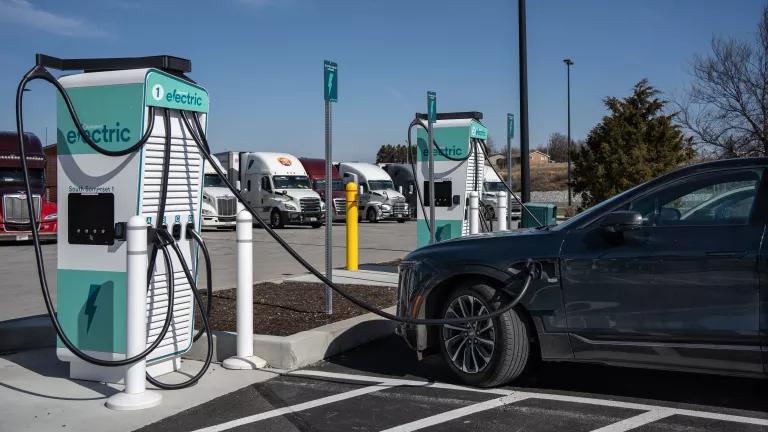
EV charging stations at a rest stop in Pennsylvania, March 2026
At a time when Americans are struggling to pay staggering prices at the fuel pump and the Trump administration sows uncertainty for states and communities by clawing back committed transportation infrastructure funds, Congress is moving to scale back more critical federal funding for affordable and clean transportation.
The need for consistent funding is clear: Transportation costs are the second-largest household expense in the United States, and our roads and transit infrastructure remain structurally inadequate. Nevertheless, state transportation and transit authorities are facing a significant funding cliff due to the expiration of the Bipartisan Infrastructure Law (BIL) on September 30, 2026. Over the past five years, the infrastructure law has provided a guaranteed pot of funding worth $36.8 billion for transportation projects. These “advanced appropriations” cover a wide breadth of programs and include large amounts of funding for clean transportation, such as electric vehicle (EV) charging infrastructure projects, transit, and rail investments. This funding has helped state transit and transportation authorities plan for longer-term projects and has been critical to the infrastructure law’s support of almost 70,000 unique transportation projects across the country.
Learn More

But transportation funding from the infrastructure law ran out on September 30, 2026, and while Congress passed a short-term extension until December 11, 2026, it does not include these guaranteed dollars. This means that, for the three-month duration of the extension, states will lack the continuity and certainty they need to plan for both large- and small-scale infrastructure projects.
To add insult to injury, Congress also seems to be contemplating leaving this guaranteed funding out of the next transportation bill altogether. The House BUILD America 250 Act proposal, released in May, proposes cutting all advanced appropriations funding. The proposal, in fact, slashes transportation funding from current infrastructure law levels by almost 50 percent, leaving Americans without access to travel options that help defray rising costs.
How is the Bipartisan Infrastructure Law funding different, and what does it fund?
Historically, transportation bills have included authorizations of two types of funding: (1) contract authority, which is supported by revenues that flow into the Highway Trust Fund and (2) general funds, which Congress has to “appropriate” and assign annually. The current infrastructure law includes another category—advanced appropriations—which makes money available in the future for certain programs without the need for any congressional action in future years, guaranteeing states and communities secure funding over the five-year bill period. This certainty allows for states to plan in advance for future projects and grant opportunities.
Any cut to this pot of money takes a sledgehammer to clean transportation programs that reduce household costs and improve the health of our communities. Particular programs at risk include the National Electric Vehicle Infrastructure program, which helps states build a national network of EV chargers; the Capital Investment Grants, a transit-related discretionary grant program; and the Reconnecting Communities Pilot, which aims to address harms caused by past transportation decisions. Also of concern are the BUILD and MEGA grants, which help support the build-out of transit, bicycle, and pedestrian infrastructure.
Congress must reauthorize all infrastructure law funding
Congress is unlikely to agree on a new bill before the current extension comes to an end in December 2026, meaning that there is an opportunity to include advanced appropriations in any future extension of the current infrastructure law and the next transportation bill so that states and local governments can avoid having to grapple with temporary or potentially even permanent funding interruptions. This guaranteed funding is even more important now as transportation decision-makers contend with the Trump administration interfering with implementation and funding guidance. Additional funding clawbacks will only serve to stall progress. The sustained funding will also allow states and local governments to continue to build on the progress that the current infrastructure law made on clean transportation investments.
Even more important, American households are currently struggling to afford their basic daily necessities, and soaring gas prices have left many searching for ways to save on their transportation costs. In 2024, when gas prices averaged below $3.50 a gallon (a far cry from the current average price of $4.35 a gallon), transportation was the second-largest cost for American households, averaging 17 percent of household budgets. Cutting advanced appropriations funding for transit, EV charging, and rail will only serve to penalize the very households struggling the most, at a time when those investments would give Americans access to a wide range of affordable, reliable, and safe transportation options.
This NRDC.org blog is available for online republication by news media outlets or nonprofits under these conditions: The writer(s) must be credited with a byline; you must note prominently that the blog was originally published by NRDC.org and link to the original; the blog cannot be edited (beyond simple things such as grammar); you can’t resell the blog in any form or grant republishing rights to other outlets; you can’t republish our material wholesale or automatically—you need to select blogs individually; you can’t republish the photos or graphics on our site without specific permission; you should drop us a note to let us know when you’ve used one of our blogs.
Related Blogs

Getting Off the Gas Price Rollercoaster
The EPA Cooks the Books in Trying to Cook the Planet