NRDC Assessment of BAAJA, the 2026 Permitting and Transmission Bill
Our examination of the Bipartisan American Affordability and Jobs Act identifies substantial transmission benefits while highlighting important policy questions around environmental and public health safeguards.
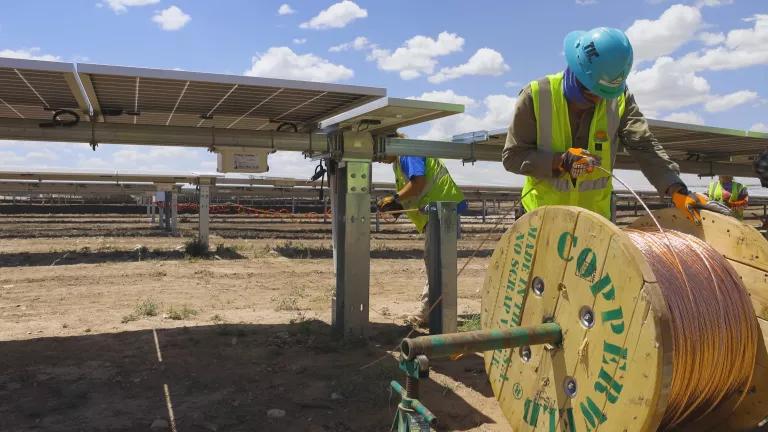
Engineers installing cable at a utility-scale solar farm under construction in Arizona
The Bipartisan American Affordability and Jobs Act of 2026 (BAAJA) is the result of years of negotiations on permitting reform. The product is a bill that combines critically important transmission and grid reforms with significant and concerning changes to federal environmental laws, permitting standards, and judicial remedies.
The transmission provisions in the bill would produce substantial and durable benefits, updating an aging power grid by allowing new investments. These reforms, which NRDC has long supported, are an essential component of accelerating the electrification and decarbonization of the power sector and achieving greenhouse gas reduction targets. On their own, these changes are much needed and overdue; they would also help any future clean energy incentives and standards succeed in cutting emissions. But transmission is an enabling technology rather than a substitute for policies that directly drive clean energy investment and reduce pollution.
However, there are a number of concerning provisions that raise substantial issues and reinforce the position of incumbent energy interests. The “project certainty” language is designed to ensure projects cannot be arbitrarily canceled. As drafted, it could benefit fossil fuel, mining, data center, and other industrial projects more than clean energy. It could also limit agencies’ ability to address newly discovered harms, constrain future pollution regulation, and create large taxpayer-funded corporate handouts.
Learn More

The bill would also weaken key elements of core environmental laws, including the Clean Water Act (CWA), the Endangered Species Act, the National Environmental Policy Act (NEPA), and the National Historic Preservation Act (NHPA). The bill would narrow environmental review across those statutes, diminish state and Tribal authority, constrain public participation, and restrict courts’ ability to stop projects proceeding under unlawful permits. These changes erode fundamental protections for communities.
The backdrop, of course, is the Trump administration’s nonstop attacks on clean energy projects, tax incentives for clean energy, and climate standards. NRDC’s analysis finds in aggregate that the Trump administration’s actions could double carbon emissions from the power sector over the next decade while raising consumers’ electric utility bills by $30 billion per year by 2035. Lawmakers should push for tangible evidence that this has changed before voting on the legislation.
While NRDC is encouraged by the transmission provisions, other elements of the bill are deeply flawed. We will be seeking improvements in the coming weeks and will take a position on the bill before a floor vote.
Below is an assessment of the most positive and most negative elements of the bill. This is not intended to be comprehensive.

The control room of the California Independent System Operator, which operates the state's high-voltage transmission grid
Positives
Transmission and grid reform are the bill’s principal strengths
An aging power grid desperately needs updating, and with more extreme weather and surging demand from data centers, getting new electricity connected to the grid quickly is essential to keeping energy costs down and maintaining resilience. In one fell swoop, this legislation would address these issues, producing the necessary conditions to deploy more clean energy.
This legislation would provide a dramatic near-term boost to the nation’s grid by increasing both the amount of power that existing transmission lines can carry and the supply of electricity available to meet growing demand. It establishes procedures that could cut the time to build a major new transmission line to five to six years from 10 years—or sometimes significantly longer—today.
The Midwest’s multi-value projects: How agreeing on who pays can unlock transmission
In 2011, the Midwest grid operator, MISO, approved 17 high-voltage lines costing more than $5 billion and spread the cost across the region based on who benefits. Within about a decade, 16 of the 17 were in service, helping to connect wind power across the Midwest.
Between regions, where no such agreement exists, almost no major lines were approved in the decade after FERC's 2011 planning rule. The bill tries to bring the Midwest's approach to lines that cross between regions.
In the short term, it would require utilities to upgrade existing transmission lines and deploy advanced transmission technologies whenever their benefits exceed their costs. This technology can increase the capacity and efficiency of existing transmission lines, reduce congestion, and improve reliability, often at a cost that is 5 to 10 times cheaper than building new transmission. If deployed aggressively in the short term, this could free up more than 100 gigawatts of transmission capacity—enough to power 75 million homes.
Importantly, the bill goes beyond simply requiring utilities to consider these technologies: It directs the Federal Energy Regulatory Commission (FERC) to establish timelines for deployment, makes it easier for utilities to recover their costs, and establishes penalties for utilities that fail to deploy cost-effective technologies.
From PJM's queue freeze to Southwest Power Pool's fix
In 2022, PJM, which runs the grid for 13 states and Washington, D.C., stopped taking new requests to connect to the grid while it worked through a backlog of more than 300 gigawatts, 95 percent of it renewables and storage. It didn't reopen until April 2026, so projects that applied after 2022 are only now starting their studies.
In March 2026, FERC approved a new approach from Southwest Power Pool, which runs the grid across much of the central United States. It plans transmission and new power plants together over 20 years, charges developers a standard up-front fee to connect, and studies projects once a year with a single decision point. The bill would require every region to adopt a process like this within two years and to speed up studies with better data and automation.
The bill makes major interstate power lines easier to build by strengthening federal authority over large interstate transmission lines. Currently, a state can block or indefinitely delay a project that would provide broad regional or national benefits. If a state rejects an eligible project or fails to act within one year, the bill requires FERC to issue a permit for a covered transmission line when a developer seeks federal review and the project satisfies specific criteria. FERC must then spread the costs fairly among all consumers who benefit from the projects.
The bill also requires neighboring grid regions to plan interregional transmission jointly, assess the benefits of potential projects, and establish methods for allocating costs. Despite a FERC order issued in 2011 that was meant to spur these cross-regional power lines, currently, virtually no major lines have been built between regions because there is no durable process for planning them or determining who should pay. The bill addresses this long-standing problem and codifies important elements of FERC’s updated regional planning framework from 2024, known as Order 1920.
The bill will also reduce the long wait times for energy projects to connect to the grid. Approximately 2,000 gigawatts of proposed generation and storage are waiting to connect to the grid, and 85 percent of that capacity is solar, wind, or storage. Projects often wait years for studies and may receive unexpectedly high upgrade costs late in the process. The bill encourages more coordinated planning, provides developers earlier information about costs, and improves data and automation.
Taken together, these transmission and interconnection reforms are a once-in-a-generation opportunity that would produce significant and durable benefits. The reforms would also facilitate the infrastructure needed so that future clean energy incentives and standards could succeed.
Require data centers’ to pay for increased costs driven by their grid demands
The data center provisions could provide protection for existing utility customers and support grid investments by requiring data centers to pay for their impact to the grid. It would direct FERC to develop pricing rules designed to prevent transmission costs created by data centers (generally 20 megawatts or more) from being shifted to other ratepayers and ensure data centers provide financial assurance to avoid costs shifting in the future. FERC would also have to revise transmission pricing policies and require standardized analysis of upgrades and cost-reduction options. These provisions address the transmission portion of the broader effects of rapid data center growth. The bill does not address local air pollution, water consumption, noise, land use, reliance on on-site fossil fuel generation, transparency, or public participation.
Provide a boost to geothermal energy
With geothermal energy poised to be a major player in the clean energy future, the bill provides policy reforms that could increase permitting efficiency and lower some of the barriers to geothermal development. But the geothermal provisions also come with their drawbacks, including the expansion of Section 390's oil and gas activity categorical exclusion to geothermal development, which allows for significant drilling and production activities to take place on public lands without environmental review.
Negatives
Project certainty provisions could backfire
In an effort to respond to the Trump administration’s relentless attacks on wind and solar projects, this legislation includes “project certainty” language to protect developers from unreasonable attacks. Unfortunately, these provisions could have problematic unintended consequences, including locking in the Trump administration’s preferential treatment of oil, gas, data centers, and mining projects. This part of the legislation could also lead to a slew of industry lawsuits that result in taxpayers paying billions of dollars to private industry.
These “project certainty” provisions would largely prevent federal agencies from canceling, suspending, or changing federal approvals once issued. The provision’s reach is not limited to energy projects and is not limited to specific agencies or types of permits. The legislation sets out a small handful of circumstances in which agencies can modify an issued permit. Notably, while these circumstances include national security or defense concerns, they do not include environmental harm—even if newly discovered, severe, or widespread. Its broad language could even lead to industry arguments and legal claims that operating facilities are protected from subsequently adopted pollution requirements under the Clean Air Act and other statutes. State permits to implement future U.S. Environmental Protection Agency (EPA) standards for power plant carbon emissions, for example, could face legal challenges based on this provision.
And if a project is canceled or amended, a company can go to court to get its permit reinstated—as well as require the government to pay for its litigation expenses and the cost of project delays. The government could also be forced to use taxpayer money to make an additional payment of 25–50 percent of total project costs incurred to the company. For a single large energy project, this could easily amount to hundreds of millions, or even billions, of dollars.
A separate provision would allow energy-project developers to sue agencies for alleged “disparate treatment.” The approach uses a five-year comparison period that could embed the second Trump administration’s energy preferences in the legal baseline, and thus advantage oil, gas, and coal projects. And it prevents agencies acting in good faith from fully defending themselves in court. Successful claims could result in payments equal to 50–100 percent of projected construction costs plus actual damages and legal costs, creating a serious risk that the provision could be gamed and produce large taxpayer-funded payouts.
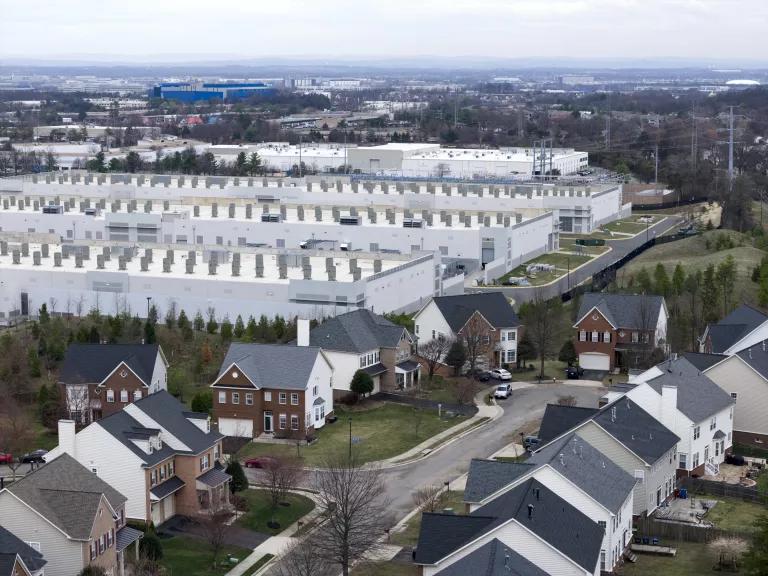
An Amazon data center beside a residential neighborhood in northern Virginia, which has the largest concentration of data centers in the world, managing roughly 70 percent of global internet traffic
Environmental reviews and judicial remedies are sharply constrained
The bill makes sweeping changes to our ability to enforce a number of environmental laws. For example, a court that finds violations of the CWA’s “dredge and fill” permit system will be unable to invalidate the permit except in narrow circumstances; a court can never invalidate a permit based on a violation of the NEPA and the NHPA, no matter how severe it finds a legal violation to be. Though a deficient review can be returned to an agency, construction is allowed to continue while the agency corrects its mistakes. The result could be that by the time the agency completes its review, the project may already be largely or entirely built and the damage difficult or impossible to reverse.
Right now, if a court finds that an agency violated NEPA, it can stop the project from moving forward until the agency corrects the environmental review documents. For example, a federal judge put an oil and gas lease in Alaska’s ecologically rich Cook Inlet on hold until the responsible agency corrected its defective environmental review. That reasonable result may not have been possible had this bill been the law.
The bill also excludes activities from NEPA review, expands exemptions for others, narrows the analysis of alternatives, and potentially limits who can bring a case. Collectively, these changes substantially reduce the practical value of NEPA as a means to improve environmental outcomes. Tribes, local organizations, and affected communities may be particularly disadvantaged if they are cut out of the process or cannot stop harmful projects before they cause damage.
Changes to historic preservation law significantly affect Tribal interests
The bill would dramatically curtail the rights and powers of Tribes enshrined in Section 106 of the NHPA, effectively limiting Tribes’ ability to protect their lands and culturally significant places from proposed projects with a federal connection. The bill limits Tribal participation in decisions concerning federally connected projects and what Tribal interests are protected, which, under current law, includes not only artifacts but also sacred places, cultural landscapes, waterways, wildlife, and living ecosystems. Tribal Nations and Indigenous partners have made clear that these changes significantly undermine Tribal sovereignty and the federal government’s nation-to-nation responsibilities.
Examples of NHPA impacts
NHPA, specifically Section 106, has played a critical role in ensuring that permitting processes must integrate Tribal Nation feedback, helping to improve the environmental and cultural resource outcomes for projects, including the Pebble Mine and the Arches and Canyonlands National Parks, due to oil and gas drilling proposals. Proposed changes to Section 106 would place additional areas in further jeopardy—including mining proposals that would impact the Brooks Range and Gates of the Arctic National Park and Preserve, along with drilling proposals in the Chaco region, the Western Arctic, and the Arctic National Wildlife Refuge, respectively.
The Clean Water Act provisions restrict state, Tribal, and federal authority to improve projects and protect water bodies and wetlands
The bill weakens several CWA programs, which will make it easier for activities that pollute or destroy water resources to move forward without adequate safeguards. It limits the ability of states and Tribes to ensure the health of streams, lakes, wetlands, and groundwater when the federal government authorizes activities that impact them. It takes a fast-tracked permitting process meant for activities that have minimal impacts (like boat ramps) and applies it to major projects such as pipelines and highways.
The bill makes significant changes to the Clean Water Act program that gives states and Tribes the ability to demand water quality–based improvements to federal permits. For gas pipelines and transmission projects, reviewing authorities are limited to considering direct discharges, (e.g., just the effects of a concrete structure for a pipeline) rather than broader construction-related effects such as erosion, sediment, contaminated runoff, groundwater pollution, and damage to wetlands and streams, or ongoing impacts from the operation of the project.
For other projects, the bill places a substantially higher burden on states seeking to require protections. Currently, a state can identify a water quality concern, request reasonable changes, and allow a project to proceed with stronger safeguards. A state would now be required to demonstrate harm by clear and convincing evidence (versus reasonable evidence) and show that its proposed condition is the least burdensome means of addressing the water quality concern. In practice, these new hurdles to water quality conditions will be very difficult to overcome, which will likely result in fewer state conditions on permits needed to protect water quality. In addition, the bill would restrict states and Tribes from taking the actions they can today to protect habitat, groundwater (including drinking water supplies), and many small streams and critical wetlands.
How the Clean Water Act change could impact states
If the special provisions for gas pipeline projects had been the law, Pennsylvania likely would not have been able to require the Atlantic Sunrise Pipeline Project to comply with state erosion and sediment laws, and West Virginia likely would not have been able to require controls and compliance monitoring that enabled the state to enforce against the Mountain Valley Pipeline's violations of runoff requirements.
By shifting and raising the burden of proof, this requirement would jeopardize precautionary state actions, such as a Tennessee decision this spring, when it refused to sign off on an Army Corps permit for a landfill because the project developer had failed to show that pollution from the site would not harm local waters. This kind of state engagement improves projects and does not end them.
The bill also weakens the Clean Water Act’s general permitting program (administered by the U.S. Army Corps of Engineers) for dredging and filling waters. The bill directs the Corps, when creating general permits, to look only at the harm that results from filling in waters. No other water impacts like water pollution or groundwater depletion could be considered. Additionally, right now, most general permits can only be used for impacts of one-half acre or less; this bill would quadruple this threshold, which could allow larger data centers or other major projects to qualify. It also extends the duration of general permits, reducing opportunities for public input on requirements for projects to once a decade. Finally, it requires the Corps to maintain fast-track permits for large “linear” projects that can have major environmental harms, like roadways and pipelines.
The bill weakens other Clean Water Act programs as well. It would curb the EPA’s ability to stop projects that dump dredged or fill material that “have an unacceptable adverse effect on municipal water supplies, shellfish beds and fishery areas (including spawning and breeding areas), wildlife, or recreational areas,” which the agency has invoked rarely, but done so to protect exceptional habitats threatened by highly damaging projects. It would slow the EPA’s development of scientific advice to states about the levels of pollutants that can cause harm to aquatic life or people, and it would delay updates to discharge requirements for industrial polluters and sewage plants; together, these two changes would constrain the ability to control “forever chemicals.”
Endangered species protections are weakened
Language relating to the “best available science” standard could be interpreted to restrict precautionary action when scientific information is uncertain. This is particularly concerning when an imperiled population of a species is difficult or expensive to study and waiting for definitive proof could result in irreversible loss.
The bill also allows states to assume responsibilities currently carried out by the U.S. Fish and Wildlife Service. Many states lack the capacity, expertise, or in some cases, the commitment necessary to perform this responsibility effectively, and if a state is not executing its responsibility, there is not a requirement for the federal government to reassume it.
Oil and gas drillers get access to resources below farmers’ and ranchers’ lands
The bill would exempt many wells drilled on private lands that tap into federally owned oil and gas reserves from federal permitting, opening at least 57 million subsurface acres of federal resources to exploitation without federal permits. If passed into law, this provision strips thousands of private landowners across the West of important protections like required notice of industry’s plans to develop on their property, increases the risk that landowners get stuck with orphaned wells and their associated environmental and financial costs, and creates new risks of fraud and abuse as it relates to royalty reporting.
Public lands are handed to the mining industry
The bill allows mining companies to claim an unlimited number of five-acre mill sites on public lands to be used for things like tailing storage—wastewater and rock often containing heavy metals and other dangerous residues—and waste dumps. And it allows mining companies to occupy public lands for any other use relevant to a mining project, regardless of its proximity to the actual mine, meaning roads, pipelines, powerlines, and any other activity formerly requiring a federal permit and environmental review would be allowed so long as the activity is included in the mine’s operation plan.
Policy analysis
The modeling completed to date focuses on greenhouse gas and economic impacts. Available analyses from NRDC and other groups generally project modest to significant greenhouse gas benefits, especially over the long term, but the results vary substantially depending on the provisions modeled, policy baseline, fuel and technology costs, and implementation assumptions.
NRDC’s initial results show modest power sector benefits.
The benefits of additional transmission will generally be greater in a policy environment that drives clean energy deployment. In a baseline with limited support for new clean energy resources, transmission may improve reliability and reduce costs without producing sizable emissions reductions.
The oil-and-gas effects remain uncertain. NRDC has not quantified the bill’s effects on oil-and-gas development. Because the existing baseline already assumes high levels of domestic production growth (oil and gas production have both doubled in the last 20 years), faster permitting may not produce a large increase in emissions compared with business as usual. Nevertheless, the bill could accelerate individual projects, improve their economics, and make approved infrastructure more difficult to regulate or modify later. The risk of locking in that trajectory merits consideration, even if near-term emissions changes appear modest.
Data-center growth creates a particularly important unknown. The grid provisions may indeed enable data centers to finance upgrades and connect to an expanded transmission system. But transmission takes years to plan and construct. In the interim, faster permitting and weaker environmental safeguards could encourage additional on-site or nearby gas generation, particularly in regions with access to existing pipelines or gas fields.
Greenhouse gas emissions are only one measure of the bill’s effects. The modeling does not quantify potential consequences for drinking water, local air pollution, public health, endangered species and wildlife, or other metrics. It also cannot account for the practical importance of judicial remedies in ensuring that agencies and developers comply with environmental law.
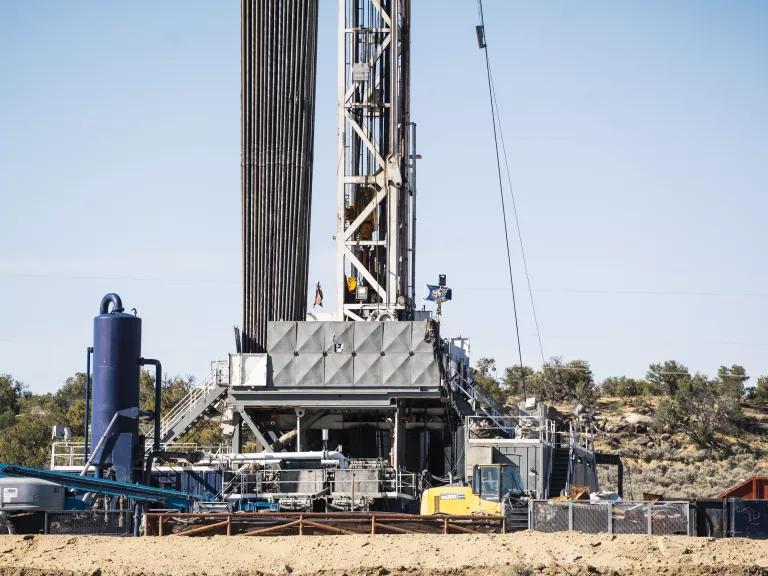
A drilling site in Counselor, an unincorporated Navajo community in Sandoval County, New Mexico, located near the edge of the 10-mile protected buffer zone surrounding Chaco Culture National Historical Park, May 2026
Critical changes needed
NRDC is seeking significant improvements to the bill in five areas:
- Revise the project certainty provisions: Agencies must retain the ability to address significant and unanticipated environmental or public health harms. The bill must preserve established processes for updating operating permits and applying future pollution standards. Any disparate treatment claim should require credible evidence of intentional targeting, permit review of a complete evidentiary record, use a baseline that does not unduly favor the current administration’s energy choices, and eliminate disproportionate taxpayer funded payments.
- Preserve meaningful judicial remedies: Courts must retain the authority to fix unlawful permits and pause construction under the CWA, NEPA, and the NHPA. Legal protections are substantially diminished if courts cannot provide an effective remedy when violations occur.
- Restore clean water protections: Congress should remove heightened burdens on states (evidentiary standards); preserve the ability of states and Tribes to address a full range of water quality effects and improve projects; and avoid further weakening of the general permit program.
- Retain core species and science protections: The legislation should remove or substantially revise the transfer of important federal consultation responsibilities to states and amend language that could constrain reasonable precautions when scientific information is incomplete.
- Changes to historic preservation law should be developed with Tribal Nations and preserve meaningful consultation.
NRDC will continue to advance technical corrections, including changes needed to address drafting errors and unintended consequences. But technical corrections cannot substitute for changes to some of these structural provisions, for which we will continue to advocate.
Related Content

Trump’s Assault on the State of Our Health and the Environment
Taking Stock of the Trump Administration's Assault on the Environment at One Year
