
Geothermal Energy: The Advantages, the Challenges, and the Potential
The heat inside the earth has been used throughout history and plays a growing role in our energy market.

A geothermal steam power plant in Holtville, California
William Warren/Alamy

Geothermal energy might sound like something you’d find at the edge of the world, but chances are you’ve already come across it firsthand. Have you ever taken a dip in a natural hot spring? Or seen the colorful geysers and thermal pools at Yellowstone National Park? Maybe you’ve visited an island with an active volcano. These are all natural geothermal sites.
The push for renewable energy has grown tremendously in the last decade, with the spotlight shining mostly on solar, wind, and hydropower. Altogether, these three sectors are currently providing around one-fifth of the total electricity generated in the United States. But beyond these renewable stalwarts, there are other sources that can help with our future energy needs and offer a powerful climate solution. Geothermal is one of them.
What is geothermal energy?
First, some basic geology: Geothermal energy, a renewable resource, is the heat that comes from within the earth. The temperatures underneath the surface of the planet are extremely high due to the decay of radioactive minerals and leftover heat from when the earth first formed.
Underneath the crust, the uppermost layer of the planet, lie three more layers: the mantle, the outer core, and the inner core. The temperature of the inner core is about 10,800 degrees Fahrenheit, just about as hot as the surface of the sun. The outer core is slightly cooler, ranging from 8,100 to 9,900 degrees. And the temperature ranges from about 1,800 to 6,700 degrees in the mantle, getting cooler the closer you get to the surface.

So how do we get at the heat locked deep underground? Gaps in the tectonic plates allow magma, extremely hot molten rock found in the mantle, to seep upward. The process heats up surrounding water and rock, creating pockets called geothermal reservoirs. These reservoirs are the key to accessing geothermal energy. And it’s possible to tap into it in ways that take a minimal toll on our environment, in contrast to extracting dirty fossil fuels to produce electricity.
Another significant advantage of geothermal is that it is extremely reliable—available 24/7. In other words, unlike solar or wind power (or oil, gas, and coal, for that matter), geothermal heat is accessible at any time for a constant generation of energy.
How does geothermal energy work?
Power plants
There are three ways we can utilize geothermal energy. The first is by harnessing the heat from the reservoirs to generate electricity. The reservoirs can be either wet, containing hot water, or dry, containing only hot rock.
Hot, dry rock is the foundation for the newer technologies—called enhanced geothermal systems (EGS)—currently being piloted by the U.S. Department of Energy (DOE). The rock is fractured and a transfer fluid (mostly made of water) is injected to absorb the heat and bring it back to the surface. This fracking process does raise some risks around water use, possible contact with existing aquifers, and the potential for seismic activity (small earthquakes), so advocates are calling for safeguards—including studies and monitoring by permitting agencies—to make sure EGS lives up to its potential.
In either case (wet or dry), the reservoirs need to be fairly deep underground, since the water or rock has to be at a very high temperature—between 300 and 700 degrees Fahrenheit—to effectively generate power. For example, at the United States’ largest geothermal power plant complex, the Geysers in California, the average depth of the wells is 8,500 feet.
A basic geothermal power plant setup consists of two wells: a production well bringing water or steam up to the power plant and an injection well bringing it back down, after use. The hot water or steam powers a turbine in the plant, which then generates electricity for the grid.
There are three types of geothermal power plants:
- Flash steam plants: This is the most common type in the United States. The system takes hot water from a reservoir through the production well and generates it into steam to power the turbines. After the steam cools, it condenses back into water and returns to the reservoirs via the injection well.
- Dry steam plants: This system uses steam from a reservoir to directly power the turbines.
- Binary-cycle power plants: This system transfers the heat from hot water to another liquid. This second liquid turns into steam from the heat and powers the turbines.


Geothermal energy systems that draw on existing underground hot water (left) and hot dry rocks (right)
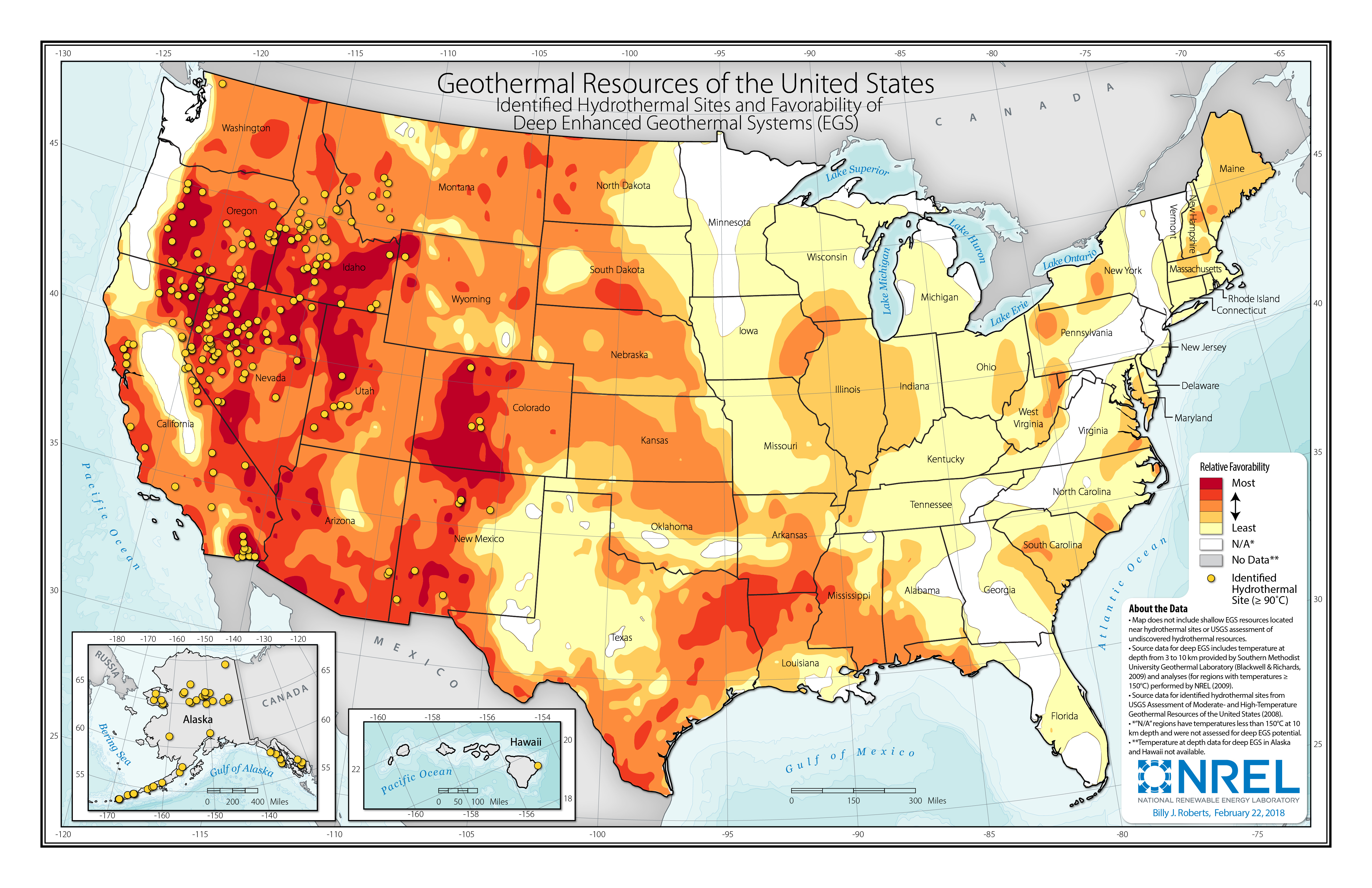
One of the disadvantages of traditional wet geothermal energy is its rarity: In the United States, for example, reservoirs with extremely high temperatures are relatively scarce. (By contrast, hot, dry rock is potentially more widely available, if it can be safely developed economically.)
All American geothermal power plants are located in the western states and Hawai‘i, near the boundary of a tectonic plate. Like other geothermal hot spots that line the edges of the Pacific Ocean—the islands of Indonesia and the Philippines among them—they form part of an area known as the Ring of Fire. Other countries that have capitalized on abundant geothermal activity include Iceland, which straddles the Mid-Atlantic Ridge, and Kenya, which lies in the Great Rift Valley. Iceland relies on geothermal sources for 66 percent of its energy consumption; in Kenya, approximately 45 percent of the electricity comes from geothermal.
District heating
Geothermal energy can also provide us with direct heat, at the source. Humans have been bathing, cooking, and heating their homes with this resource long before we started using it to generate electricity.
The city of Boise, Idaho, has been utilizing direct geothermal energy for heating since the 1890s. Originally, the city took advantage of a hot, underground river to feed two geothermal wells then piped the heat into some 200 buildings (plus an enclosed swimming pool) that dotted Warm Springs Avenue. Today, Boise operates the country’s largest municipal district heating system, with more than 20 miles of underground pipes heating city hall, the state capitol building, and more.
Another name for this type of district heating system is thermal looping, named for the way it brings up hot water from a production well, circulates it to a series of buildings connected through a network of pipes, and then returns the cooled water back underground. (This way, the system sustains the water levels in the reservoir.) There are variations in how district heating systems work—for example, another type circulates antifreeze liquid to transport the heat instead of directly using water from the reservoir.
An advantage of using district heating over geothermal power plants is a simpler setup: You don’t need to dig thousands of feet underground to access the energy because these systems operate at much lower temperatures. The shallower reservoirs more commonly found underground will suffice; a sizable plot of land is also key.
Geothermal district heating is taking off, in particular, on college campuses, since the basic infrastructure for centralized energy distribution is often already in place, and many schools are looking to make good on ambitious climate commitments. Universities like Ball State, Brown, and Princeton are all exploring or already utilizing these systems for their campuses.

Heat pumps
In many areas, just 20 feet below the earth’s surface, the temperature sits at around 55 degrees Fahrenheit year-round, regardless of the weather. This consistent temperature makes heat pumps very efficient as they suck heat from one place and pump it to another. It also makes them capable of serving a dual purpose: They can be used to heat or cool a home.
Heat pumps that utilize geothermal energy specifically are called ground-source heat pumps, or GSHPs. (The more commonly used air-source heat pumps draw heat from or dump heat into the air.) To set up a GSHP, a technician installs a system of pipes at least four feet underground, with water to circulate. The water will draw heat from the ground during colder weather and connect to the heat pump, which transfers the heat to the indoor air. In the summer, the heat pump works in reverse—drawing heat from the indoor air and dumping it into the circulating water.
While the initial cost of installing a GSHP is high—around $15,000 to $40,000 for installation—the systems immediately reduce energy bills.
What’s next for geothermal energy in the United States?
The DOE found that the country could increase geothermal electricity output to 60 gigawatts by 2050, a projected 8.5 percent of all electricity generation in the country for that time. Reaching this goal, however, hinges on our efforts to increase basic awareness of the resource while continuing to develop the necessary technology. Because we can’t feel (or see) geothermal energy like the sun or the wind, promoting it as a bountiful resource with the public remains a challenge.
But in good news, geothermal energy is gaining momentum within the renewables space. The Bipartisan Infrastructure Law of 2021 included $84 million in funding for geothermal technology development, and the Inflation Reduction Act of 2022 included several provisions that grant tax credits for qualifying geothermal projects (including those costly GSHPs).
States are also taking action. Colorado and New York both passed legislation in 2022 that would allow public utilities to own and operate district heating systems, which will cut down energy costs, and designate public funding for research, modeling, and analysis. A similar law in Washington State allotted $25 million for utilities to start selling geothermal energy to customers instead of gas.
How to know if geothermal is right for you
Interested in whether you could heat your home with geothermal energy? You’ll first want to reach out to a geothermal designer or engineer to see if your land is suitable for installing this technology. There are a number of directories you can look through to find experts in your state, including the Geothermal Exchange Organization. You can also reach out to your state energy office for resources, including local policy information and potential financial incentives for making the switch.
This NRDC.org story is available for online republication by news media outlets or nonprofits under these conditions: The writer(s) must be credited with a byline; you must note prominently that the story was originally published by NRDC.org and link to the original; the story cannot be edited (beyond simple things such as grammar); you can’t resell the story in any form or grant republishing rights to other outlets; you can’t republish our material wholesale or automatically—you need to select stories individually; you can’t republish the photos or graphics on our site without specific permission; you should drop us a note to let us know when you’ve used one of our stories.
Decarbonization: Why We Must Electrify Everything Even Before the Grid Is Fully Green
Offshore Wind Can Power the Future (If We Just Let It)
The AI Boom Is Stressing the Grid—but It Doesn’t Have to Be This Way