
Environmental Leadership Can Shape the Future of Carbon Removal
There is no longer a plausible route to climate stability without carbon dioxide removal; environmentalists must advocate for environmentally and socially responsible CDR growth.

Fans pulling in large volumes of ambient air at Climeworks’ Orca direct air capture plant (a form of CDR) in Iceland
Climateworks


The world will almost certainly overshoot the 1.5 degrees Celsius global warming limit set by the Paris Agreement, potentially by a considerable margin. According to scientific experts, reducing greenhouse gas (GHG) emissions will no longer be enough. In addition to the GHGs already in the atmosphere, global systems like agriculture and heavy industry continue to produce billions of tons of emissions each year that may be impossible to fully eliminate. To address climate change, we must now accelerate carbon dioxide removal (CDR) solutions that can absorb CO2 directly from the atmosphere, alongside emissions reduction and adaptation.
NRDC’s new issue brief argues that as CDR scales from small projects to a meaningful climate tool, the environmental community—including both advocates and policymakers—has a critical window to shape how CDR pathways and policies develop.
Learn More


Environmentalists have cheered on several critical climate industries over the past decades: photovoltaic power, wind power, electric vehicles, batteries, and more. It is now time to set the stage for another—an industry that removes carbon dioxide from the atmosphere—to contribute to the fight for climate stability.
NRDC has developed a set of principles that represents our vision and guiding priorities for responsible CDR. These principles define the outcomes that NRDC hopes to see and are meant to provide direction as we advocate for policies to grow global CDR capacity.
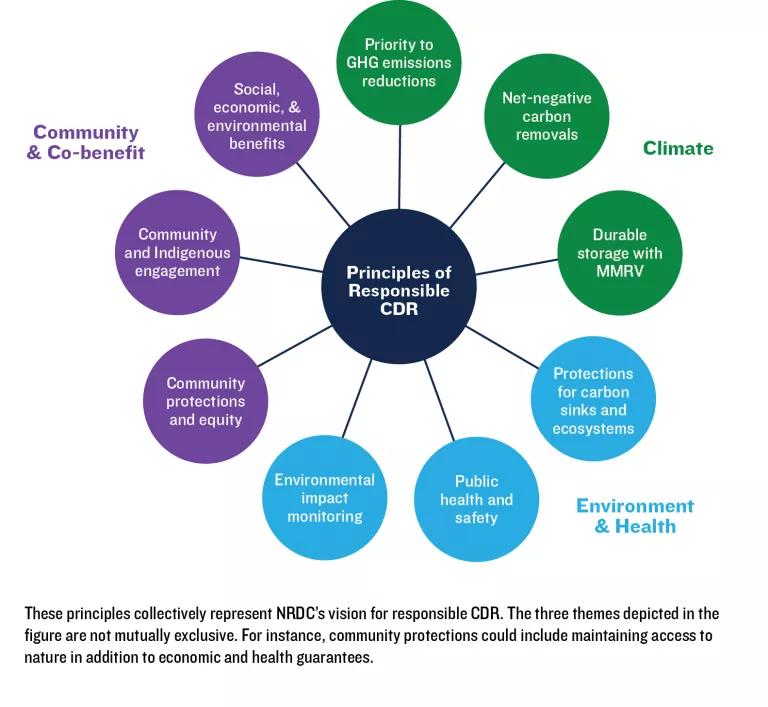
There will be real consequences for our communities and the environment if this scale-up is not done responsibly and sustainably, but if done correctly, CDR can be a real asset in reaching our climate goals.
Together, we—the environmental movement, with advocates and policymakers working hand –in hand—must find a way to make responsible, effective CDR a reality.
READ THE FULL ISSUE BRIEF
Related Resources
NRDC at Climate Week NYC 2026: Meeting the Moment
The Carbon Removal Market Can Work—If We Build It Right
