
NRDC at London Climate Action Week: The Culmination of Global Sustainability Action
At London Climate Action Week 2026, NRDC will join the international community to figure out ways to implement climate plans that can deliver energy security, nature protection, economic resilience, and a safer, healthier future for all.

Central London

London Climate Action Week (LCAW) is a vibrant point of convergence for the world, where leaders, civil society, activists, and the private sector come together to align on priorities to drive action in combating climate change and protecting nature. This year, it comes at a pivotal moment against the backdrop of increased economic, geopolitical, and scientific urgency to ramp up efforts worldwide and prepare for the impacts we can no longer avoid. It also closes out a month full of high-level climate and environmental policy negotiations and campaigns.
The places where we have traditionally negotiated these challenges, such as United Nations forums, are themselves struggling to meet the moment under global tensions. Global treaties to tackle climate change and protect the high seas and ozone layer, as well as negotiations about a plastics treaty, are coming up against protectionist trade measures, economic conflicts, and sovereignty disputes. These tensions and trade-offs have complicated this month-long period of environmental negotiations.
Yet, while the challenges before us are many and big, there is hope in the actions many leaders at all levels across the globe are taking. This is what makes non-negotiation moments like LCAW more exhilarating. Both government and nongovernment officials rally to show that investment in clean energy and an appetite for scaling up smart solutions that protect nature, communities, and climate are happening on the ground. And it’s not just happening in big economies like the United Kingdom, the European Union, India, and China; it’s also happening in smaller and more vulnerable countries like Costa Rica, Uruguay, Jamaica, and Malawi, as well as at the city and provincial level in the United States.
Against this backdrop, LCAW serves specifically as a bridge between the United Nations Framework Convention on Climate Change’s Bonn negotiating sessions and the upcoming COP31 to translate commitments into actions.
Implementing promises requires all hands on deck: All actors—governments, financial institutions, private companies, industry, and civil society—must come prepared to accelerate the phasedown of volatile fossil fuels, to scale up finance to transition to clean energy, to build communities that are more resilient to the impacts of climate change, to halt the destruction of forests, and to protect our oceans. How we do this is the real question. Implementation of climate plans requires different approaches to international cooperation so they can deliver energy security, nature protection, economic resilience, and a safer, healthier future for all.
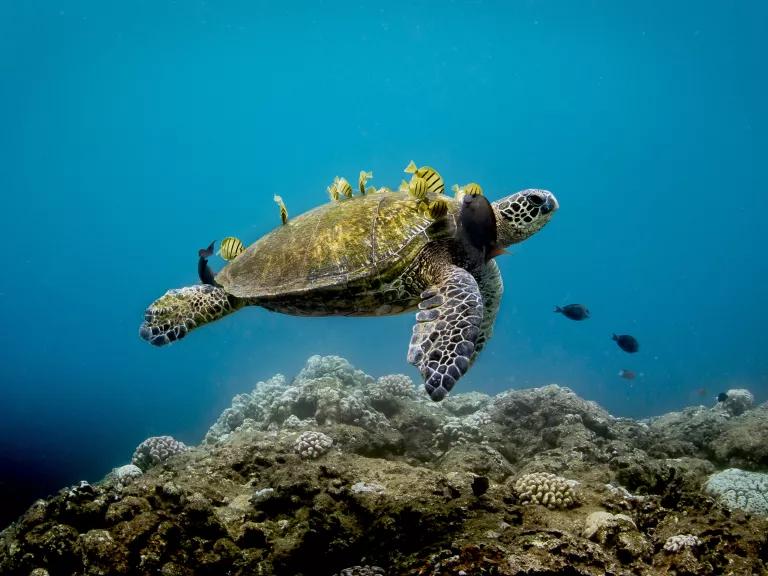
A Hawaiian green sea turtle (honu) visiting a "cleaning station" near Hale'iwa Ali'i Beach in the Hawaiian Islands Humpback Whale National Marine Sanctuary
NRDC priorities for London Climate Action Week
Accelerate the phasedown of fossil fuels
Clean energy is a multitrillion-dollar industry—sitting at the heart of global safety, national security, long-term economic resilience, and prosperity—and the next phase of the global economy will be led by those countries that embrace it.
Recent market volatility as a result of conflict in the Middle East has exposed the economic risks of fossil fuel dependence, creating energy crises and price spikes around the world. This is particularly true for import-dependent economies and many emerging economies, underscoring the urgency of shifting to reliable clean energy systems that stabilize costs and protect livelihoods.
Short-term responses to these energy crises and economic shocks are not sustainable. We must transition to cheaper and more secure alternatives. The rapid growth of AI and data centers globally is increasing energy demand exponentially, further underscoring the need to break away from our dependence on fossil fuels and meet that demand with clean energy. LCAW provides avenues to build on the spirit of the first high-level Conference on Transitioning Away from Fossil Fuels in Santa Marta, Colombia, earlier this year, and to advance national road maps to accelerate such transitions.
Scale up climate finance while tripling down on adaptation
Global climate investments continue to grow, with clean energy now receiving twice the investment of fossil fuels. But this investment is still below the $6 trillion-plus needed globally each year to meet climate goals, and it is not distributed equitably, with most investments concentrated in major economies. Climate finance is not charity. It is a strategic investment that addresses the root causes of many of the crises we see daily: cost of living, supply chain disruptions, natural disasters, forced migration, and conflict.
At LCAW, leaders will appraise how to turn lofty goals into concrete actions that ensure vital investment flows, bridging the gap between policy ambition and real-world investment, execution, and delivery; elevating not only the role of the public sector and multilateral development banks but also that of domestic and private institutions to green financial flows and turn plans into investable and transformative solutions on the ground faster and at scale—including in more challenging areas like adaptation, as promoted by initiatives like FINI (Fostering Investable National Implementation for Adaptation and Resilience).
Adaptation is inherent to economic development, especially for the countries and communities most vulnerable to climate impacts. For instance, extreme heat, in particular, poses a growing threat to public health and to economies through reduced labor productivity, increased health-care expenditures, agricultural losses, and infrastructure and energy disruptions. Women, children, the elderly, and low-income populations bear the brunt of this. The need to drive comprehensive, practical, and scalable solutions for heat adaptation and resilience is urgent and profitable.
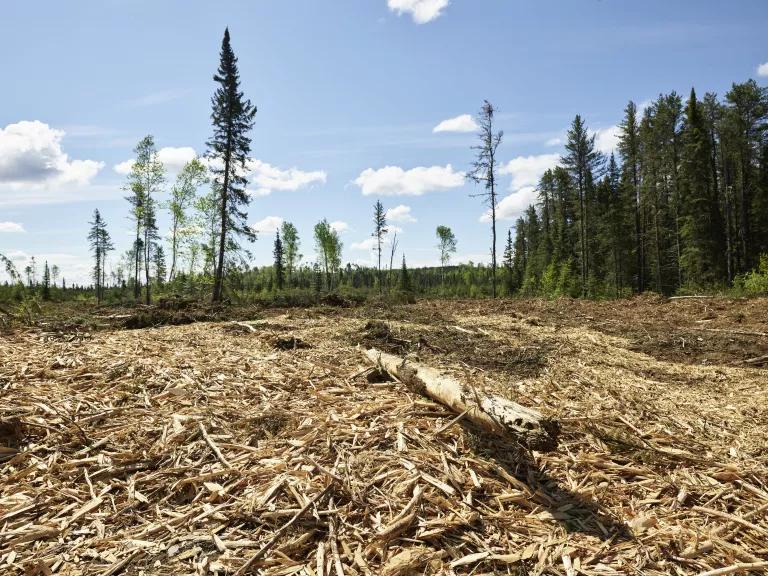
A clearcut area of boreal forest near Dryden in northwestern Ontario, Canada, June 2019
Protect nature and foster nature-based solutions
The global community can’t come close to reaching climate goals without protecting natural ecosystems like forests and oceans. While there is growing international momentum to halt and reverse deforestation and forest degradation by 2030, the world remains far off target. And for too long, forest conservation efforts have focused almost exclusively on tropical deforestation, letting many Global North countries off the hook for widespread forest degradation from industrial logging to feed supply chains for products such as toilet paper and unsustainable biomass energy.
At the same time, there are important signs of progress. U.S. policymakers just introduced the U.S. TREE Act, which would align U.S. trade with the E.U. Deforestation Regulation. And at COP30, Brazilian President André Aranha Corréa do Lago announced a road map on halting and reversing deforestation and forest degradation by 2030. This has spurred a global dialogue about what transformations are necessary to finally deliver on forests. LCAW is an important moment to build on that momentum.
Demonstrate that international cooperation can deliver
While multilateralism is more and more constrained, the latest breakthrough U.N. resolution on the International Court of Justice’s advisory opinion on climate obligations demonstrates that multilateralism can prevail. Tactics and perseverance with a coalition of the willing matter. At the end of the day, while some countries retreat into isolation, in order to effectively confront the climate crisis, we must deepen cooperation, not abandon it. That means sharing lessons on accelerating renewable energy deployment, protecting forests, and supporting vulnerable communities facing growing climate impacts. Doing it alone is not an option. Going together is the only way to build a sustainable future.
Looking ahead
Across much of the world, progress is being driven by coalitions of countries, cities, businesses, investors, and communities that are moving forward together, sharing solutions and demonstrating what is possible. States and cities are often the ones carrying the torch, bridging the gap between policy and real-world outcomes.
And cities like London are proof points for implementation and productive dialogue. Here, action is not theoretical but already underway. London Climate Action Week must serve as both a stocktaking moment and an accelerator to address the climate and nature crises and protect people for greater health, safety, and economic stability.
NRDC’s LCAW events
We will be busy joining partners—and learning and shaping solutions with them—in closed-door sessions and through the following public events:
Expert Roundtable on the Implications of the Strait of Hormuz crisis for the Global Energy Transition
By invitation only
FINI: Too Risky to Ignore: Rewiring Capital for Mainstreaming Resilience
8:30–10:30 a.m.
By invitation only
Enabling Conditions in the COP30 Forest Road Map: A Dialogue and Workshop on the Critical Levers for Halting and Reversing Deforestation and Forest Degradation by 2030
9:30–11:30 a.m.
By invitation only
The Resilience Prescription: Preventative Interventions as High-impact, Investable Solutions for Climate-health Adaptation
1:30–2:30 p.m.
Resilience Hub
Open to public
Green and Greening National Development Banks
1–5:30 p.m.
By invitation only
FINI: Community of Practice
2–4:30 p.m.
By invitation only
Scaling Investment through Country-led Finance Coalitions and Coordination Mechanisms
12–1:30 p.m.
Open to public
Related Resources

COP30: World Continues to Take Action on Climate

Building Community Resilience Through Smarter Oil and Gas Revenue Policy
